E-invoicing in UAE
Transform Your Financial Management with e-Invoicing in UAE
Our Products:
E Invoice & E Invoicing in UAE – Regulations, Compliance & Benefits

Last updated at
November 3, 2026
Book a Demo
Learn more about this by booking a demo call with us. Our team will guide you through the process and answer any questions you may have.
Book NowE Invoice & E-Invoicing in UAE: Complete Guide for Your Business [Updated 2026]
The UAE is introducing e-invoicing through a phased rollout. Businesses covered by the mandate must issue, exchange, and report structured electronic invoices through accredited service providers. An emailed PDF or scanned invoice alone does not meet these requirements.
The pilot and voluntary implementation began on 1 July 2026. Mandatory implementation starts on 1 January 2027 for businesses with annual revenue of AED 50 million or more, followed by smaller businesses and government entities.
The Ministry of Finance’s Electronic Invoicing Guidelines Version 2.0, dated 26 October 2026, clarify business identification, invoice classification, storage responsibilities, and specific transaction scenarios. These details affect how businesses prepare customer records, configure invoices, and manage their service providers.
Recent updates on UAE e-invoicing
October 2026: Updated penalties
Cabinet Decision 173 of 2026 replaces Decision 106 of 2025. It revises implementation and data-update penalties, addresses recipient compliance, and removes the former system-failure notification penalties. The updated amounts appear in the penalties section below.
26 October 2026: Guidelines Version 2.0
Version 2.0 adds or expands guidance on:
- TIN and VAT TRN requirements for sellers and buyers.
- Onboarding for newly established businesses.
- Invoice storage, technical logs and business responsibility.
- Advance payments, contractual retention and invoice classification.
- Healthcare supplies where an insurer pays the patient’s bill.
The published rollout dates remain unchanged. The Ministry’s official e-invoicing portal provides the guidelines, legislation and technical resources.
19 October 2026: Changes to exclusions and business obligations
Ministerial Decision 197, effective from 1 October 2026, provides temporary relief for transactions within the same VAT Tax Group, revises record-storage requirements and removes the two-business-day system-failure notification duty for issuers and recipients.
It also changes Article 6(5) to 14 business days, subject to the VAT-law timing requirements preserved by Article 6(4).
9 October 2026: Updated ASP accreditation framework
Ministerial Decision 168 of 2026 replaces the earlier accreditation framework from 1 October 2026. It removes the pre-approval stage. Businesses should check providers against the Ministry’s current register.
Earlier implementation decisions
Decisions 243 and 244 of 2025 established the system and rollout phases. Decision 66 of 2026 extended the large-business ASP appointment deadline to 30 October 2026. The corresponding implementation date remains 1 January 2027.
What is e-invoicing?
E-invoicing means issuing, sending and receiving invoices in a structured electronic format that software can process automatically. In the UAE, accredited service providers exchange the invoice and report the required tax data to the FTA.
Structured invoice data
The exchanged e-invoice uses XML in accordance with the UAE’s PINT AE specifications. An unstructured PDF, image, Word document or email does not qualify on its own.
Businesses may still use a readable invoice representation for operational purposes, but it does not replace the required structured invoice.
UAE-specific standards
PINT AE is the UAE implementation of the Peppol International Invoice model. It defines the structure and business rules used to exchange invoice information between systems.
Exchange through an accredited provider
Businesses appoint an ASP to support invoice exchange and reporting. Their ERP or accounting system provides invoice data in the agreed format, and the ASP handles the applicable validation, conversion and transmission processes.
Tax-data reporting to the FTA
Invoice exchange and FTA reporting are related but distinct activities. The invoice is exchanged with the buyer through the ASP network, while the required tax data is reported to the FTA.
Reporting does not replace the business’s responsibility to retain its invoices, credit notes and associated records.
UAE e-invoicing implementation timeline
The rollout depends on revenue and entity type. Revenue means gross income for the most recent accounting period, based on the financial statements or other documentation acceptable to the FTA.
| Category | Deadline to appoint an ASP | Implementation date |
| Pilot programme | Participation arranged with the authorities | Started 1 July 2026 |
| Voluntary implementation | Complete applicable onboarding | Available from 1 July 2026 |
| Businesses with annual revenue of AED 50 million or more | 30 October 2026 | 1 January 2027 |
| Businesses with annual revenue below AED 50 million | 31 March 2027 | 1 July 2027 |
| Government entities | 31 March 2027 | 1 October 2027 |
ASP appointment and implementation are separate milestones. Allow time for integration and testing.
Newly established businesses
Section 8.4 of Version 2.0 states that newly established persons within scope must appoint an ASP and complete onboarding before issuing their first invoice, irrespective of their establishment date. Their invoices must meet the applicable electronic invoicing requirements.
Who must comply with UAE e-invoicing, and which transactions are excluded?
The scope extends beyond VAT-registered businesses. Persons conducting business in the UAE must assess their obligations for covered transactions, including sales and purchases, subject to exclusions and implementation requirements.
B2B, B2G and B2C transactions
Business-to-business and business-to-government transactions are covered unless an exclusion applies. Transactions involving government suppliers can also fall within scope.
Supplies to consumers acting in a personal capacity are outside mandatory e-invoicing. A business with B2C sales should separately assess its B2B purchases and receiving obligations. Consumer sales remain subject to applicable VAT invoicing rules.
A buyer’s VAT status or incomplete onboarding does not, by itself, remove an in-scope supplier’s obligations.
Transactions within the same VAT Tax Group
Transactions between members of the same registered VAT Tax Group receive temporary relief from 1 January 2027 through 31 December 2028. Decision 197 treats them as excluded transactions during this period. Version 2.0 explains that the relief is temporary and does not permanently remove these transactions from the framework.
Common ownership alone does not qualify. Transactions with parties outside the registered VAT Tax Group remain subject to ordinary scope and implementation rules.
Other excluded transactions
The exclusions include:
- Government activities performed in a sovereign capacity without competing with the private sector.
- International airline passenger transport supported by an electronic ticket, and related ancillary services supported by an Electronic Miscellaneous Document.
- International airline goods transport supported by an airway bill, for the specified 24-month exclusion period.
- Qualifying financial services exempt under Article 42 of the VAT Executive Regulation, including qualifying zero-rated exports of those exempt services.
- Other transactions or persons excluded by ministerial decision.
The financial-services exclusion does not cover every zero-rated export of a financial service. The airline cargo exclusion also has its own statutory starting point; it should not be assigned the VAT-group relief dates automatically.
Healthcare and insurance payments
An insurer paying a patient’s medical bill does not automatically make the healthcare supply a B2B transaction. Where the patient receives the healthcare and the insurer only settles the bill, the payment alone does not create a supply to the insurer.
If the insurer receives a separate in-scope service under the contractual arrangements, it should be identified as the buyer of that service. Splitting payment between the patient and insurer does not determine the classification.
Voluntary participation
Businesses can participate voluntarily, including for otherwise excluded transactions. Technical requirements still apply. The specific e-invoicing penalty exception for voluntary participation does not remove separate VAT invoicing obligations.
UAE e-invoice format
UAE e-invoices follow PINT AE specifications. The required fields depend on the document type and transaction. See our mandatory fields guide and XML format guide.
| Information | What businesses need to prepare |
| Invoice identification | Number, issue date, document type and required identifiers |
| Supplier details | Legal name, address and applicable registration and tax identifiers |
| Buyer details | Legal name, address and applicable electronic, legal and tax identifiers |
| Supply details | Descriptions, quantities, units and prices |
| VAT information | Tax categories, rates, taxable amounts and tax amounts |
| Totals | Line totals, allowances, charges and amount payable |
| Payment and references | Currency, payment information and relevant document references |
The ASP generates a UUID to identify each electronic invoice. The UAE XML invoice does not require a printed QR code or barcode.
TIN, VAT TRN and buyer identification
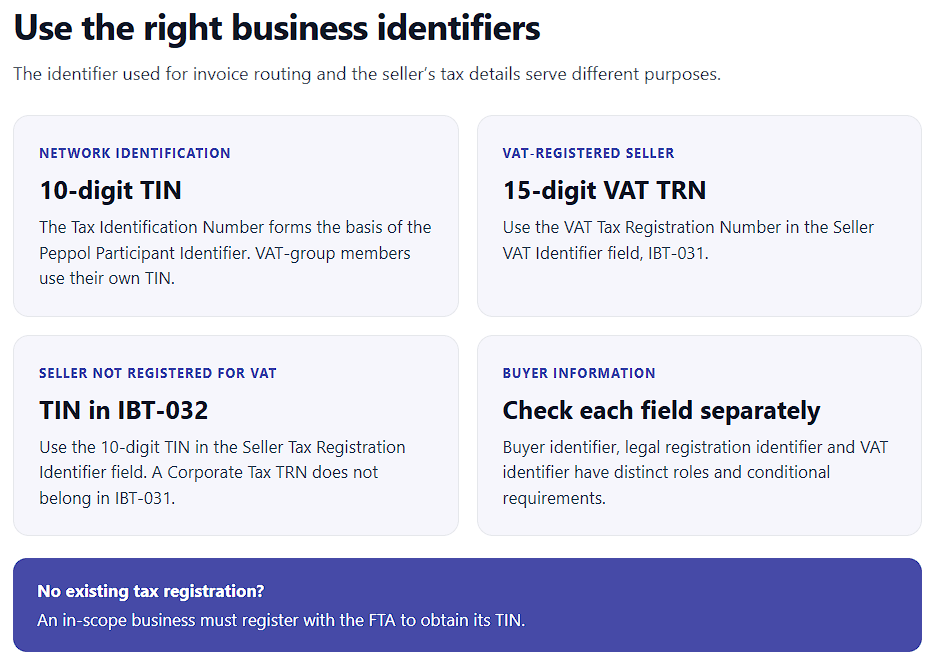
The 10-digit Tax Identification Number, or TIN, forms the basis of the Peppol Participant Identifier. The UAE scheme identifier is 0235. A person already registered with the FTA generally has a TIN as the first 10 digits of its TRN.
An in-scope business without a tax registration must register with the FTA to obtain a TIN. VAT-group members use their own TIN for participant identification, rather than the group representative’s TIN.
| Seller’s status | Tax identifier in the invoice |
| VAT registered | 15-digit VAT TRN in Seller VAT Identifier, IBT-031 |
| Not VAT registered | 10-digit TIN in Seller Tax Registration Identifier, IBT-032 |
A Corporate Tax TRN must not be entered in the seller’s VAT identifier field. Where the same entity has different TINs across its VAT and Corporate Tax profiles, Version 2.0 directs it to seek FTA clarification or qualified advice.
Buyer identifier, legal registration identifier and VAT identifier are separate fields. Their conditional requirements must be checked individually; one identifier does not automatically replace another.
Invoice categories and transaction classification
The framework supports tax invoices, commercial invoices, their corresponding credit notes, and self-billed tax invoices and tax credit notes where permitted.
Invoice type code 380 is used for UAE tax invoices where VAT applies. Code 480 is for invoices relating exclusively to supplies outside the scope of VAT. Zero-rated and exempt supplies remain within the VAT framework and must not be classified as code 480 merely because no VAT is charged.
A foreign buyer does not automatically make a transaction an export. Select the transaction classification and any predefined buyer endpoint together, based on the applicable PINT AE scenario and the buyer’s participation status.
Advance payments and contractual retention
Where an advance payment requires a tax invoice, issue it when the advance is received. The final invoice covers the remaining balance and references the advance invoice. Avoid invoicing the full contract value again.
For a contract worth AED 10,000 before VAT, with an invoiced advance of AED 1,000, the final invoice covers AED 9,000 before VAT. At 5% VAT, the advance invoice totals AED 1,050 and the final invoice totals AED 9,450.
For multiple items, allocate the advance to the relevant lines. An advance tied to a particular supply must not be moved arbitrarily to another line with different VAT treatment.
For contractual retention, Version 2.0 permits an invoice for the amount payable after retention, followed by a separate invoice when the retained amount becomes payable, provided the treatment complies with VAT and e-invoicing requirements. Keep milestone and retention calculations in the separate commercial document described by the guidelines.
E-invoice deadlines and record retention
When must invoices and credit notes be issued and transmitted?
Amended Article 6(5) specifies 14 business days from the Date of Business Transaction, subject to Article 6(4). VAT registrants remain subject to VAT-law timing requirements. This is not a universal extension to 14 business days for every VAT invoice or credit note.
Decision 243 defines the Date of Business Transaction by reference to the earlier of the transaction occurring or payment being received.
What records must businesses retain?
Retain electronic invoices, electronic credit notes and associated data for the applicable statutory period. Records must preserve integrity, remain secure and be retrievable in complete, readable form for the FTA.
Version 2.0 defines associated data by its role in supporting the invoice’s integrity, authenticity and auditability. Other business documents may still have separate retention requirements.
Must the records be stored within the UAE?
Amended Article 11 removes the previous UAE-only storage requirement. Businesses must still meet applicable security, privacy and sector-specific obligations. Version 2.0 does not mandate storage at a particular system layer.
Who is responsible when an ASP stores the records?
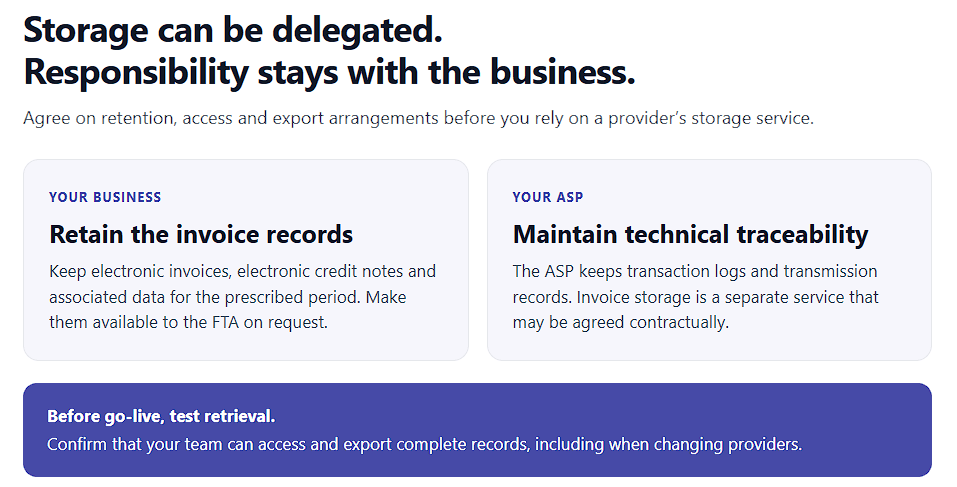
An ASP may store invoice records under a contractual agreement. Legal responsibility remains with the business. ASP transaction logs document technical transmission and routing; they do not replace the business’s invoice archive.
Agree on retention, access and export arrangements, including what happens when the service contract ends. Test retrieval before relying on the arrangement.
E-invoicing framework in the UAE
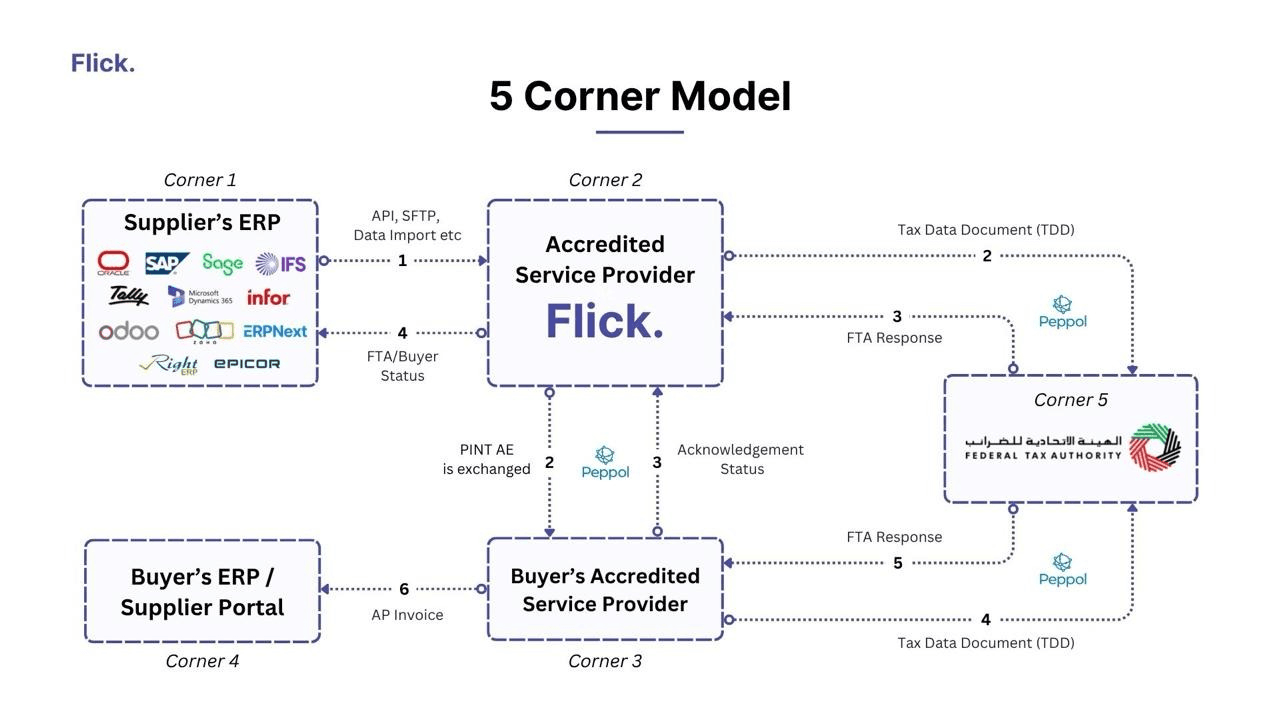
The UAE uses a Decentralized Continuous Transaction Control and Exchange model, commonly called DCTCE, based on Peppol’s five-corner approach.
The five participants are:
- Supplier: Creates the invoice data.
- Supplier’s ASP: Validates and exchanges the invoice and reports tax data.
- Buyer’s ASP: Receives and validates the invoice, delivers it to the buyer and performs the applicable reporting.
- Buyer: Receives and processes the invoice.
- FTA: Receives tax data and returns reporting-status messages.
How does this work in the UAE?
Step 1: The supplier sends invoice data to Flick.
The supplier generates invoice data in its ERP or accounting system and submits it to Flick in an agreed format, such as JSON.
Step 2: Flick validates and converts the data.
Flick checks the submitted data and converts it into the required PINT AE XML format where necessary.
Step 3: Flick exchanges the invoice and reports tax data.
The validated invoice is sent to the buyer’s ASP. The corresponding Tax Data Document, or TDD, is reported to the FTA.
Step 4: The buyer’s ASP validates the invoice.
The receiving ASP checks the invoice and returns the applicable Message Level Status, or MLS.
Step 5: The invoice reaches the buyer.
The buyer’s ASP delivers the validated invoice in the format agreed with the buyer.
Step 6: The buyer’s ASP completes its reporting.
Following successful validation, the buyer’s ASP reports the corresponding tax data. Where validation fails, the applicable status messages identify the issue.
Step 7: The FTA returns reporting status.
The government system processes the reported tax data and returns status messages to the relevant ASPs.
Step 8: The supplier receives status updates.
Flick passes the relevant exchange and reporting statuses back to the supplier.
Step 9: The buyer receives status updates.
The buyer’s ASP passes the applicable statuses to the buyer, allowing both sides to monitor the transaction.
E-invoicing process in SAP
Businesses using SAP S/4HANA, SAP Business One or SAP ECC can connect their invoicing workflows to the UAE e-invoicing workflow through an appointed ASP.
The integration must extract the required invoice information, map it to UAE requirements, support validation and exchange, and return processing statuses to the business.
Flick supports invoice integration and reporting workflows so finance teams can monitor documents and investigate differences between ERP records and submitted data.
Our SAP integration guide explains the process for SAP Business One.

Benefits of e-invoicing
E-invoicing can reduce manual work across invoice creation, delivery, processing and reconciliation.
- Efficiency: Structured information reduces repeated data entry and helps systems process invoices.
- Accuracy: Validation can identify missing information and inconsistent values before exchange.
- Compliance: Standardised exchange and tax-data reporting support the required invoicing processes.
- Cost savings: Digital workflows reduce printing, postage and manual document handling.
- Visibility: Exchange and reporting statuses help teams identify documents requiring attention.
- Environmental impact: Lower paper use reduces the physical resources needed for invoicing.
The benefits depend on accurate source data and a properly configured workflow. Businesses still need to review tax treatment, calculations and exceptions.
E-invoicing solution providers in the UAE
Businesses should appoint a provider that holds the required UAE accreditation and can support their invoicing processes.
Check the Ministry of Finance’s official ASP register before appointment.
The current accreditation framework is governed by Ministerial Decision 168 of 2026. It replaced Decision 64 of 2025 and its amendments from 1 October 2026.
When assessing a provider, businesses should review:
- Its current status on the Ministry’s register.
- Compatibility with their ERP or accounting system.
- Support for PINT AE validation, invoice exchange and tax-data reporting.
- Information-security and business-continuity arrangements.
- Record retrieval and export options.
- Onboarding, testing and technical support.
- Pricing, service levels and responsibilities under the contract.
Assess service suitability for your invoice volumes, transaction types and integrations. Our ASP selection guide explains the practical considerations.
How Flick Network helps your business with e-invoicing
Flick Network supports UAE e-invoicing integration and reporting workflows.
Our platform helps businesses create, validate, exchange and track invoices through connected workflows. Flick supports ERP integration, structured invoice conversion and the reporting of required tax data to the FTA.
How e-invoice exchange works with Flick
Your business provides invoice data from its existing system. Flick validates and converts that data for exchange, sends the invoice through the ASP network and reports the required tax data.
Processing statuses help your team distinguish successful submissions from documents that need correction or follow-up. Your business remains responsible for the accuracy of the underlying transaction and its applicable legal obligations.
Role of Accredited Service Providers in UAE e-invoicing
ASPs support onboarding, technical validation, secure transmission, invoice exchange, tax-data reporting and processing confirmations. They also manage technical traceability and service recovery.
Businesses initiate ASP onboarding through EmaraTax. The selected ASP supports participant registration and the technical setup. One appointed ASP handles both sending and receiving for the in-scope person.
What changed for system-failure notification?
Decision 197 removed the issuer’s and recipient’s obligation to notify the FTA within two business days. ASPs retain separate incident responsibilities described in the guidelines. Businesses should coordinate recovery and complete delayed processing with their provider.
UAE e-invoicing penalties and fines
Decision 173 of 2026 replaces Decision 106 of 2025. Its schedule includes:
| Violation | Penalty |
| Failure to implement, including appointing an ASP, or a recipient’s failure to maintain compliance | AED 5,000 initially, then AED 5,000 per month or part-month of continued non-compliance; capped at AED 50,000 over any 12 consecutive months |
| Failure to issue and transmit an electronic invoice | AED 100 per invoice; capped at AED 5,000 per calendar month |
| Failure to issue and transmit an electronic credit note | AED 100 per credit note; capped at AED 5,000 per calendar month |
| Failure to notify the ASP of changed FTA-registered data | AED 250 per day or part-day of delay; capped at AED 5,000 per calendar month |
The same person is penalised once for the same violation when acting as issuer, recipient or both. The former system-failure notification fines are removed. Voluntary participation is excepted under the decision; separate VAT obligations remain relevant.
How to prepare for e-invoicing in the UAE
1. Identify your implementation phase
Check the applicable revenue threshold, entity type and exclusions. Record both your ASP appointment deadline and mandatory implementation date.
For businesses with revenue of AED 50 million or more, the ASP appointment deadline was 30 October 2026. Implementation is due by 1 January 2027. Newly established businesses must also assess the before-first-invoice onboarding provision.
2. Classify your transactions
Separate covered transactions from excluded ones. For VAT groups, identify transactions between members of the same registered group and distinguish them from dealings with external parties.
Document the temporary exclusion period so it is not applied indefinitely.
3. Review your ERP and invoice data
Check whether your system can provide the required customer, supplier, tax, payment and invoice information. Resolve missing identifiers, inconsistent tax codes and incomplete master data before testing.
4. Appoint an accredited provider
Select a UAE-accredited ASP and complete the required appointment and onboarding process through the applicable channels, including EmaraTax.
Agree the integration approach, responsibilities, testing plan and support arrangements.
5. Test invoice exchange and reporting
Run representative transactions with your ASP. Include invoices, credit notes and relevant business scenarios, and check that your team can identify successful exchanges and rejected documents.
6. Check deadlines and record retention
Configure issuance and transmission deadlines according to the rules applicable to your business.
Confirm that electronic invoices, credit notes and associated data will be retained for the prescribed period and can be produced to the FTA. Test retrieval rather than relying only on a storage setting.
7. Train your team and go live
Make sure finance, tax and IT teams understand their responsibilities. Assign ownership for corrections, rejected documents, reconciliation and technical incidents.
Start operating under the system by your mandatory implementation date and monitor the results.
8. Keep your registered information current
Notify your appointed ASP in writing of relevant changes to data registered with the FTA within five business days of receiving the FTA’s confirmation of the amendment, as required by Article 5(3).
Features offered by Flick for UAE e-invoicing integrations
Global e-invoicing API
Flick’s global e-invoicing APIs support businesses managing invoicing across multiple jurisdictions. Integration can connect regional workflows while allowing the applicable country requirements to be handled separately.
End-to-end ERP integration
Flick supports integration with major ERP and accounting systems, including SAP, Oracle, Microsoft Dynamics, Tally and others.
Businesses can connect invoice data and processing statuses with their existing workflows. See our guides for Oracle EBS integration and Microsoft Dynamics integration.
Automated tax reconciliation
Flick’s reconciliation tools help finance teams compare ERP records with submitted data and investigate differences.
UAE local presence
Flick’s UAE team supports businesses with integration, implementation coordination and user training.
Validation before processing
Validation checks help identify missing fields and inconsistent information before invoice exchange. This supports error handling while leaving the business responsible for accurate source data and tax treatment.
Implementation checklist
- Confirm your implementation phase and transaction scope.
- Appoint your ASP and complete onboarding.
- Verify TINs, VAT identifiers and customer records.
- Test invoices, advances, credit notes and status reporting.
- Confirm deadlines, archive access and record retrieval.
- Assign responsibility for corrections and registered-data updates.
Conclusion
UAE e-invoicing requires businesses to prepare their systems, data and operating processes for the applicable implementation phase.
The October 2026 changes affect same-VAT-group transactions, record retention, storage location, invoice timing, system-failure notification and penalties. Version 2.0 also clarifies identifiers, invoice classification and advance payments. Businesses should incorporate these changes while continuing to meet the rollout deadlines for their covered transactions.
Flick’s UAE e-invoicing product supports integration, validation, exchange and reporting workflows. Contact sales@flick.network to discuss your implementation requirements.

E-invoicing in UAE: Frequently asked questions
Q1. Is e-invoicing mandatory in the UAE?
Yes, for persons and transactions covered by the phased mandate. Mandatory implementation begins on 1 January 2027 for businesses with revenue of AED 50 million or more. The pilot and voluntary implementation started on 1 July 2026.
Q2. What are the rules and regulations on e-invoicing in the UAE?
Covered businesses must use the required structured invoice format, exchange documents through an accredited provider, report the required tax data and retain their records. The framework includes Decisions 243 and 244 of 2025 and subsequent amendments, including Decisions 66 and 197 of 2026. Decision 168 of 2026 governs ASP accreditation; Decision 173 of 2026 sets the revised penalties.
Q3. Who needs to send e-invoices?
Persons conducting business in the UAE must assess their obligations for covered business transactions, subject to exclusions and implementation phases. The scope is not limited to VAT-registered businesses.
Q4. What is an e-invoice?
An e-invoice is an invoice issued, transmitted and received in a structured electronic format that supports automated processing. In the UAE system, the exchanged document follows the applicable PINT AE requirements.
Q5. What is the difference between an e-invoice and a regular invoice?
A paper invoice or unstructured PDF is designed primarily for people to read. A structured e-invoice allows software to process its data, validate required information and support electronic exchange and reporting.
Q6. How do I generate an e-invoice?
Use an ERP, accounting system or invoicing application connected to the required UAE e-invoicing workflow. Your accredited service provider can validate and convert the submitted data into the required format and support exchange and reporting.
Q7. What information should be on an e-invoice in the UAE?
Key information includes invoice identification, supplier and buyer details, goods or services, tax information, totals, currency and payment details. Additional fields and references depend on the transaction and document type.
Q8. What if I fail to issue an e-invoice when required?
Failure to issue and transmit an electronic invoice within the required timeframe can attract a penalty of AED 100 per invoice, capped at AED 5,000 per calendar month. Other failures, including late implementation, have separate penalties.
Q9. Who needs to receive an e-invoice?
Recipients covered by the system must receive and process applicable electronic invoices through the required workflow. Receiving obligations depend on scope, exclusions and implementation requirements, rather than simply whether a transaction carries VAT.
Q10. Is a PDF invoice an e-invoice?
An unstructured PDF alone does not qualify as an e-invoice under the UAE system. A readable PDF may accompany the transaction, but it does not replace the required structured electronic document.
Q11. Is the UAE using a global e-invoicing standard?
Yes. The UAE uses a Peppol-based five-corner framework with PINT AE specifications for the structured invoices exchanged through the system.
Q12. When will e-invoicing be mandatory for the different business categories?
Mandatory implementation starts on 1 January 2027 for businesses with revenue of AED 50 million or more, 1 July 2027 for businesses below that threshold, and 1 October 2027 for government entities. Applicable exclusions continue to matter. Newly established businesses must also assess the onboarding provision in section 8.4 of Version 2.0.
Q13. Will freelancers or individuals be required to issue e-invoices?
An individual carrying on business may fall within the scope, depending on their transactions, exclusions and implementation phase. Being a freelancer or being below the VAT-registration threshold does not automatically settle the e-invoicing question.
Q14. What type of software will I require?
You need software that can provide the required invoice data and work with a UAE-accredited service provider. It should support the applicable document formats, validation, exchange, reporting and record-retrieval processes.
Q15. What are the advantages of e-invoicing?
E-invoicing can reduce manual data entry, improve document visibility, support validation, simplify reconciliation and reduce paper use. Accurate source data and a well-configured workflow are necessary to achieve these benefits.
Q16. What happens when the service provider discovers an invoice error?
The provider returns the relevant validation or processing status so the issue can be corrected. The next step depends on whether the document failed before exchange or whether an already-issued transaction requires a corrective document.
Q17. Are QR codes mandatory on UAE e-invoices?
The UAE e-invoicing framework does not impose a general requirement to print QR codes on e-invoices. Businesses must still meet the applicable structured-data and exchange requirements.
Q18. Is e-invoicing only an exchange of data between businesses?
No. The framework includes structured invoice exchange between the supplier and buyer through their ASPs, together with reporting of the required tax data to the FTA.
Q19. How are businesses identified for electronic invoice exchange?
The Peppol Participant Identifier uses the UAE scheme identifier 0235 and the business’s 10-digit TIN. VAT-group members use their own TIN. The ASP supports technical setup and routing. This identifier is distinct from the seller’s VAT TRN field.
Q20. How are errors corrected under the e-invoicing system?
Correct validation failures before resubmitting the affected document. For issued transactions, electronic credit notes are required in the circumstances set out by the rules, including cancellation, reduced consideration, returns and relevant administrative or numerical errors.
Q21. How should retail businesses handle their invoices?
B2C transactions are currently outside the mandate. Retailers should separately assess their B2B and B2G transactions, including purchases, and continue meeting the invoicing requirements that apply to their sales.
Q22. Are additional digital signatures or certifications required beyond Peppol?
Businesses should follow the UAE technical requirements implemented through their ASP. The framework does not establish a general requirement for businesses to add a separate digital signature to each invoice beyond the applicable system requirements.
Q23. Must UAE e-invoices be in English, or is Arabic supported?
The UAE electronic invoicing framework is designed to support both Arabic and English. Businesses should meet the applicable data and reporting requirements rather than treating English as the only supported language.
Q24. Is e-invoicing required for transactions between members of the same VAT group?
These transactions are temporarily excluded for 24 months from 1 January 2027, covering the period through 31 December 2028. Both parties must belong to the same registered VAT Tax Group. Transactions with parties outside that group remain subject to the ordinary rules.
Q25. Does a business with only B2C sales need to assess its B2B purchases?
Yes. B2C sales being outside the system does not by itself resolve the treatment of B2B purchases. The business should assess its receiving obligations and applicable implementation requirements.
Q26. Must UAE e-invoices be stored within the UAE?
Amended Article 11 no longer imposes the previous UAE-only storage requirement. Businesses must retain electronic invoices, electronic credit notes and associated data for the prescribed period and be able to produce them to the FTA on request.
Q27. Must businesses notify the FTA of a system failure within two business days?
The obligation in Article 12 of Decision 243 was repealed by Decision 197, effective 1 October 2026. Businesses should still work with their ASP to resolve disruptions and complete outstanding invoice processing.
Q28. What is the deadline for issuing and transmitting an e-invoice or electronic credit note?
Amended Article 6(5) specifies 14 business days from the Date of Business Transaction, subject to Article 6(4). VAT registrants remain subject to the timing prescribed by VAT law; the amendment does not give every VAT invoice a universal 14-business-day deadline.
Quick Navigation
Book a Demo
Learn more by booking a demo with our team. We'll guide you step by step.