E-invoicing in UAE
Transform Your Financial Management with e-Invoicing in UAE
Our Products:
UAE E-Invoicing Foreign Currency Rules: AED Requirements
Last updated at
November 4, 2026
Book a Demo
Learn more about this by booking a demo call with us. Our team will guide you through the process and answer any questions you may have.
Book NowUAE E-Invoicing Foreign Currency Rules: AED Values, Exchange Rate and Example
One missing exchange rate is enough for a US dollar e-invoice to fail UAE validation. Under UAE e-invoicing, foreign currency invoices are allowed, but the amount payable for each item, the VAT and the gross total must also appear in AED. These AED values use the Central Bank of the UAE rate for the date of supply, and the invoice must state the rate. This guide covers both currency fields, AED values, a worked example and data to capture.
Can a UAE E-Invoice Be Issued in a Foreign Currency?
Yes. Section 12.2, point 17 of the MoF Electronic Invoicing Guidelines covers e-invoices where the document currency differs from AED, so your business can bill in USD, EUR or another currency. Article 69 of the VAT Decree-Law sets the UAE invoice AED conversion rule. It requires amounts on a Tax Invoice issued in a foreign currency to be converted into AED.
Article 59(1) of the VAT Executive Regulation requires three AED particulars on every Tax Invoice. They are the amount payable for each good or service (clause h), the gross amount payable (clause j) and the VAT charged with the exchange rate applied (clause k).
Under Article 65(5) of the VAT Decree-Law, a business subject to the Electronic Invoicing System issues its Tax Invoices as Electronic Invoices, so every e-invoice UAE suppliers issue in a foreign currency must carry these values. Article 59(16) disapplies several Tax Invoice clauses for Electronic Invoices but not clause 1, so you still need these AED values regardless of the invoice currency.
Invoice Currency vs Tax Accounting Currency in UAE E-Invoicing
Every UAE e-invoicing foreign currency document uses two currency fields. The invoice currency is the currency you bill in. The PINT-AE tax accounting currency is the currency used for VAT. It can only be AED, and it becomes mandatory when you bill in any other currency. The exchange rate then converts each amount from the invoice currency into the tax accounting currency.
Here’s how the currency fields differ on an AED invoice and a USD invoice:
| Field | What it holds | AED invoice | USD invoice |
| Invoice currency code (IBT-005) | Currency of the invoice amounts | AED | USD |
| Tax accounting currency (IBT-006) | Currency for VAT, AED only (IBR-140-AE) | Not mandatory; AED if shown | AED, mandatory |
| Currency exchange rate (BTAE-04) | Rate from invoice currency to AED (IBR-153-AE) | Not required | Mandatory (IBR-159-AE) |
Which Exchange Rate Applies to Foreign Currency E-Invoices in the UAE?
Use the exchange rate approved by the Central Bank of the UAE at the date of supply (Article 69 of the VAT Decree-Law). For UAE e-invoicing foreign currency documents, the date of supply and the decimal format decide which rate appears on the invoice.
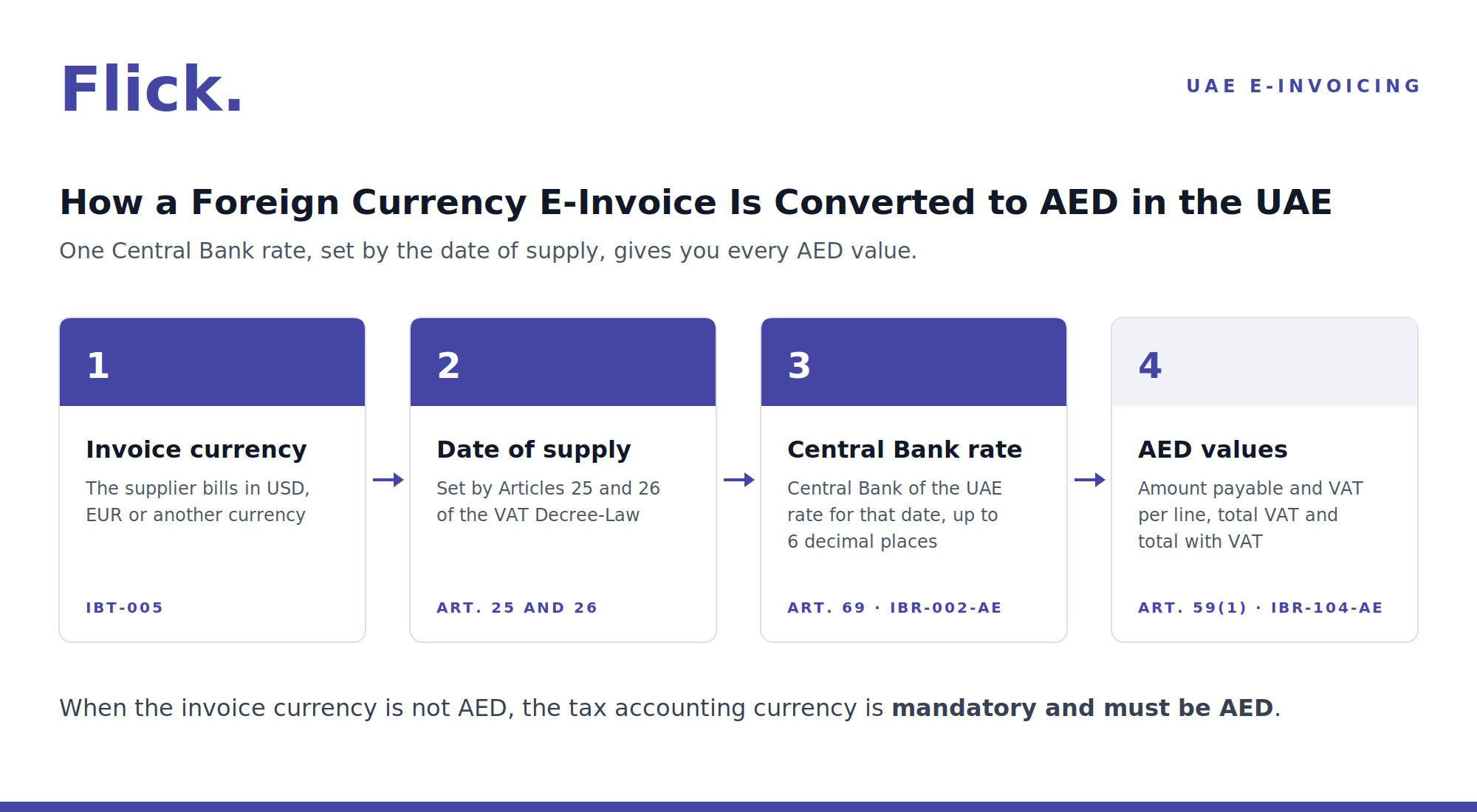
How UAE e-invoicing converts a foreign currency invoice into the AED values required for VAT.
How the Date of Supply Sets the Exchange Rate on UAE E-Invoices
Under Article 25 of the VAT Decree-Law, the date of supply is the earliest of events such as the transfer of the goods, completion of the services, receipt of payment or issue of the Tax Invoice. That is why advance payments under UAE e-invoicing can bring the rate date forward.
For periodic payments or consecutive invoices, Article 26 uses the earliest of the invoice date, the payment due date on the invoice, the payment date, or one year after supply. If the date of supply differs from the invoice issue date, enter it in the VAT Point Date field. PINT-AE expects that date to fall before the issue date.
How Many Decimal Places Can the Exchange Rate Have on a UAE E-Invoice?
The exchange rate on UAE e-invoicing foreign currency documents can carry up to 6 decimal places (IBR-002-AE). It is shown on the e-invoice itself, because Article 59(1)(k) requires the exchange rate applied to appear with the VAT in AED.
What AED Values Must a Foreign Currency E-Invoice Show in the UAE?
A foreign currency e-invoice shows AED values at two levels, each invoice line and the invoice totals, plus the exchange rate applied. At line level, the amount payable in AED is the total amount payable for each line item expressed in AED.
Here are the AED values required on UAE e-invoicing foreign currency documents:
| AED value | Level | Basis |
| Amount payable in AED for each good or service (BTAE-10) | Line | Article 59(1)(h); Guidelines 12.2, point 16; IBR-194-AE |
| VAT amount in AED for each good or service (BTAE-08) | Line | Guidelines 12.2, point 16; IBR-104-AE; IBR-163-AE; IBR-165-AE |
| Invoice total VAT amount in tax accounting currency (IBT-111) | Document | Article 59(1)(k); IBR-175-AE |
| Invoice total amount with VAT in AED (BTAE-20) | Document | Article 59(1)(j); Guidelines 12.2, point 17; IBR-175-AE |
| Exchange rate applied (BTAE-04) | Document | Article 59(1)(k); IBR-159-AE |
Line VAT depends on the tax category: omit BTAE-08 for exempt lines; enter zero for zero-rated lines.
Foreign Currency E-Invoice Example: Converting a USD Invoice to AED in the UAE
In this illustrative example, a UAE VAT-registered supplier sells one standard-rated service to a UAE VAT-registered buyer. The price is USD 10,000 plus 5% VAT, and the assumed Central Bank rate is 3.6725 AED per USD. Each AED value is the USD value multiplied by that rate, as Article 69 requires. On a real invoice, use the published rate for the actual date of supply. Because the invoice has one line, the line and document totals match.
Here is how the UAE invoice AED conversion works on this USD e-invoice, from invoice currency to AED:
| Amount | USD (invoice currency) | AED (tax accounting currency) |
| Taxable amount | 10,000.00 | 36,725.00 |
| VAT at 5% | 500.00 | 1,836.25 |
| Total with VAT | 10,500.00 | 38,561.25 |
Zero-Rated Export Invoice in USD Under UAE E-Invoicing
In a second illustrative example, the same supplier exports services to an overseas buyer for USD 10,000 at the same assumed rate. This is where the rules on UAE e-invoicing for importers and exporters apply, with two changes from the first example. First, the export qualifies for the zero rate under Article 31 of the VAT Executive Regulation. Second, the buyer has no Peppol ID, so the supplier enters the predefined endpoint 0235:9900000099 set out in Guidelines section 10.4.
The line VAT in AED is now zero, but the line amount payable in AED, the tax accounting currency and the exchange rate are still required:
| Amount | USD (invoice currency) | AED (tax accounting currency) |
| Taxable amount | 10,000.00 | 36,725.00 |
| VAT at 0% | 0.00 | 0.00 |
| Total with VAT | 10,000.00 | 36,725.00 |
What Data Do Businesses Need for Foreign Currency E-Invoices in the UAE?
Before your system can generate a UAE e-invoicing foreign currency document, check that it holds these source data points in addition to the standard UAE e-invoice mandatory fields:
| Data point | Why it is needed | Reference |
| Invoice currency code | Identifies the billing currency | IBT-005 |
| Tax accounting currency set to AED | Mandatory when the invoice currency is not AED | Guidelines 12.2, point 17; IBR-140-AE |
| Central Bank exchange rate for the date of supply | Converts every amount into AED | Article 69; IBR-159-AE; IBR-002-AE |
| Date of supply, and VAT point date where it differs from the issue date | Decides which day's rate applies | Articles 25 and 26; Guidelines 12.2, point 23 |
| Tax category and VAT rate for each line | Drives the VAT amount in AED per line | Guidelines 10.5; IBR-145-AE |
Readiness Checks for Foreign Currency E-Invoicing in the UAE
Under e-invoicing, UAE businesses should run two checks on foreign currency documents before go-live. Build both into your UAE e-invoicing implementation timeline:
Include UAE e-invoicing foreign currency invoices in your gap analysis of e-invoice data points, and confirm your accounting or ERP system can extract the currency code, exchange rate and AED amounts.
Test foreign currency invoices end to end before go-live, including the failure confirmations you receive when a document is rejected, such as for a missing exchange rate.
How Flick Network Helps with Foreign Currency E-Invoices in the UAE
Flick Network L.L.C is an MoF Accredited Service Provider under Accreditation No. 138271. Its e-invoicing software for the UAE supports foreign currency documents in four steps, from submission to status tracking:
Submission through one API: Your team sends the document currency, the exchange rate, the total VAT in AED and the total with VAT in AED. The rate can carry up to 6 decimal places and is required whenever the currency is not AED. Flick then sets the tax accounting currency to AED.
Validation before filing: Flick validates each document before filing it. If something is wrong, such as a missing exchange rate, the document comes back with a list of issues and nothing is filed. Your finance team can then correct it and resubmit.
PINT-AE XML, Peppol delivery and FTA reporting: Flick generates the PINT-AE UBL XML, delivers it to the buyer over Peppol and reports the tax data to the FTA.
Separate delivery and reporting status: Each document carries its own delivery status and FTA reporting status, so your team can see which step completed or failed.
Conclusion
UAE e-invoicing foreign currency rules let you bill in USD, EUR or another currency. But the amount payable per line, the VAT and the gross total must also appear in AED, with the exchange rate shown. Those AED figures use the Central Bank rate for the date of supply, and AED is the tax accounting currency. Before your mandatory date, check your system captures these values and test foreign currency invoices. To discuss a UAE e-invoicing solution, contact sales@flick.network.
Frequently Asked Questions
1. Does an AED Invoice Need a Tax Accounting Currency in UAE E-Invoicing?
No. Under UAE e-invoicing foreign currency rules, you only need the PINT-AE tax accounting currency when the invoice is not in AED. If you do include it on an AED invoice, it must be AED.
2. Who Is Responsible for the AED Values on a UAE E-Invoice?
The supplier. It is responsible for the accuracy of the AED amount payable on each line and the AED total with VAT.
3. Do Foreign Currency Credit Notes Need AED Values in UAE E-Invoicing?
Yes. The same UAE e-invoicing foreign currency checks apply to a credit note. If the credit note is not in AED, it must also show the total VAT and the total with VAT in AED.
4. Do Commercial Invoices in a Foreign Currency Need an Exchange Rate?
Yes. Articles 59 and 69 set the AED rules for Tax Invoices, but PINT-AE asks for the exchange rate on every UAE e-invoicing foreign currency document, not only Tax Invoices.
5. Do Self-Billed E-Invoices in a Foreign Currency Need AED Values?
Yes. A buyer-issued Tax Invoice must carry every particular listed in Article 59(1) of the VAT Executive Regulation, including the AED amounts and the exchange rate applied. The buyer must also be on the Electronic Invoicing System.
6. Are Imported Services Billed in a Foreign Currency Subject to UAE E-Invoicing?
No. The Guidelines say imported services and goods that fall under the reverse charge are not subject to any e-invoicing requirements. The reverse charge itself still applies for VAT under Article 48 of the VAT Decree-Law.
Quick Navigation
Book a Demo
Learn more by booking a demo with our team. We'll guide you step by step.