E-invoicing in UAE
Transform Your Financial Management with e-Invoicing in UAE
Our Products:
UAE E-Invoicing for VAT Groups and Intra-Group Transactions
Last updated at
November 4, 2026
Book a Demo
Learn more about this by booking a demo call with us. Our team will guide you through the process and answer any questions you may have.
Book NowUAE E-Invoicing for VAT Groups: Intra-Group Transactions, Grace Period and Examples
UAE e-invoicing for VAT groups works differently from VAT itself. The group files as one Taxable Person, yet each member needs its own e-invoicing setup. Transactions between members of the same VAT group are in scope, and the Ministry of Finance has allowed them a 24-month grace period starting 1 January 2027. Sales to and purchases from parties outside the group get no extra time, but only transactions otherwise in scope need an e-invoice, as supplies to consumers and other excluded transactions remain outside the system. This guide covers scope, the grace period, dates, onboarding, practical examples and the pending clarifications.
What Is a Tax Group (VAT Group) in the UAE?
A Tax Group, usually called a VAT group, is two or more businesses registered with the Federal Tax Authority (FTA) as a single Taxable Person. Under Article 14 of the VAT Decree-Law, each member must have a place of establishment or fixed establishment in the UAE, the members must be related parties, and one or more of them must control the others. One member acts as the representative member and applies for the registration.
For VAT, the group works as one unit. A supply from one member to another may be disregarded, and every member's output tax and input tax is treated as the representative member's. All members remain jointly liable for the group's VAT.
Are Intra-Group Transactions Covered by UAE E-Invoicing?
Yes. Ministerial Decision No. 243 of 2025 applies e-invoicing to every business transaction carried out by a person doing business in the UAE, unless that transaction is specifically excluded. The exclusions cover certain sovereign government activities, certain airline services and certain exempt or zero-rated financial services. VAT groups are not on that list, and the MoF Guidelines confirm that transactions between group members are not excluded simply because they happen inside the group.
This is where VAT and e-invoicing work differently. E-invoicing scope does not depend on VAT registration, and its requirements sit apart from Tax Invoice requirements. A supply that VAT may disregard is still a business transaction for e-invoicing, so UAE intra-group electronic invoices remain part of the system.
VAT Group E-Invoicing Grace Period in the UAE
Transactions between members of the same VAT group have a temporary grace period of 24 months, starting 1 January 2027. The arrangement comes from the MoF Electronic Invoicing Guidelines. Ministerial Decision No. 244 of 2025, which sets the implementation timeline, does not address intra-group transactions.
How Long Does the VAT Group Grace Period Last?
The grace period runs for 24 months commencing 1 January 2027. During that time, a group does not have to implement e-invoicing for transactions between its members. When it ends, the full requirements apply to those transactions under the applicable mandatory phase.
What the Grace Period Does Not Change
The grace period changes timing, not scope. Intra-group transactions stay within the e-invoicing system throughout. A member's sales to and purchases from businesses outside the group are not affected and follow the normal dates from the start.
Why VAT Groups Received More Time
Intra-group billing is rarely simple. The Guidelines point to high volumes of recurring transactions, complex internal pricing and settlement, and centralised accounting or automated intercompany charging. The Ministry and the FTA recognise that aligning data, reporting and systems across a group can take longer.
Intra-Group Transactions vs Sales to Outside Customers Under UAE E-Invoicing
Once a transaction is in scope, one question decides its timing: is the other party a member of the same VAT group? If it is, the transaction benefits from the grace period. If it is not, the normal mandatory dates apply, with no grace period. An outside customer does not automatically mean e-invoicing is required. Supplies to natural persons who are not doing business and transactions excluded under Article 4 of Ministerial Decision No. 243 of 2025 remain outside e-invoicing. For day-to-day work, keep an up-to-date list of group members in the billing system before any UAE e-invoice workflow goes live. 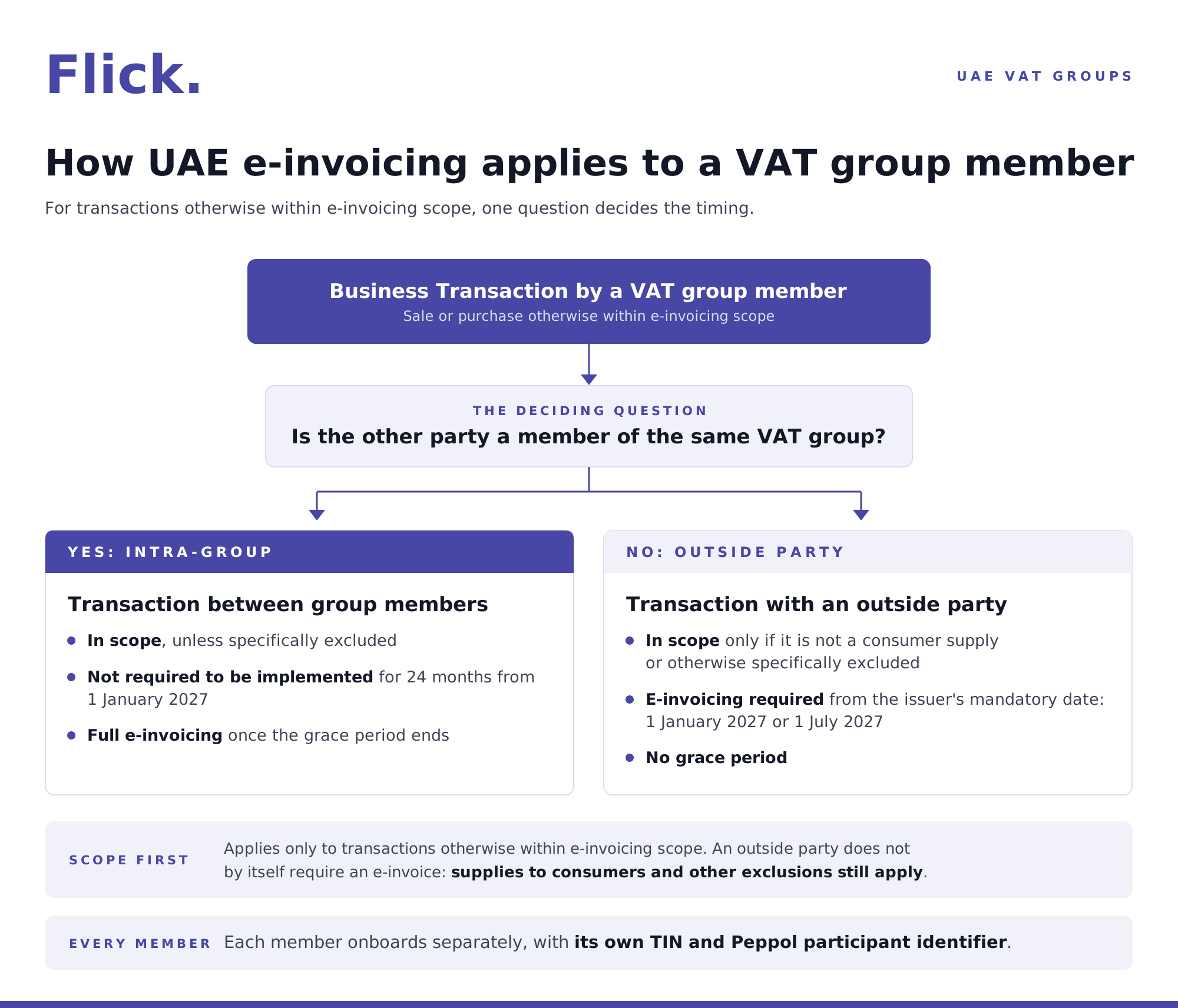
How UAE e-invoicing treats in-scope intra-group transactions and in-scope transactions with outside parties for a VAT group member.
The two types of transactions compare as follows:
| Point of comparison | Transaction between members of the same VAT group | Transaction with a customer or supplier outside the group |
| In scope of e-invoicing | Yes, unless excluded under Article 4 | Yes, if it is a business transaction not excluded under Article 4. Supplies to natural persons not doing business are out of scope. |
| When e-invoicing is required | After the 24-month grace period from 1 January 2027 | From the issuer’s mandatory date, with no grace period, where the transaction is in scope |
| VAT position | Supply between members may be disregarded | Depends on the supply: standard-rated, zero-rated, exempt or outside the scope of VAT |
| Basis | Guidelines 6.3.2 and 6.3.2.1; VAT Executive Regulation, Article 12(1)(b) | Ministerial Decision No. 243 of 2025, Article 3; Guidelines 6.3.2.1; VAT Decree-Law, Articles 3, 45 and 46 |
UAE E-Invoicing Dates for VAT Group Members
Any business can implement e-invoicing voluntarily from 1 July 2026. For intra-group transactions, the grace period starts on 1 January 2027 for every VAT group. The dates below are the general rollout schedule, and the published guidance does not clarify how the AED 50 million revenue threshold applies to VAT group members.
Here is the general rollout schedule under the UAE e-invoicing implementation timeline:
| Annual revenue | Appoint ASP by | Implement e-invoicing by |
| AED 50 million or more | 30 October 2026 | 1 January 2027 |
| Below AED 50 million | 31 March 2027 | 1 July 2027 |
TIN, Peppol ID and ASP Onboarding for VAT Group Members
Every member of a VAT group onboards separately, under its own identifiers. The group holds one VAT registration, but each member is onboarded for e-invoicing in its own right. Check each member's identifiers early, since they decide where its e-invoices are sent and received.
The VAT group e-invoicing requirements for each member are as follows:
| Requirement | What applies to VAT group members | Reference |
| Onboarding | Each member of a Tax Group must be onboarded | Guidelines Appendix 1, section 13.2 |
| TIN | First 10 digits of the member's own TRN, not the representative member's TRN | Guidelines section 2 |
| Peppol participant identifier | 0235 followed by the member's own 10-digit TIN | Guidelines section 3 |
| Choice of ASP | Members may onboard with different ASPs | Guidelines Appendix 1, section 13.2 |
| ASPs per member | One ASP per member for both sending and receiving | Guidelines section 6.1 |
| How onboarding starts | Through EmaraTax, started by the member itself, not the ASP | Guidelines section 9 |
Practical Examples of UAE E-Invoicing for VAT Groups
The scenarios below are illustrative and built from the official guidance, not from customer cases. Consider a UAE VAT group with three members. For these examples only, Member A, the representative member, is assumed to fall under the 1 January 2027 phase and Member B under the 1 July 2027 phase, since the published guidance does not confirm how the revenue threshold applies to group members. Member C is an investment holding company, and every example takes place in 2027 or 2028, during the grace period.
Here is how the guidance applies in each scenario:
| Scenario | E-invoicing treatment | Basis |
| A charges B a monthly shared services fee | In scope; not required to be implemented until the 24-month grace period ends | Guidelines 6.3.2 and 6.3.2.1 |
| A sells goods to an unrelated UAE business | Full e-invoicing from A's assumed phase date of 1 January 2027; the grace period does not apply | Guidelines 6.3.2.1; Ministerial Decision No. 244 of 2025 as amended |
| A charges a related company that is not a member of the same VAT group | Common ownership alone does not qualify the transaction for the grace period; it follows A's assumed implementation date (1 January 2027), provided the transaction is otherwise in scope | Guidelines 6.3.2.1; Ministerial Decision No. 243 of 2025, Articles 3 and 4 |
| C recharges management costs to B | Recharges are Business Transactions, so the transaction is in scope; as B is in the same group, the grace period applies to timing | Guidelines 6.3.1 and 6.3.2.1 |
| B buys services from an outside UAE supplier that is live on e-invoicing | Outside the grace period. Once live, B receives e-invoices through its own ASP; until then, if B has no participant identifier, the supplier includes the predefined endpoint 0235:9900000098 and also provides a regular Tax Invoice | Ministerial Decision No. 243 of 2025, Article 6(3); Guidelines 6.1 and 10.2.2 |
| Aexports services to a client in France with no Peppol ID | Full e-invoicing for A; A includes the predefined endpoint 0235:9900000099 | Guidelines section 10.4, scenario 8 |
| B leaves the VAT group | B updates its ASP through EmaraTax (reverification or offboarding, as applicable) | Guidelines Appendix 1, section 13.5(a) |
What UAE E-Invoicing Guidance Does Not Yet Cover for VAT Groups
The published guidance leaves three VAT group points open, so a group facing them should confirm its position with the FTA or a tax adviser:
- Document type after the grace period: the Guidelines, Ministerial Decision No. 243 of 2025 and Ministerial Decision No. 244 of 2025 do not specify the e-invoice category or tax category for UAE intra-group electronic invoices once the grace period ends.
- VAT identifiers on the e-invoice: no official e-invoicing source states whether the group TRN or another identifier goes in the seller and buyer VAT identifier fields for group members, although Article 12 of the VAT Executive Regulation treats supplies as made by the representative member.
- Revenue threshold: the Guidelines define Revenue for a Person but do not address how the AED 50 million threshold applies to VAT group members.
How VAT Groups Can Prepare for Intra-Group E-Invoicing in the UAE
The grace period gives a VAT group time to prepare before e-invoicing applies in full to intra-group flows. Use the UAE e-invoice mandatory fields as the data checklist. The preparation steps are listed below:
- Identify intra-group flows in your ERP separately from sales to and purchases from outside parties, since only intra-group flows benefit from the grace period.
- Run a gap analysis for each member and confirm that its accounting or ERP system can generate every data point an e-invoice needs.
- Confirm that every member's onboarding and Peppol participant identifier are in place before testing begins.
- Agree with each ASP how invoice data will be shared and how exchange and reporting confirmation messages will come back.
- Test end-to-end exchange and reporting, including intra-group documents, well before the grace period ends.
- Agree an error-resolution governance model with each ASP.
- Update the relevant ASP promptly whenever a member joins or leaves the group.
Conclusion
UAE e-invoicing for VAT groups depends on the counterparty to each transaction. Transactions between members of the same VAT group are in scope and benefit from a 24-month grace period starting 1 January 2027. Sales to and purchases from outside parties receive no such period and follow the normal mandatory dates, but only transactions otherwise in scope need an e-invoice, as supplies to consumers and other excluded transactions remain outside the system. In both cases, each member must onboard separately with its own TIN and participant identifier. To prepare your group’s flows with a UAE e-invoicing solution, contact sales@flick.network.
Frequently Asked Questions
1. Do VAT Group Members Need E-Invoices for Sales to Consumers?
No. Supplies to or from natural persons who are not doing business are outside the scope of UAE e-invoicing, including where a billing agent issues the invoice. Tax Invoice obligations under the VAT Decree-Law are separate and continue to apply.
2. Can a VAT Group Member Start E-Invoicing Before Its Mandatory Date?
Yes. Any Person can implement e-invoicing voluntarily from 1 July 2026 and must then follow all the technical requirements. Administrative penalties apply only from its mandatory date.
3. What Must a VAT Group Member Do When Its FTA Registration Data Changes?
It must notify its ASP in writing within 5 Business Days of receiving the FTA's confirmation of the change, under Article 5(3) of Ministerial Decision No. 243 of 2025.
4. Are Imported Services Bought by a VAT Group Member Subject to E-Invoicing?
No. The Guidelines state that the import of Concerned Services and Concerned Goods is not subject to any e-invoicing requirements. The reverse charge for VAT purposes still applies under Article 48 of the VAT Decree-Law.
5. What Happens If a VAT Group Member's E-Invoicing System Fails?
The issuer and the recipient must notify the FTA of a system failure within 2 Business Days of it occurring, using the mechanism the FTA sets, under Article 12 of Ministerial Decision No. 243 of 2025.
6. How Long Must VAT Group Members Keep E-Invoice Records?
A Taxable Person keeps e-invoice data for 5 years following the Tax Period it relates to, with longer periods in specific cases such as real estate records or a tax audit. Article 11 of Ministerial Decision No. 243 of 2025 requires e-invoices and associated data to be stored in line with the Tax Procedures Law timeline.
Quick Navigation
Book a Demo
Learn more by booking a demo with our team. We'll guide you step by step.