E-invoicing in UAE
Transform Your Financial Management with e-Invoicing in UAE
Our Products:
UAE E-Invoicing Advance Payments: Advance and Final Invoices
Last updated at
October 8, 2026
Book a Demo
Learn more about this by booking a demo call with us. Our team will guide you through the process and answer any questions you may have.
Book NowUAE E-Invoicing Advance Payments: How to Issue the Advance and Final Invoice
With UAE e-invoicing advance payments, the old habit of invoicing on delivery no longer works, because the tax invoice is due the day the payment is received, not the day the goods or services are supplied. This advance invoice is a standard electronic Tax Invoice with Invoice Type Code 380, not a separate type of document. When the supply is completed, the final invoice covers only the remaining balance and can reference the advance invoice, so the two documents stay traceable.
The tax-invoice treatment described here applies to VAT-registered suppliers receiving advances against taxable supplies, with VAT at the applicable rate. This sequence is set out in Appendix 5 of the UAE Electronic Invoicing Guidelines V1.1, published by the Ministry of Finance, which also treats retention separately. This guide explains the rules, with a worked example, and shows how to avoid invoicing the same amount twice.
What Happens When a Business Receives an Advance Payment in the UAE?
For UAE e-invoicing advance payments, the invoicing obligation starts when your business receives the money, not when the goods are delivered or the service is completed. Appendix 5 requires the tax invoice at the time of receipt, so the advance is invoiced in the period it is paid.
For example, a contractor may receive an upfront payment when a project starts, or a manufacturer may take a part payment before producing made-to-order goods. In both cases, your finance team issues the advance invoice when the money arrives and leaves the rest of the contract value for the final invoice.
The UAE Advance Payment Tax Invoice Is a Standard Electronic Tax Invoice
The UAE advance payment tax invoice follows the same rules as any other electronic Tax Invoice:
- It uses Invoice Type Code 380, the standard code for a Tax Invoice.
- It is exchanged through your Accredited Service Provider (ASP), which also reports the tax data to the Federal Tax Authority (FTA).
Which Advance Payments Need a Tax Invoice Under UAE E-Invoicing?
UAE e-invoicing advance payments cover any payment that arrives ahead of the related supply, whether it is a first instalment or a later payment made before the work is done. Your finance team should flag these receipts as they arrive, so the invoice is not held back until delivery. If the date of supply differs from the invoice issue date, it can be recorded in the VAT Point Date field.
How to Issue the Advance Payment Tax Invoice and the PINT AE Final Invoice
Both invoices must follow PINT-AE, the UAE's electronic invoice specification, and both are issued through your ASP. For UAE e-invoicing advance payments, the process follows four steps:
1. Issue a Tax Invoice When the Advance Is Received
Issue the advance invoice for the advance amount plus VAT when the payment arrives. Record its number and issue date against the contract, as the final invoice will need both.
2. Issue the Final Invoice for the Remaining Balance
When the supply is completed, issue the PINT AE final invoice for the remaining balance only, not the full contract value.
3. Reference the Advance Invoice
Link the final invoice to the advance invoice so the two documents stay traceable. Appendix 5 allows this reference under IBT-25 (preceding invoice reference) and IBT-26 (preceding invoice issue date), or as a note in IBT-022.
4. Check the Prepaid Amount Field
Check how the Prepaid Amount field (cbc:PrepaidAmount) is handled on the final invoice. Under Appendix 5, it may be left blank, as the final invoice already shows only the outstanding amount and needs no further adjustment for the advance.
Example of an Advance Invoice and Final Invoice Under UAE E-Invoicing
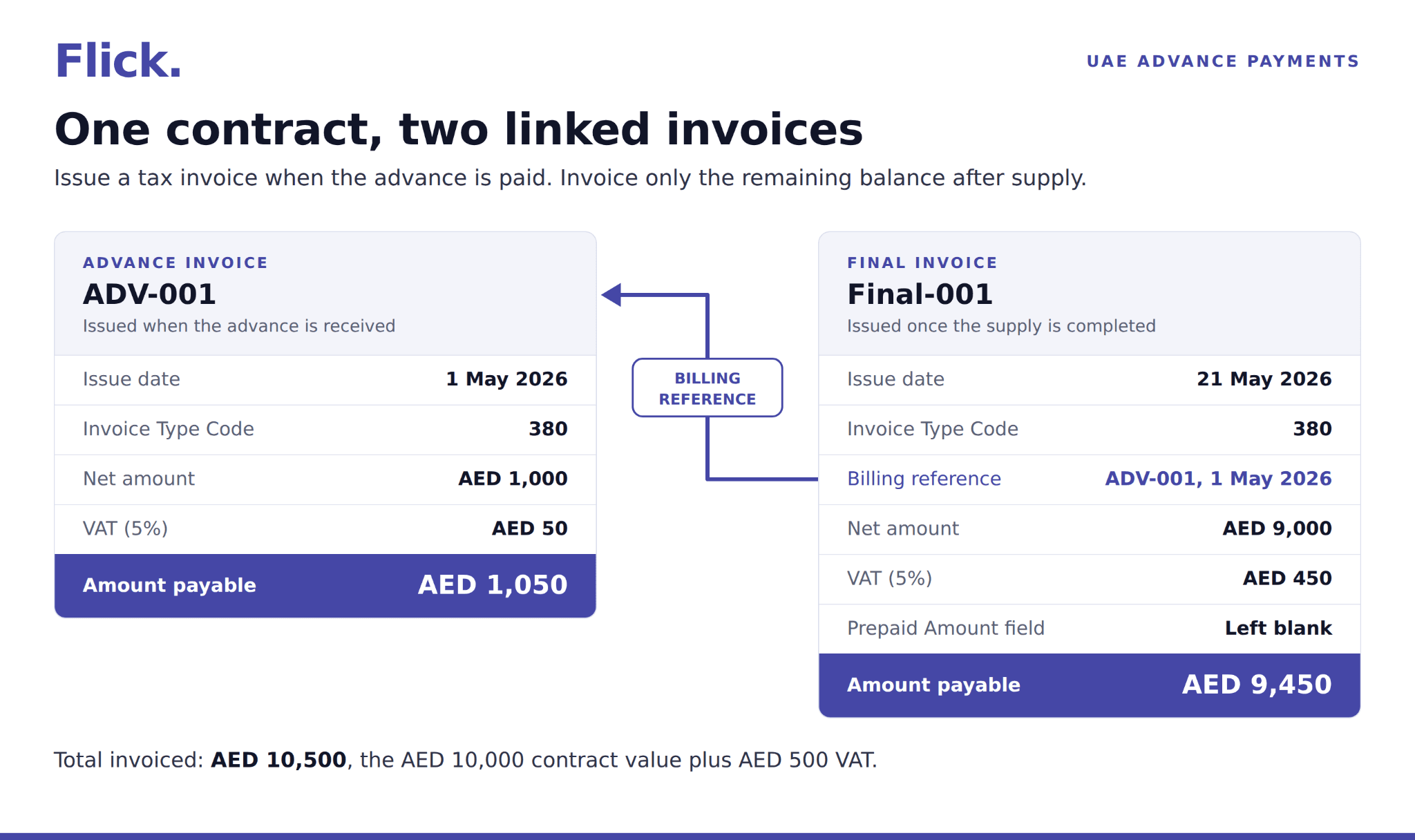
The worked example in Appendix 5 of the guidelines shows how UAE e-invoicing advance payments work in practice. A supplier agrees a contract worth AED 10,000 plus 5% VAT, and the buyer pays an advance of AED 1,000 plus 5% VAT before supply.
Advance Invoice
If the buyer pays the advance on 1 May 2026, the supplier issues invoice ADV-001 on the same day. The invoice covers the AED 1,000 advance plus AED 50 VAT, making the total amount payable AED 1,050.
Final Invoice
Once the supply is completed, the supplier issues invoice Final-001 on 21 May 2026 for the remaining AED 9,000 plus AED 450 VAT, an amount payable of AED 9,450. It references ADV-001, issued on 1 May 2026, and leaves the Prepaid Amount field blank.
Together, the two invoices total AED 10,500, which matches the AED 10,000 contract value plus AED 500 VAT.
Note: Illustrative example based on the Ministry of Finance's Appendix 5. The May 2026 dates are taken from the Ministry's example and are not e-invoicing rollout dates.
How to Avoid Invoicing the Same Advance Payment Twice Under UAE E-Invoicing
With UAE e-invoicing advance payments, double invoicing happens when the final invoice repeats an amount that the advance invoice already covers. Linking the final invoice back to the advance invoice is the first safeguard. Two more steps help stop the same amount from being invoiced twice:
Invoice Only the Remaining Balance
The final invoice should show only the amount still owed. If your billing system builds it from the full contract value, take off the advance first so the invoice shows only the remaining balance. VAT is then charged on that balance alone, and the VAT already charged on the advance is not charged again.
Set Up the ERP for Advance Billing
Set up your ERP to record each advance invoice against its contract, so the reference is added automatically when the final invoice is raised. This reduces manual matching and keeps UAE e-invoicing advance payments consistent across contracts.
PINT-AE does not allow businesses to add their own optional fields, so check with your ASP before including any industry-specific details. To learn more about preparing your ERP for advance and final invoices, visit Flick's UAE e-invoicing solution.
Advance Payment vs. Retention Under UAE E-Invoicing
Retention is handled differently from UAE e-invoicing advance payments, because the buyer holds back part of a payment until the retained amount becomes due. Appendix 5 describes one acceptable way to handle retention, not a rule for every contract. Existing retention practices can continue if they remain VAT and e-invoicing compliant, with the retention calculation kept on a separate commercial document.
The table below compares retention with UAE e-invoicing advance payments:
| Situation | What happens? | Treatment |
| Advance payment received | Buyer pays before supply | Issue an electronic Tax Invoice on receipt |
| Final invoice after an advance | Remaining balance becomes payable | Invoice the remaining balance and reference the advance invoice |
| Milestone billing with retention | Part of the amount is held back | Invoice the amount payable after retention |
| Retention released | Buyer becomes liable to pay the retained amount | Issue a separate electronic Tax Invoice with VAT |
Note: VAT on a retained amount may become due earlier than its release under the applicable date-of-supply rules.
When Do the Advance Payment E-Invoicing Rules Apply in the UAE?
The rules for UAE e-invoicing advance payments apply once your business is live on the Electronic Invoicing System. The go-live date depends on revenue under Ministerial Decision No. 244 of 2025, but revenue sets only the timing, not whether a business is within the scope of e-invoicing in the UAE. Our summary of the Electronic Invoicing Guidelines V1.1 updates covers the other changes in this version.
Pilot and Voluntary Adoption
Businesses can begin before their mandatory date. From 1 July 2026, two routes are available:
Pilot Programme: The Ministry of Finance contacts selected businesses, which take part only if they agree in writing.
Voluntary adoption: Any business can implement e-invoicing voluntarily. Administrative penalties apply only from its mandatory implementation date, which gives teams time to test their process.
Businesses With Revenue of AED 50 Million or More
Businesses with revenue of AED 50 million or more are the first group required to implement e-invoicing. With about two months between the ASP deadline and go-live, onboarding and testing should be planned early. The deadlines are:
- ASP appointment: By 30 October 2026, extended from 31 July 2026 by Ministerial Decision No. 66 of 2026, which amends Ministerial Decision No. 244 of 2025.
- Go-live: By 1 January 2027, a date that did not change with the extension.
Businesses Below AED 50 Million and Government Entities
Businesses with revenue below AED 50 million and Government Entities follow a later timeline. Both appoint an ASP by the same date but go live on different dates:
Revenue below AED 50 million: Appoint an ASP by 31 March 2027 and go live by 1 July 2027.
Government Entities: Appoint an ASP by 31 March 2027 and go live by 1 October 2027.
Managing Advance Payment E-Invoices in UAE Business Workflows
Issuing the advance and final invoices correctly is only the first step. Under e-invoicing in the UAE, businesses also need records that show how each part of the contract was invoiced, stored and accounted for. This comes down to three areas:
Maintain an Audit Trail
Link the advance and final invoices to the same contract reference, so UAE e-invoicing advance payments can be followed from the first payment to the final invoice. Where a contract has several advances, make sure each advance invoice can be traced to the final invoice, and link retention invoices to the milestones they relate to. A clear trail makes it easier to answer questions during a later tax review.
Store Invoice Records
The Ministry of Finance's Electronic Invoicing Guidelines V1.1 set the following storage requirements, which apply to UAE e-invoicing advance payments and all other e-invoices:
Taxable Persons generally keep e-invoice data for 5 years after the end of the related tax period. Add 4 more years if there is a dispute, a tax audit or an FTA audit notification. If a voluntary disclosure is filed in the fifth year, keep the data for 1 year from the filing date.
Real estate records are kept for 7 years from the end of the calendar year in which they were created, with the same 4-year extension during a dispute or tax audit. Where these are VAT records relating to real estate, the longer retention requirement of 15 years after the end of the relevant tax period applies.
Storage can sit inside or outside the UAE if the FTA can retrieve complete, readable records on request.
Storage can be delegated to the ASP, but the business stays legally responsible.
Update Accounting Records
Record UAE e-invoicing advance payments and the remaining balance as separate entries, then reconcile both invoices against the total contract value. This confirms that the full contract value was invoiced once and that VAT was charged on each part.
Conclusion
UAE e-invoicing advance payments use two linked invoices. The first is issued when the advance is received, and the second covers only the remaining balance. Linking the two, and handling retention separately, means each amount is invoiced and taxed once.
Test the process with a few real contracts, such as one with a single advance, one with several advances and one with retention. To discuss how these cases fit your invoicing process, contact Flick Network at sales@flick.network.
FAQs
1. Is a tax invoice required when a business receives an advance payment in the UAE?
Yes. For UAE e-invoicing advance payments, Appendix 5 of the guidelines requires a tax invoice to be issued at the time the advance is received. Once a business is live on the system, it is issued as an electronic Tax Invoice.
2. Does the final e-invoice in the UAE show the full contract value after an advance payment?
No. The final invoice covers only the remaining balance, because a tax invoice has already been issued for the advance. In the Ministry's example, it shows AED 9,000 plus AED 450 VAT rather than the full AED 10,000.
3. Which fields link the PINT AE final invoice to the advance invoice?
The reference can go under IBT-25 (preceding invoice reference) and IBT-26 (preceding invoice issue date). Alternatively, a note can be added in IBT-022.
4. Should the Prepaid Amount field be filled in on the final invoice?
It may be left blank when the final invoice shows only the outstanding balance. Appendix 5 states that the Prepaid Amount field (cbc:PrepaidAmount) may be left blank, as no further adjustment for the advance is needed.
5. How is retention shown on a UAE e-invoice?
Under the practice described in Appendix 5, the Electronic Invoice shows the amount payable after adjusting for retention, while the retention calculation sits on a separate commercial document. When the retained amount becomes due, the supplier issues a separate electronic Tax Invoice with the applicable VAT.
6. Can a PDF be used instead of an e-invoice in the UAE for an advance payment?
No. A PDF does not count as an e-invoice. If the buyer is not yet on the e-invoicing system, the supplier sends a regular tax invoice, such as a PDF, as well as the electronic Tax Invoice. In that case, the electronic invoice uses a fixed endpoint, 0235:9900000098, set by the Ministry of Finance for buyers who are not yet connected.
Quick Navigation
Book a Demo
Learn more by booking a demo with our team. We'll guide you step by step.