E-invoicing in UAE
Transform Your Financial Management with e-Invoicing in UAE
Our Products:
UAE E-Invoicing Self-Billing: Buyer-Issued Invoice Guide
Last updated at
October 13, 2026
Book a Demo
Learn more about this by booking a demo call with us. Our team will guide you through the process and answer any questions you may have.
Book NowSelf-Billing Under UAE E-Invoicing: When Can the Buyer Issue the Invoice?
A self-billing arrangement that works on paper can break under UAE e-invoicing if the buyer is not on the Electronic Invoicing System. Under UAE e-invoicing self-billing, a buyer can issue its supplier's Tax Invoice only when both are VAT registered, a written agreement is in place and the buyer is live. Commercial Invoices cannot be self-billed, because self-billing exists only for VAT purposes. This guide covers the conditions, the agreement, the buyer's readiness steps and how self-billing differs from supplier billing.
What Is Self-Billing Under UAE E-Invoicing?
In a normal sale, your supplier issues the invoice and your business receives it. With UAE e-invoicing self-billing, the roles swap: the buyer raises the invoice for a supply it received, on behalf of a VAT-registered supplier, and the supplier does not issue its own.
The legal basis is Article 9 of Ministerial Decision No. 243 of 2025, which allows self-billing under the conditions in Article 59 of the VAT Executive Regulation. When these conditions are met, the buyer's invoice counts as the supplier's own Tax Invoice. If the supplier also issues an invoice for the same supply, that invoice does not count as a Tax Invoice.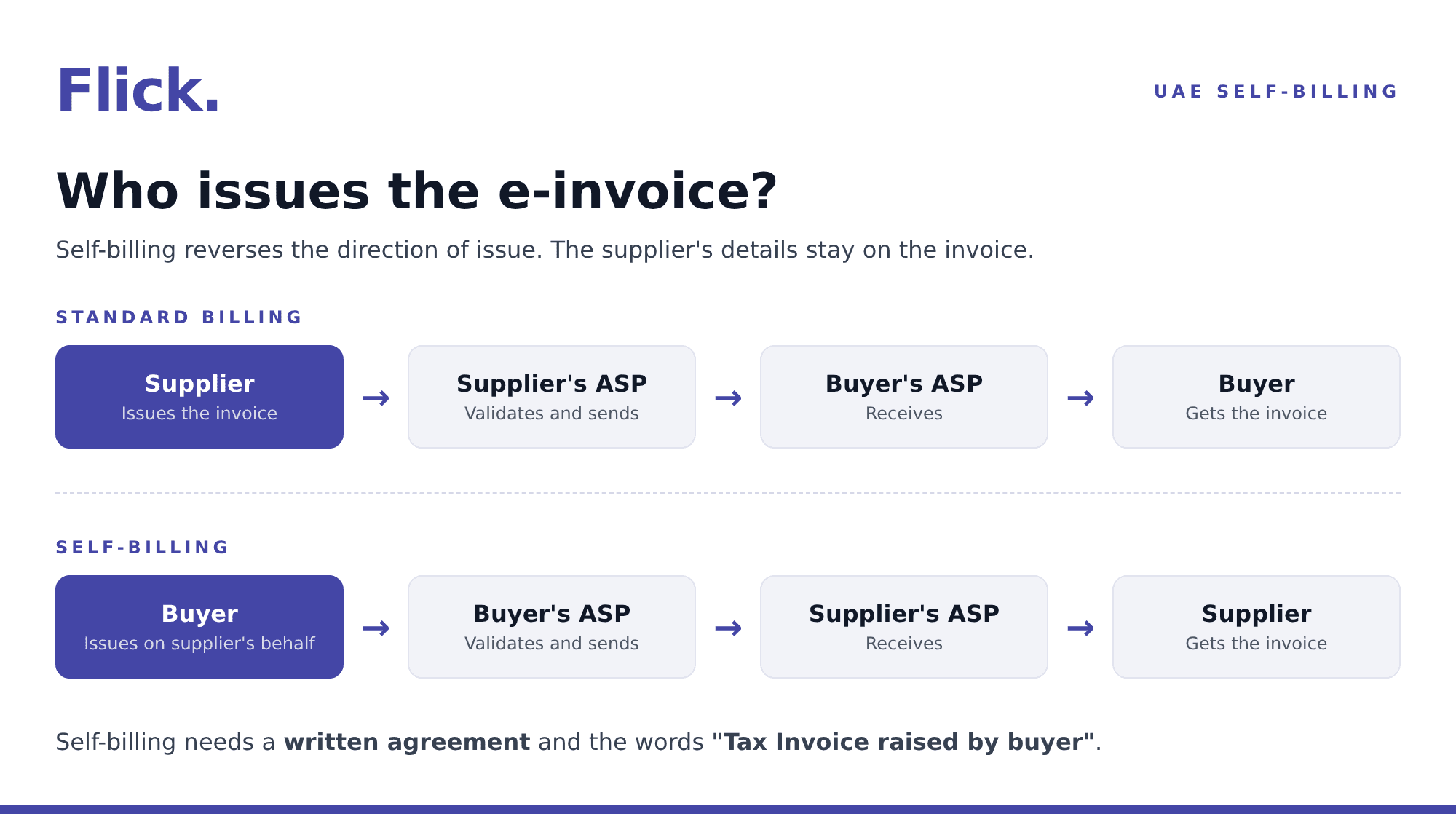
Standard billing and self-billing compared: who issues the e-invoice and which ASP sends it.
When Can a UAE Buyer Issue a Tax Invoice? Self-Billing Conditions
A UAE buyer-issued tax invoice counts as the supplier's own Tax Invoice only when it passes all five checks below, four legal and one technical:
1. Both the Supplier and the Buyer Are VAT Registered
Ministerial Decision No. 243 of 2025 allows the Recipient to issue an e-invoice on the Issuer's behalf only where both businesses are VAT Registrants. Article 59(9) of the VAT Executive Regulation also requires both the buyer and the supplier to be VAT registered for tax invoices.
2. A Written Self-Billing Agreement Is in Place
Before UAE e-invoicing self-billing can begin, the supplier and the buyer must put a written agreement in place, which keeps one Tax Invoice per supply.
3. The Invoice Meets Full Tax Invoice Requirements
A UAE buyer-issued tax invoice must contain every particular of a full Tax Invoice, such as both parties' TRNs, a sequential or unique invoice number, a description of the supply, the VAT rate and the amounts in AED. It must also clearly display the words "Tax Invoice raised by buyer" on the invoice. As with every e-invoice in the UAE, it must include all the mandatory fields listed by the Ministry of Finance.
4. The Buyer Is Live on the Electronic Invoicing System
The Ministry of Finance guidelines state that self-billing of electronic Tax Invoices requires the buyer to be on the Electronic Invoicing System. If your business is the buyer and is not yet live, it cannot issue self-billed electronic Tax Invoices, even when every other condition is met.
5. Technical Requirement: The Self-Billing Document Type Is Used
A self-billed e-invoice is sent as its own document type, not as an ordinary supplier invoice with the parties swapped. For IT and ERP teams, this means the PINT-AE self-billing specification (urn:peppol:pint:selfbilling-1@ae-1) and the self-billing business process (urn:peppol:bis:selfbilling). Before testing UAE e-invoicing self-billing, ask your ASP to confirm it supports this specification rather than relabelling standard invoices.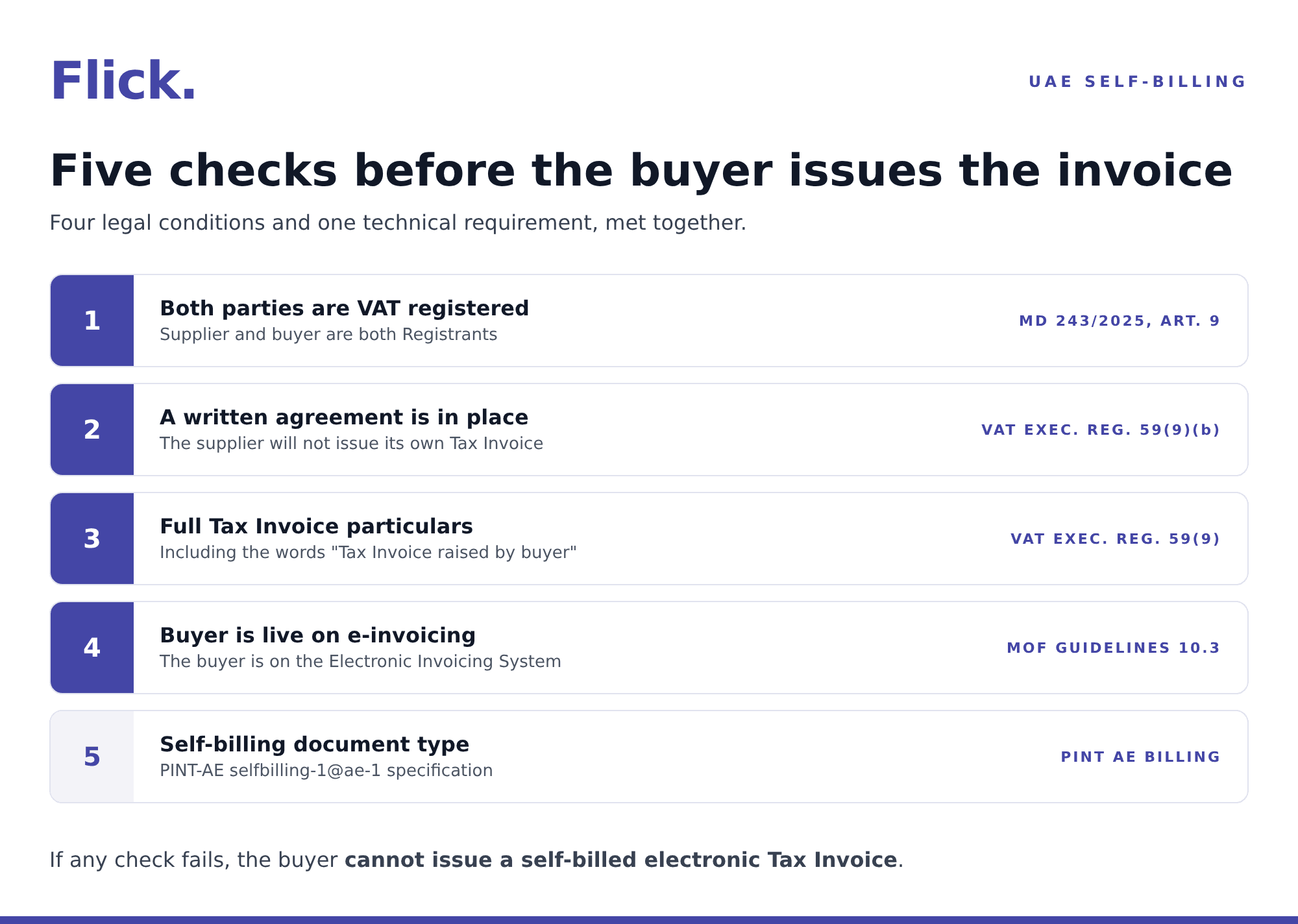
All five checks must be met together before a buyer issues a self-billed electronic Tax Invoice in the UAE.
Tax Invoice vs Commercial Invoice in UAE E-Invoicing
UAE e-invoicing self-billing applies only to Tax Invoices and Tax Credit Notes, not to Commercial Invoices. Under the MoF Electronic Invoicing Guidelines, a Tax Invoice records a Taxable Supply, while a Commercial Invoice is any invoice that is not a Tax Invoice.
Commercial Invoices cover exempt supplies, out-of-scope supplies and supplies by businesses not registered for VAT. E-invoicing still applies to these supplies where the transaction is within scope, but self-billing exists only for VAT purposes. A supplier that issues only Commercial Invoices therefore cannot be self-billed.
The guidelines set out six e-invoice categories, two of which are self-billed versions of the Tax Invoice and the Tax Credit Note:
| Document type | Standard billing (supplier issues) | Self-billing (buyer issues) |
| Tax Invoice | Electronic Tax Invoice | Self-billed electronic Tax Invoice |
| Tax Credit Note | Electronic Tax Credit Note | Self-billed electronic Tax Credit Note |
| Invoice (not a Tax Invoice) | Commercial Invoice | Not applicable |
| Credit note (not a Tax Credit Note) | Electronic Credit Note | Not applicable |
UAE Self-Billing Agreement: What It Should Cover
The UAE self-billing agreement is the document that allows the buyer to raise tax invoices in place of its supplier under UAE e-invoicing self-billing. Without it, an invoice the buyer raises is not treated as the supplier's Tax Invoice under Article 59(9).
Under the VAT Executive Regulation and the MoF guidelines, a UAE self-billing agreement should cover the following:
- Written agreement: The supplier and the buyer put their agreement in writing, confirming that the supplier will not issue its own Tax Invoice for the supplies it covers.
Buyer issues the invoice: With the agreement in place, the buyer issues the electronic Tax Invoice on the supplier's behalf under UAE e-invoicing self-billing.
Credit notes: If the buyer will also raise credit notes, both parties must agree that the supplier will not issue its own Tax Credit Notes, under Article 60(4) of the VAT Executive Regulation.
Self-Billed Credit Notes Under UAE E-Invoicing
A buyer can also raise credit notes under UAE e-invoicing self-billing, but they follow their own conditions. Under Article 60(4) of the VAT Executive Regulation, a buyer-created Tax Credit Note counts as the supplier's own when the buyer is VAT registered and both parties agree that the supplier will not issue a Tax Credit Note. The credit note must also contain the full Tax Credit Note particulars and clearly display the words "Tax Credit Note created by buyer".
Unlike the condition for tax invoices, Article 60(4) does not say this agreement must be in writing. If the supplier also issues a credit note for the same supply, that credit note does not count as a Tax Credit Note. The guidelines also list the self-billed electronic Tax Credit Note as its own e-invoice category.
Buyer Readiness Requirements for Self-Billing Under UAE E-Invoicing
For a self-billed invoice, the exchange and reporting obligation sits with the buyer, and appointing an ASP does not move that obligation to the ASP.
Before issuing any documents under UAE e-invoicing self-billing, work through these steps with your ASP and finance team:
Appoint an ASP: Onboard through EmaraTax with one ASP that handles both sending and receiving e-invoices.
Obtain a Peppol participant identifier: The identifier is 0235 followed by your 10-digit TIN, which is the first 10 digits of your TRN.
Run a gap analysis: Confirm your ERP or accounting system can generate every data point a self-billed e-invoice needs, including the supplier's TRN and Peppol participant identifier.
Agree data exchange: Agree with the ASP how invoice data is shared and how confirmation messages on exchange and reporting come back.
Test end to end: Test the exchange and FTA reporting of each document type used in UAE e-invoicing self-billing before going live.
Set up error handling: Decide with your ASP who checks rejected e-invoices, who corrects the invoice data and who resubmits the corrected e-invoice, during testing and after go-live. Your business stays responsible for sending and reporting, so each step needs a named owner in your team.
Mandatory E-Invoicing UAE Dates That Affect Self-Billing
Any business can start e-invoicing voluntarily from 1 July 2026, ahead of its own mandatory date, and the UAE e-invoicing implementation timeline lists the deadlines to appoint an ASP and go live:
| Entity | Annual revenue | Appoint ASP by | Implement e-invoicing by |
| Business | AED 50 million or more | 30 October 2026 | 1 January 2027 |
| Business | Below AED 50 million | 31 March 2027 | 1 July 2027 |
| Government Entity | Not applicable | 31 March 2027 | 1 October 2027 |
When the Supplier Goes Live Before the Buyer
This is the gap where a working self-billing arrangement can stop. Once a supplier reaches its mandatory date, e-invoicing applies to all its business transactions within the scope of e-invoicing, including those under a UAE e-invoicing self-billing arrangement. The buyer may not have reached its own mandatory date at that point, so the guidelines advise suppliers to check their self-billing arrangements with customers.
A buyer that joins early does not take on penalty exposure sooner, because e-invoicing penalties apply only from its own mandatory date. Implementing before the supplier's mandatory date lets the buyer keep issuing self-billed electronic Tax Invoices without a gap.
For example, take a hypothetical supplier with revenue of AED 50 million or more that must implement e-invoicing by 1 January 2027, while its buyer, with revenue below AED 50 million, has until 1 July 2027. Unless the buyer implements earlier on a voluntary basis, it cannot issue self-billed electronic Tax Invoices between those two dates.
Supplier Billing vs Self-Billing Under UAE E-Invoicing
The table below compares standard supplier billing with UAE e-invoicing self-billing in day-to-day practice:
| Point of comparison | Standard supplier billing | Self-billing |
| Who issues the e-invoice | Supplier | Buyer, on behalf of the supplier |
| Legal basis | Article 6, Ministerial Decision No. 243 of 2025 | Article 9, Ministerial Decision No. 243 of 2025; Articles 59(9) and 60(4), VAT Executive Regulation |
| VAT registration | Needed to issue Tax Invoices; non-registered suppliers issue Commercial Invoices | Both supplier and buyer must be VAT registered |
| Agreement | Not required | Written agreement that the supplier will not issue a Tax Invoice |
| Available documents | Electronic Tax Invoice, Electronic Tax Credit Note, Commercial Invoice, Electronic Credit Note | Self-billed electronic Tax Invoice, self-billed electronic Tax Credit Note |
| Required wording | "Tax Invoice" | "Tax Invoice raised by buyer" and "Tax Credit Note created by buyer" |
| Party that sends through its ASP | Supplier | Buyer |
| Buyer not yet on e-invoicing | If the buyer has not implemented e-invoicing and has no Participant Identifier, the supplier includes the predefined endpoint 0235:9900000098 on the e-invoice and also provides a regular Tax Invoice, such as a PDF | Self-billing cannot run until the buyer is on the Electronic Invoicing System |
| Supplier's own invoice for the supply | It is the Tax Invoice | Does not count as a Tax Invoice (Article 59(10)) |
How Flick Network Helps with UAE E-Invoicing Self-Billing
Flick Network supports both sides of UAE e-invoicing self-billing, from the buyer issuing the e-invoice to the supplier receiving it:
Accredited Service Provider: Flick Network L.L.C is a UAE Ministry of Finance eInvoicing Accredited Service Provider (Accreditation No. 138271), eligible for appointment as a business's ASP.
Self-billed invoices and credit notes: Flick's UAE API supports self-billed invoices with document type code 389 and self-billed credit notes with code 261. The document type code makes the document self-billed, not the self-billing flag alone.
One connection for sending and receiving: Flick acts as the access point for documents a business sends and documents it receives, which fits the requirement to appoint one ASP for both.
Validation before transmission: Flick validates each document before filing it and returns a list of issues when a document is rejected, so the finance team can correct and resubmit it.
Delivery and FTA reporting status: Each document carries a separate delivery status and FTA reporting status, so teams can see which step completed or failed.
Integration through API: Businesses send invoice data to Flick's API, and Flick generates the PINT-AE UBL XML, delivers it over Peppol and reports the tax data to the FTA.
Conclusion
UAE e-invoicing self-billing lets a buyer issue the Tax Invoice on its supplier's behalf. It works only when the supplier and the buyer are VAT registered, a written agreement is in place and the invoice carries full Tax Invoice particulars. The buyer must also be live on the Electronic Invoicing System by the supplier's mandatory date to continue the self-billing arrangement. The supplier's deadline does not automatically become the buyer's own mandatory date, so plan the buyer's go-live early. For help with self-billed e-invoices, visit Flick's UAE e-invoicing solution or contact sales@flick.network.
FAQs
1. Does self-billing need FTA approval?
No. The VAT Executive Regulation does not list FTA approval as one of the conditions for self-billing. Once the conditions are met, the buyer's invoice counts as the supplier's Tax Invoice.
2. Who reports a self-billed e-invoice to the FTA?
Both the buyer's side and the supplier's side report a self-billed e-invoice to the FTA. The buyer's ASP reports it when it is sent, and the supplier's ASP reports it when it is received. Under the guidelines, the buyer is responsible for sending and reporting each self-billed invoice.
3. Is Agent Billing the Same as Self-Billing in UAE E-Invoicing?
No, self-billing and agent billing are two separate arrangements under UAE e-invoicing. In self-billing, the buyer issues the e-invoice on behalf of the supplier that made the supply. In agent billing, an agent issues it for its principal, but the supplier stays responsible for issuing it.
4. Can a PDF Be Used as a Self-Billed E-Invoice in the UAE?
No. The Ministry of Finance confirms that a PDF, Word file, image, scan or email is not an e-invoice. Every e-invoice, including a self-billed one, is issued and exchanged in XML format.
5. Does a Self-Billed E-Invoice in the UAE Need a QR Code?
No. E-invoices in the UAE are issued in XML format, and the guidelines confirm they will not carry a QR code or barcode.
Quick Navigation
Book a Demo
Learn more by booking a demo with our team. We'll guide you step by step.