E-invoicing in UAE
Transform Your Financial Management with e-Invoicing in UAE
Our Products:
UAE E-Invoicing for a Buyer Not Onboarded: Supplier Steps
Last updated at
November 4, 2026
Book a Demo
Learn more about this by booking a demo call with us. Our team will guide you through the process and answer any questions you may have.
Book NowWhat Happens When Your Customer Has Not Adopted UAE E-Invoicing?
From 1 January 2027, a supplier with Revenue of AED 50 million or more must issue a UAE e-invoice even when the buyer is not onboarded. The supplier reports it to the Federal Tax Authority (FTA) through its Accredited Service Provider (ASP), uses endpoint 0235:9900000098 for a buyer without a Participant Identifier and gives a regular Tax Invoice, such as a PDF. This guide covers the process, buyer identification, official scenarios and readiness for a UAE e-invoicing buyer not onboarded.
Does a Customer’s Onboarding Status Affect UAE E-Invoicing Obligations?
No. A customer not using UAE e-invoicing does not change your e-invoicing obligations. Section 6.1 of the Ministry of Finance (MoF) Electronic Invoicing Guidelines (the Guidelines) states that a customer's onboarding or tax registration status does not affect the obligations for a Business Transaction. This covers both B2B and B2G transactions.
The legal basis is Ministerial Decision No. 243 of 2025. Article 3 brings every Business Transaction of a Person conducting Business in the UAE into scope, unless Article 4 excludes it. Article 6(1) then requires the Issuer to issue and transmit an e-invoice to the Recipient.
A PDF invoice alone does not meet this obligation. Under Article 65(5) of the VAT Decree-Law, a Registrant subject to the Electronic Invoicing System must issue and transmit its Tax Invoices as Electronic Invoices. The obligation starts on your own mandatory date, or earlier if your business adopts e-invoicing voluntarily.
Which Customers Are Not Yet Required to Use UAE E-Invoicing?
These are customers that have not adopted e-invoicing voluntarily and whose mandatory date has not yet arrived. Because the rollout is phased, a customer can lawfully stay outside the system from 1 January 2027 until its own date of 1 July 2027 or 1 October 2027.
The phase alone does not confirm a customer's status, because a customer may adopt e-invoicing voluntarily before its date. The detail to confirm is the Participant Identifier, also called the End Point ID or Peppol participant identifier. It is 0235 followed by the customer's 10-digit Tax Identification Number (TIN).
The table below sets out the dates for each customer type in the UAE e-invoicing implementation timeline:
| Customer type | Appoint ASP by | Implement e-invoicing by | Basis |
| Person with Revenue of AED 50 million or more | 30 October 2026 | 1 January 2027 | Ministerial Decision No. 244 of 2025, Article 5(1)(a), as replaced by Ministerial Decision No. 66 of 2026 |
| Person with Revenue below AED 50 million | 31 March 2027 | 1 July 2027 | Ministerial Decision No. 244 of 2025, Article 5(1)(b) |
| Government Entity | 31 March 2027 | 1 October 2027 | Ministerial Decision No. 244 of 2025, Article 5(1)(c) |
Step-by-Step UAE E-Invoicing Process for Customers Not Onboarded
The UAE’s standard e-invoicing framework uses a five-corner model. For a customer that has not onboarded, the guidance specifies the predefined endpoint, supplier-side reporting and an additional regular Tax Invoice, but does not explain buyer-side routing. Section 10.2.2 of the Guidelines requires 0235:9900000098 as the buyer electronic address and a regular Tax Invoice in addition to the e-invoice.
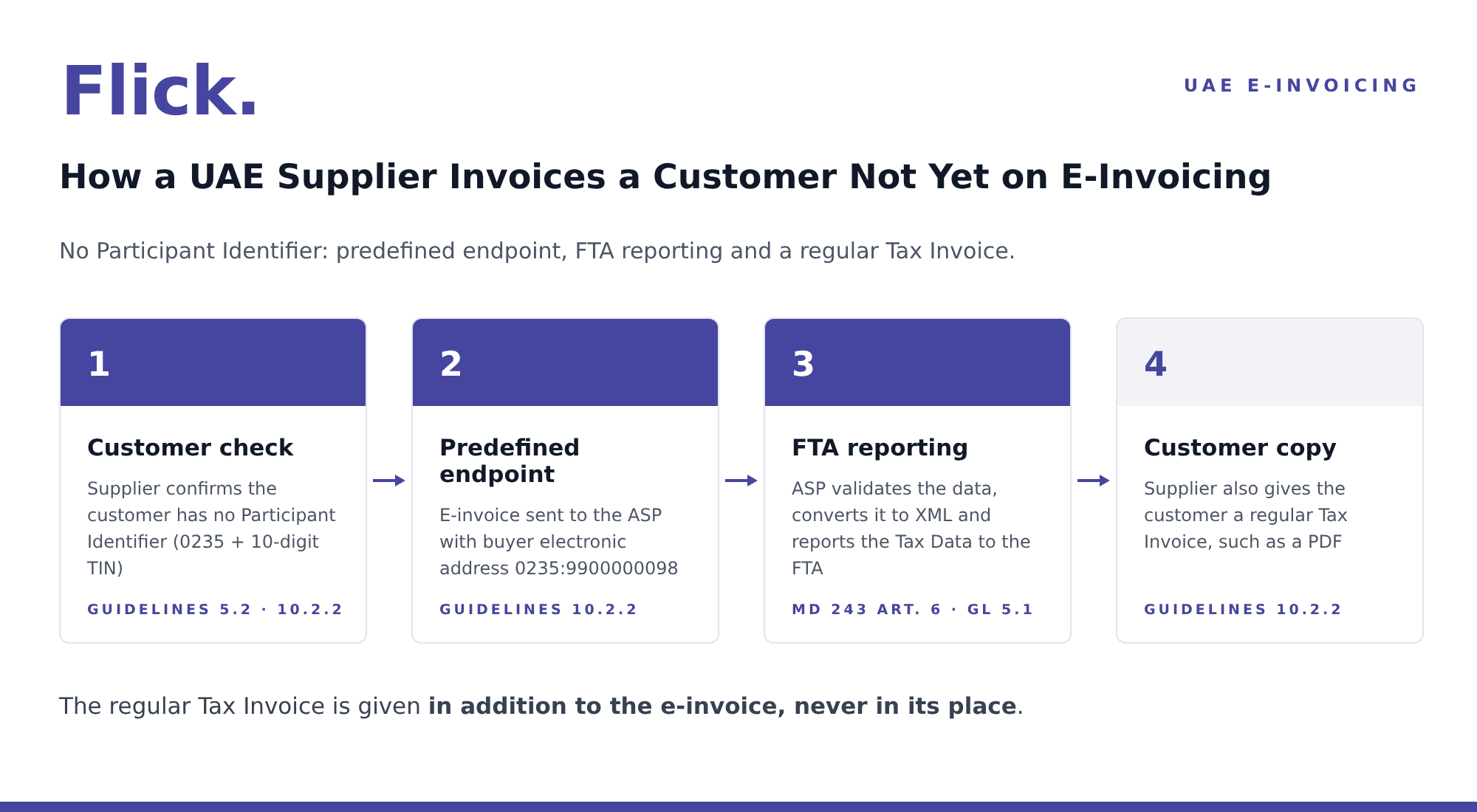
How a UAE supplier invoices a customer that has no Participant Identifier under e-invoicing.
Here is how the process runs for a UAE buyer without a Participant Identifier:
- Customer check: Confirm that the customer has not implemented e-invoicing and has no Participant Identifier. If the identifier is simply missing from your records, obtain it before selecting the endpoint.
- Invoice submission: Send the invoice data to your ASP with 0235:9900000098 as the buyer electronic address.
- Validation and conversion: The ASP validates the data and converts it into the UAE e-invoice in XML, based on the Peppol PINT-AE specification.
- FTA reporting: The ASP reports the Tax Data to the FTA, and the FTA confirmation returns to you through the ASP.
- Customer copy: Give the customer a regular Tax Invoice, such as a PDF, in addition to the e-invoice.
Predefined Endpoint 0235:9900000098 for Customers Without a Peppol ID
The e-invoice must carry 0235:9900000098 as the buyer electronic address when the customer has not yet implemented e-invoicing and has no Participant Identifier (Guidelines section 10.2.2).
When to Use 0235:9900000098 on a UAE E-Invoice
The MoF mandatory fields list has two buyer identification fields. The buyer electronic address (field 22) shows where the invoice is delivered, and the buyer electronic identifier (field 23) identifies the buyer. For an onboarded customer, the endpoint is its Participant Identifier. For a UAE buyer without a Participant Identifier, the endpoint is 0235:9900000098, while separate predefined endpoints apply to exports and deemed supplies.
Buyer Details Required on a UAE E-Invoice Without a Participant ID
The predefined endpoint does not remove the buyer details. The table below lists what still applies, based on the MoF UAE e-invoice mandatory fields and the PINT-AE checks:
| Buyer data | What applies | Reference |
| Buyer name | Full name of the buyer | MoF Mandatory Fields, electronic Tax Invoice, field 21 |
| Buyer tax identifier (TRN) | TRN for buyers registered for VAT; 15 digits, starting with 1 and ending with 03 | MoF Mandatory Fields, electronic Tax Invoice, field 24; IBR-132-AE |
| Buyer identifier or buyer VAT identifier | At least one is required when the buyer electronic address under scheme 0235 does not start with 1, unless the invoice is an export | IBR-135-AE |
| Buyer address | Address line 1, city, country subdivision (Emirate code) and country code | MoF Mandatory Fields, electronic Tax Invoice, fields 26 to 29; IBR-144-AE; IBR-128-AE |
Is a Regular Tax Invoice Still Required Alongside the UAE E-Invoice?
Yes. When the buyer has not yet implemented UAE e-invoicing, a regular Tax Invoice, such as a PDF, is required in addition to the electronic Tax Invoice (Guidelines section 10.2.2).
The reason is the format. E-invoices are issued and received in XML and carry no QR code or barcode. A buyer outside the system may therefore need a separate Tax Invoice or Commercial Invoice to support input tax recovery, corporate income tax deductions or to understand the amount payable. The regular copy is still a Tax Invoice, so it carries the particulars listed in Article 59 of the VAT Executive Regulation.
The table below shows what the customer receives in each situation:
| Situation | What the customer receives | Basis |
| Tax Invoice to a buyer that has not implemented e-invoicing | Electronic Tax Invoice, issued and reported, plus a regular Tax Invoice such as a PDF | Guidelines 10.2.2 |
| Sale that needs no Tax Invoice (Commercial Invoice) to a buyer that has not implemented e-invoicing | Commercial e-invoice; the buyer may also require a separate Commercial Invoice | Guidelines 6.2 and 10.2.1 |
| Tax Invoice to a buyer that has implemented e-invoicing | E-invoice only; a separate Tax Invoice may not be required where the e-invoice meets Article 65 of the VAT Decree-Law and Article 59 of the VAT Executive Regulation | Guidelines 10.2.2 |
Is the E-Invoice Reported to the FTA When the Customer Is Not Onboarded?
Yes. The reporting obligation applies to every e-invoice in the UAE, including one issued to a buyer not onboarded.
Who Reports the E-Invoice to the FTA in the UAE
Article 6(6) of Ministerial Decision No. 243 of 2025 requires the Issuer and the Recipient to report e-invoices and e-credit notes to the FTA within the timeline prescribed by the Minister. Article 6(7) requires both to meet these obligations through an Accredited Service Provider. In the five-corner flow, the supplier's ASP (Corner 2) reports the Tax Data to the FTA (Corner 5) in parallel with transmitting the e-invoice.
UAE E-Invoice Issue Deadline and FTA Confirmation
Article 6(5) allows 14 days from the Date of Business Transaction to issue and transmit the e-invoice. This is subject to Article 6(4), which applies the VAT Law timeline where the Issuer is a Registrant. The Date of Business Transaction is the earlier of the date the transaction occurred and the date payment was received.
After reporting, the FTA sends a confirmation to your ASP, which forwards it to you. ASPs must inform the supplier without undue delay, on an event-driven basis, that the Tax Data documents reached the FTA.
Official UAE E-Invoicing Scenarios for Customers Not Yet Onboarded
The table below applies the Guidelines and Ministerial Decision No. 243 of 2025 to customer situations a supplier that is already live may meet. Each row reflects official guidance, not a customer case:
| Customer situation | Supplier treatment | Basis |
| UAE business with Revenue below AED 50 million, not yet implemented, no Participant Identifier | Electronic Tax Invoice with 0235:9900000098, plus a regular Tax Invoice | Guidelines 8.3 and 10.2.2 |
| UAE Government Entity before 1 October 2027, no Participant Identifier | B2G supplies are in scope; for a Tax Invoice, use 0235:9900000098 and give a regular Tax Invoice | Guidelines 6.2, 8.3 and 10.2.2 |
| UAE customer not registered for VAT | Supplier's e-invoicing obligations do not change | Guidelines 6.1 |
| Overseas customer with no Peppol ID | Predefined endpoint 0235:9900000099; the Tax Invoice is issued as an e-invoice and may be provided to Customs | Guidelines 10.4, scenario 8 |
| Consumer (natural person not in Business) | Outside e-invoicing scope, including where a billing agent issues the invoice | Guidelines 6.2 |
| Self-billing customer not on e-invoicing | Self-billed e-invoices require the buyer to be on the system and both parties to be Registrants, so review the arrangement before go-live | Guidelines 10.3; Ministerial Decision No. 243 of 2025, Article 9 |
What UAE E-Invoicing Guidance Does Not Cover for Customers Not Onboarded
For a customer not using UAE e-invoicing, the published guidance leaves the following points open, so confirm them with the FTA or a tax adviser before relying on an assumption:
- Delivery to 0235:9900000098: The Guidelines require the endpoint but do not describe how the e-invoice is routed or whether buyer-side (Corner 3) steps take place.
- Commercial Invoices: The endpoint requirement sits in the Tax Invoice context, and the guidance does not state whether it also applies to Commercial Invoices.
- Credit notes: Section 10.2.2 covers electronic Tax Credit Notes, but the regular copy requirement names Tax Invoices only, so the need for a regular Tax Credit Note is not stated.
- Link between the copy and the e-invoice: No official source states whether the regular Tax Invoice must carry the same invoice number or UUID as the e-invoice.
- Customers that onboard later: The guidance does not address invoices already issued to 0235:9900000098 before the customer received its Participant Identifier.
Readiness Checklist for Customers Not Onboarded to UAE E-Invoicing
Alongside the general UAE e-invoicing preparation checklist, use the following steps to prepare for each UAE e-invoicing buyer not onboarded:
- Add Participant Identifier and TRN fields to the customer master record in your ERP system.
- Confirm with your ASP that buyer data is sufficient for the transitional period.
- Flag customers with no Participant Identifier in your ERP, so their e-invoices carry 0235:9900000098 and a regular Tax Invoice is produced (Guidelines section 10.2.2).
- Include the predefined endpoint case in gap analysis and end-to-end testing.
- Update the customer record once the Participant Identifier is received, and review whether a separate Tax Invoice is still needed.
Let Flick Network Support Your UAE E-Invoicing Onboarding
Customers that have not onboarded are part of your e-invoicing obligations from your first live day. Getting this case right before go-live keeps every invoice compliant, whatever your customer's status.
Flick Network supports businesses through UAE e-invoicing onboarding, including invoicing for customers that are not yet on the system. Speak to our team at sales@flick.network to plan your onboarding.
Frequently Asked Questions
1. Can Emailing the XML Replace the Required UAE E-Invoicing Process?
No. An e-invoice is issued, transmitted and received through the Electronic Invoicing System, and Article 6(7) of Ministerial Decision No. 243 of 2025 requires the Issuer to meet its obligations through an Accredited Service Provider. The regular Tax Invoice copy is given in addition to that process, never in place of it (Guidelines section 10.2.2).
2. Does a Customer Need Its Own ASP to Receive UAE E-Invoices?
Yes, once e-invoicing applies to the customer, whether voluntarily or from its mandatory date. Article 5(1) of Ministerial Decision No. 243 of 2025 requires the Recipient to appoint an Accredited Service Provider, and a Person in scope appoints only one ASP for both sending and receiving e-invoices.
3. How Does a Customer Get a Peppol Participant ID in the UAE?
The customer starts onboarding through EmaraTax and obtains the identifier via its chosen ASP, and the ASP shares the Participant Identifier once onboarding is complete (Guidelines Appendix 3, section 15.4). The identifier uses the customer's TIN, which is the first 10 digits of its TRN, or a TIN obtained from the FTA where the customer is not registered for any tax.
4. Can a Customer Receive UAE E-Invoices Before Its Mandatory Date?
Yes. Any Person can implement e-invoicing voluntarily from 1 July 2026. It must then meet all technical requirements, although administrative penalties apply only from its mandatory date (Guidelines section 8.2).
5. Who Is Responsible for the Buyer Details on a UAE E-Invoice?
The supplier. Guidelines section 5.2 keeps the compliance obligation with the supplier even where an ASP carries out the activities in practice, and it assigns both the calculation of e-invoice values and the gathering of the buyer's identifier to the supplier.
Quick Navigation
Book a Demo
Learn more by booking a demo with our team. We'll guide you step by step.