E-Invoicing in Oman 2027: Fawtara Deadlines and Requirements

Last updated at
October 23, 2026
Book a Demo
Learn more about this by booking a demo call with us. Our team will guide you through the process and answer any questions you may have.
Book NowOman E-Invoicing: Complete Requirements and Compliance Guide
Oman's Fawtara e-invoicing mandate requires all VAT-registered businesses to issue and exchange structured electronic tax invoices. Under Tax Authority Decision No. 189/2026, this becomes a legal obligation from 1 April 2027 for businesses with annual supplies above OMR 5 million, and from 1 October 2027 for all others. Built on the Peppol five-corner model, the system routes invoices through service providers accredited by the Oman Tax Authority (OTA). This guide covers scope, deadlines, invoice flows, technical requirements, archiving and preparation.
Key Takeaways
- E-invoicing is mandatory from 1 April 2027 for VAT-registered businesses with annual supplies above OMR 5 million, and from 1 October 2027 for those with annual supplies of OMR 5 million or less, under Decision 189/2026.
- The August 2026 first rollout of OTA-selected taxpayers was a pilot and not a mandatory phase. The Decision sets no legal obligation for any business before 1 April 2027.
- Invoices must be issued in structured XML aligned with the PINT OM specification and validated and exchanged through an OTA-accredited service provider, per OTA guidance.
- B2B invoices are exchanged in real time, while B2C invoices are reported within 24 hours and carry a mandatory QR code on the human-readable invoice, per OTA guidance.
- Archiving is a legal obligation under Article 70 of the VAT Law, requiring 10 years of retention, or 15 years for real estate records. The taxpayer, not the OTA, is responsible for storing invoices for the full retention period.
What Is E-Invoicing (Fawtara) in Oman?
E-invoicing in Oman, referred to as the Fawtara Programme, is a mandatory digital invoicing initiative introduced by the Oman Tax Authority (OTA) to modernise how businesses issue and record taxable transactions. Under Fawtara, VAT-registered businesses must generate invoices through approved software and transmit them in a structured electronic format, replacing paper and PDF invoices for in-scope transactions. The OTA states plainly that a PDF invoice is not an e-invoice.
The Peppol network is the technical foundation of Fawtara, aligning Oman with the Peppol-based framework used for e-invoicing in the UAE. Building on this framework, all e-invoices must be generated through accounting or ERP software in XML, aligned with the PINT OM specification. The overall objective of the Fawtara system is to strengthen VAT compliance, reduce invoice fraud, and give the OTA accurate, real-time visibility into business transactions across the country.
The programme now has a formal legal basis. Decision 189/2026, published in Official Gazette issue 1660 on 9 August 2026, amends the Executive Regulation of the VAT Law (Decision 53/2021) to require tax invoices in an approved, secured electronic format.
Is E-Invoicing Mandatory in Oman?
Yes, e-invoicing is mandatory in Oman for all VAT-registered businesses from 2027. Decision 189/2026 requires all VAT-registered taxable persons to issue electronic tax invoices, with two implementation dates based on the value of annual supplies: 1 April 2027 and 1 October 2027. A business implements from 1 April 2027 if its actual supplies from 1 April 2026 to 31 March 2027, or its expected supplies from 1 April 2027 to 31 March 2028, exceed OMR 5 million, and from 1 October 2027 otherwise. The Decision sets no legal obligation for any business before 1 April 2027.
The technical requirements come from the PINT OM specification, which is published and remains subject to updates by the OTA and OpenPeppol. The OTA’s September 2026 FAQ states that e-invoices are required for transactions where VAT legislation requires an invoice, including when assessing exempt and out-of-scope supplies.
The OTA’s Fawtara FAQ, updated on 30 September 2026, refers to Decision 189/2026 and sets out how annual supplies are measured (section 3.1). Earlier OTA material referred to an August 2026 first rollout and deferred later rollout dates to legislation. Decision 189/2026 now sets those dates in law, replacing the earlier rollout schedule.
Which Fawtara Deadline Applies to Your Business?
The mandatory implementation date depends on the value of a business's annual supplies. The Oman e-invoicing timeline under Decision 189/2026 is set out below:
| Annual supplies | Implementation date | Status |
| Above OMR 5 million | 1 April 2027 | Mandatory under Decision 189/2026 |
| OMR 5 million or less | 1 October 2027 | Mandatory under Decision 189/2026 |
| OTA-selected taxpayers | From August 2026 | Pilot (OTA first rollout), separate from the mandatory dates |
For an article-by-article breakdown of the Decision, see our guide to the Oman Fawtara deadline under Decision 189/2026.
Oman Fawtara Pilot Phase
The OTA selected the pilot participants based on criteria such as revenue size, annual invoice volume, technical readiness and sector coverage. Participation in the pilot does not bring forward the legal deadline set by the Decision.
How Annual Supplies Are Measured
The OTA’s Fawtara FAQ (updated 30 September 2026, section 3.1) sets how annual supplies are measured. A business must implement e-invoicing from 1 April 2027 if its actual supplies from 1 April 2026 to 31 March 2027, or its expected supplies from 1 April 2027 to 31 March 2028, exceed OMR 5,000,000. Otherwise, the deadline is 1 October 2027. The calculation includes taxable supplies (excluding capital assets), supplies subject to the reverse charge, and intra-GCC supplies of goods and services.
The same test applies to residents and non-residents, but non-residents count only supplies made in Oman. VAT groups are assessed at group level, not per member. For an indicative result, businesses can use the OTA’s Potential Rollout Checking tool, which the OTA states is for awareness, preparation and readiness purposes only.
Temporary Exemption From E-Invoicing
New Article 143 bis 2 allows the OTA Chairman to exempt a taxable person from issuing electronic tax invoices for a period the OTA determines. The business must apply with supporting documents and reasons the OTA accepts, and must continue to file VAT returns on time, complete in form and data, and pay tax due on time.
Government Entities
The Decision sets no separate implementation date for government institutions or public sector entities. No OTA announcement on a separate government timeline has been confirmed to date.
Who Must Comply With Oman E-Invoicing Requirements?
- The mandate applies to all VAT-registered businesses in Oman, brought in on the implementation dates above. The OTA has confirmed there are no industry exceptions. The value of annual supplies decides only when a business joins, not whether it joins, and no turnover threshold for exemption has been announced, so small businesses registered for VAT must comply by 1 October 2027. Members of a VAT group adopt e-invoicing according to the rollout (OTA guidance), and earlier OTA guidance states that a group sharing one VAT number must use a single, shared service provider.
- A VAT-registered business that has not yet reached its implementation date can keep issuing invoices through its current method, provided those invoices comply with VAT law. This is a timing allowance, not an exemption from the mandate.
Who Is Currently Excluded From Oman E-Invoicing
A business that is not registered for VAT sits outside the Fawtara network. It cannot charge VAT or issue a valid tax invoice, even if a customer requests one. Businesses below the registration threshold may still register voluntarily, while those that exceed it are required to register. Once registered, a business falls within the scope of Fawtara from its applicable implementation date.
What Is B2C E-Invoicing in Oman?
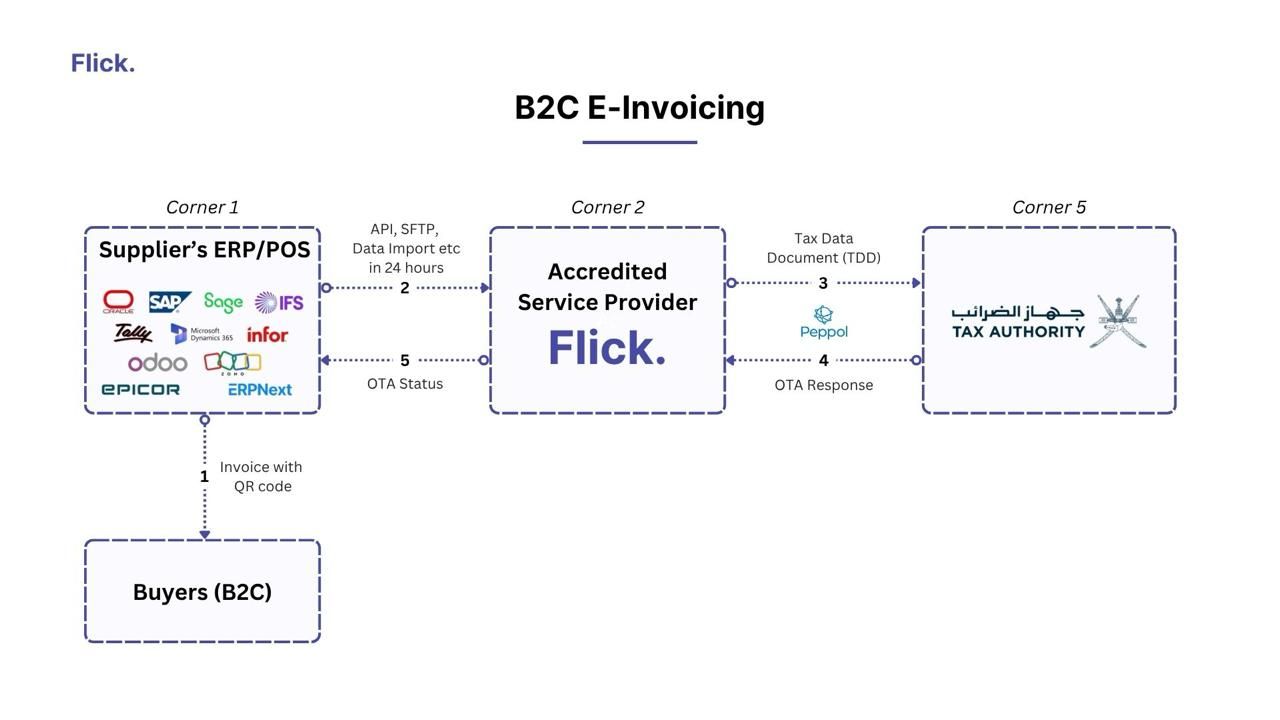
OTA guidance indicates that B2C invoices must be submitted to the tax authority within 24 hours of issuance, following the same implementation dates as B2B and B2G transactions rather than a separate stage. Every B2C sale needs its own e-invoice, because consolidated B2C invoices are not allowed. Where the buyer is not VAT-registered and has no accredited service provider, the seller still submits the invoice through its own provider, which sends the Tax Data Document to the OTA. The buyer receives a separate human-readable output such as a receipt or PDF, while the structured e-invoice remains the legal invoice.
The OTA has also clarified how QR-code treatment applies specifically to B2C invoices. The taxpayer generates the QR code, and it appears on the human-readable invoice rather than inside the structured XML file. This code is mandatory for every B2C transaction, full or simplified, and is designed to support future authenticity checks through an OTA mobile application.
Oman E-Invoicing Technical and Legal Requirements
The OTA's published materials and Decision 189/2026 set out a combined legal, operational and technical compliance model. Invoices must be generated electronically through a compliant solution, validated and exchanged through the Fawtara operating model, and reported to the OTA according to the applicable workflow.
The confirmed technical direction is Peppol-aligned UBL/XML, paired with a separate Oman Tax Data Document used for tax reporting. Businesses should generate invoices directly from a compliant solution rather than creating manual invoices and entering them afterwards, and systems should support structured XML generation, validation controls and compliant archiving. Invoices may be issued in more than one language, provided they meet the VAT legislation.
Service-provider accreditation criteria include mainland Oman commercial registration with relevant activity, paid-up capital of at least OMR 6,000, at least 2 years of local or international operating history for the company or its parent (1 year for Riyada card holders), no tax debt collection process, and technical controls such as multi-factor authentication, encryption, security monitoring and ISO/IEC 27001 certification (OTA Service Provider Criteria). Foreign or GCC-based providers may participate, but local presence in Oman is required.
Oman E-Invoicing Requirements
Businesses in Oman must meet the following e-invoicing requirements under Decision 189/2026 and OTA guidance:
- Tax invoices must be issued in an approved and secured electronic format that safeguards their integrity, with each invoice stored under a unique number, covering all VAT-registered businesses unless the OTA grants a temporary exemption (Articles 143 and 143 bis 2).
- An electronic tax invoice is required when making supplies, including supplies to a person who is not a taxable person, when making deemed supplies, and when receiving consideration before the date of supply (Article 143).
- Tax invoices must be issued within 15 days of the triggering event, and the same deadline applies to simplified tax invoices (Articles 143 and 146).
- Every invoice must be generated through a digital system and validated and sent via an OTA-accredited service provider, which can be the business itself if it is accredited (OTA guidance).
- Each e-invoice must carry the mandatory particulars required by Article 147 of the Executive Regulation, plus any additional data the OTA specifies (Article 147, item 11).
- B2B e-invoices must be exchanged in real time through the Fawtara network, and B2C e-invoices must be reported within 24 hours (OTA guidance).
- Invoices must remain verifiable for authenticity of origin, integrity of content and legibility until the end of the retention period (Article 143).
- The taxable person must issue invoices securely through an electronic system, protect it from unauthorised access, prepare for emergencies and technical failures, and maintain mechanisms to recover lost data (Article 143 bis 1).
- Credit notes and debit notes must also be issued electronically, because an issued invoice can only be adjusted through an electronic credit note or debit note (OTA guidance).
E-Invoicing Process in Oman: The Five-Corner Model Explained
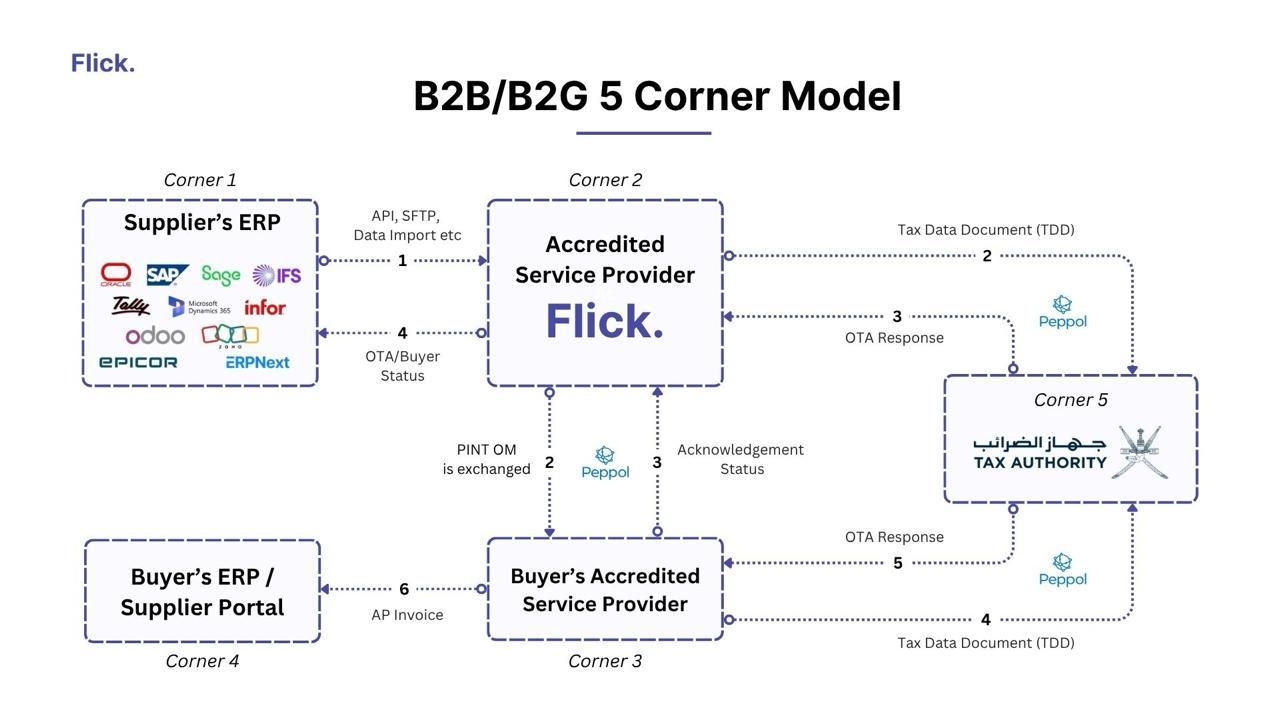
Oman's e-invoicing process is structured around the five-corner Peppol model, where invoices are exchanged between the supplier, the buyer and the Oman Tax Authority through a network of accredited service providers. The model is decentralised, meaning no single government portal processes all transactions. For B2C transactions where the buyer is not connected to Fawtara, the seller's service provider handles Corner 5 reporting only, and the buyer receives a human-readable invoice copy outside the network.
[Image: B2C E-Invoicing]
The table below outlines the role of each corner in the Fawtara e-invoicing exchange:
| Corner | Party | Role |
| Corner 1 | Supplier (Seller) | Generates the e-invoice in structured XML per the PINT OM specification from the ERP or billing system |
| Corner 2 | Supplier's Accredited Service Provider | Receives the invoice, validates it against the Oman Schematron rules, and transmits it through the Peppol network |
| Corner 3 | Buyer's Accredited Service Provider | Receives the validated invoice from Corner 2 and delivers it to the buyer |
| Corner 4 | Buyer | Receives the structured e-invoice for automated processing |
| Corner 5 | Oman Tax Authority (OTA) | Receives the Tax Data Document (TDD) for tax reporting |
Here is how the e-invoicing workflow operates at each step:
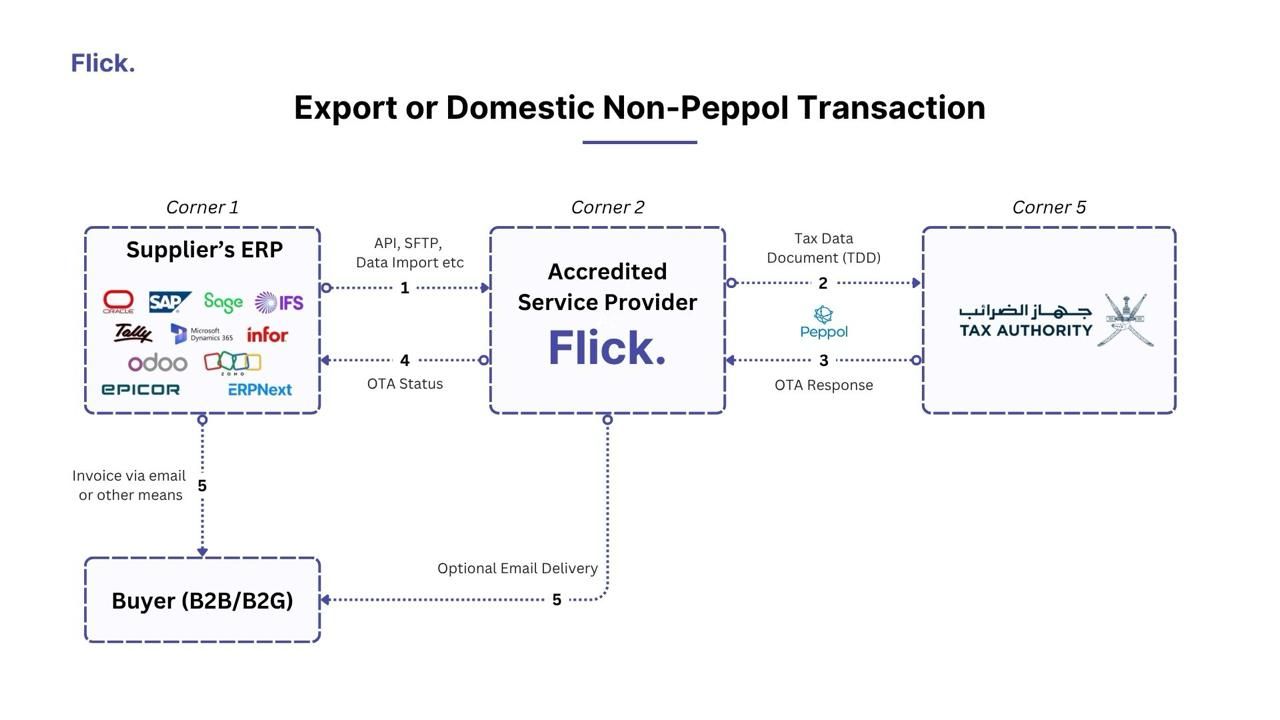
- Invoice generation: The supplier creates a structured XML invoice in PINT OM format from its ERP or billing software at the point of supply.
- Validation at Corner 2: The invoice is submitted to the supplier's OTA-accredited service provider, which validates it against the Oman Schematron rules and code lists.
- Network exchange at Corner 3: The validated invoice is passed to the buyer's accredited service provider through the Peppol network for onward delivery.
- Buyer receipt at Corner 4: The buyer receives the machine-readable, validated invoice for automated processing into its accounting system.
- OTA reporting at Corner 5: The supplier's service provider submits the Tax Data Document (TDD) to the OTA's Fawtara platform for tax reporting.
Taxpayers request a connection to an accredited service provider through the Fawtara Portal. A taxpayer can be linked to only one service provider at a time, and can disconnect and switch to another provider. For a deeper look at each corner, see our guide to the Oman Peppol five-corner model.
Fawtara E-Invoicing Model, Format, and Technical Specifications
- Model: Invoices move through OTA-accredited service providers under the five-corner model, and the OTA operates a centralised Peppol SMP that accredited service providers must use. Providers may not run their own SMP.
- Structure: E-invoices must be issued in structured XML, aligned with the PINT OM specification (version 1.0.1, released through OpenPeppol on 29 July 2026). The PINT OM standard sets out Oman-specific data structures, validation rules and exchange processes while remaining interoperable with the global Peppol network.
- Content: Each e-invoice must include the mandatory data covering buyer and seller details, VATINs, invoice number, issue date, line items, VAT rate and amount, and totals, all structured within a standardised schema for automatic validation.
- Security: Invoices are validated by the service provider against the Oman Schematron rules, and each invoice must carry a unique number (Article 143). A QR code is mandatory for B2C invoices, per the OTA's official FAQ, while guidance on UUID and invoice hash requirements has not been finalised.
E-Invoice Archiving in Oman
Invoice archiving is a legal obligation for all taxable persons in Oman. Under Article 70 of the VAT Law (Royal Decree No. 121/2020), taxable persons must keep tax invoices, accounting records, books and customs documents by secure and reliable means for 10 years following the end of the tax year in which the relevant VAT return was filed. Records relating to real estate must be kept for an extended period of 15 years. The OTA has confirmed that storing and archiving e-invoices is the taxpayer's responsibility, and it will not provide invoice information to taxpayers or service providers, so businesses cannot rely on the Fawtara platform as their archive.
What Format Must Archived Invoices Be In?
The OTA has not published a separate archiving format. E-invoices are issued in structured XML, and under amended Article 143 archived invoices must satisfy three conditions throughout the entire retention period:
- Authenticity of origin: The invoice must remain traceable to the issuing party for the full retention period.
- Integrity of content: The invoice data must be unchanged from the point of issuance through to the end of the retention period.
- Legibility: The invoice must remain readable throughout the entire archiving obligation.
What Oman E-Invoice Archiving Means for Business Systems
Archiving decisions touch system design, data ownership and long-term record integrity, not simply where files are stored after go-live. The following are the key considerations for any business building its archiving approach:
- Provider storage: The OTA sets no archiving duty for service providers. Where a provider offers storage, confirm its scope and duration in the contract.
- ERP integration: Archived invoice records must stay linked to the corresponding accounting entries in the ERP for VAT audit purposes. Invoices stored in isolation from their source transactions create reconciliation risk.
- Access controls and tamper-evidence: Access controls should protect archived data and demonstrate record integrity to auditors.
Fawtara E-Invoicing Exemptions and Special Cases
Oman's e-invoicing mandate carries no industry exceptions, and all VAT-registered businesses are expected to comply once their implementation date arrives. Current OTA guidance addresses the following specific situations and transaction types under the Fawtara mandate:
- Exempt and out-of-scope supplies: The OTA’s Fawtara FAQ (30 September 2026, section 1.3) states that e-invoices must be issued where VAT legislation requires an invoice. Businesses should therefore determine the invoicing obligation for each transaction under the applicable VAT rules
- Zero-rated supplies: These supplies fall within the full scope of the Fawtara e-invoicing mandate. Zero-rated supplies are taxable supplies under Article 1 of the VAT Law, and amended Article 143 requires an electronic tax invoice when making supplies, so invoices for zero-rated supplies must be issued electronically (interpretation of the law; no separate OTA statement).
- Self-billing and imports: Imports of goods and services are reported through self-billed e-invoices, where the buyer issues the invoice under the PINT OM Self-Billing specification (OTA guidance). Earlier OTA guidance also requires the bayan number to be recorded for imports of goods.
- Non-resident suppliers: Purchases from foreign suppliers do not all receive the same VAT treatment. Imported goods generally attract import VAT through customs, while qualifying imported services are subject to reverse charge by the Omani taxable buyer. Separately, OTA guidance requires imports of goods and services to be reported through self-billed e-invoices under Fawtara
- Historical invoices: Invoices issued before joining Fawtara do not need to be submitted to the OTA (OTA guidance).
Peppol/PINT Oman Technical Signals for Solution Design
Version 1.0.1 of PINT OM Billing, PINT OM Self-Billing and the Oman Tax Data Document was released through OpenPeppol on 29 July 2026. The table below outlines the key technical planning signals for solution design:
| Technical area | Planning signal |
| Core artefacts | PINT OM Billing, PINT OM Self-Billing and a separate Oman Tax Data Document |
| Exchange syntax | UBL-based XML with Peppol-style identifiers and endpoint addressing |
| Validation | Schematron business rules, including reconciliation of line, allowance, charge, tax and payable totals |
| Centralised SMP | Accredited providers use the OTA SMP rather than an independent SMP |
| Special scenarios | Oman code lists cover invoice transaction type, special economic and free zones, VAT categories, exemption and zero-rating reasons, profit-margin items, and credit and debit note reasons; each needs mapping in the ERP |
How to Generate E-Invoices in Oman
Generating compliant e-invoices in Oman involves considerably more than redesigning an invoice PDF template. The seller creates the invoice within an ERP or billing system capable of producing structured data, the invoice passes to an accredited service provider for validation and exchange, and the relevant tax data is reported to the OTA.
For export flows where the foreign customer sits outside the network, the supplier shares the invoice as under current practice, and tax data is reported through a reduced path of Corners 1, 2 and 5 (OTA guidance). See Oman e-invoicing for overseas customers. Businesses should also prepare document identifiers, transaction classification codes, buyer and supplier details, VAT registration data, line-level pricing and quantities, and reference data covering credit notes, self-billing, imports, exports, special zones and profit-margin transactions.
Oman E-Invoicing Implementation Checklist
Businesses should treat Oman e-invoicing as a cross-functional transformation across finance, tax, IT and sales, not a single IT initiative. The table below shows what the business's ERP and its accredited service provider are each responsible for:
| Area | Your ERP and business | Your accredited service provider |
| Invoice data | Maps master data and transactions to the PINT OM data model, including document identifiers, transaction classification codes, buyer and supplier details, VAT registration data and line-level pricing; issues invoices within 15 days | Not responsible for the accuracy of source data |
| Validation | Corrects and reissues rejected invoices; legal responsibility for invoice compliance stays with the taxpayer | Validates every invoice against the Oman Schematron rules before exchange |
| Exchange | Passes invoices to the service provider through the agreed integration | Delivers invoices to the buyer's service provider through the Peppol network |
| Tax reporting | No direct submission to the OTA | Reports the Tax Data Document to the OTA in the issuer or receiver role |
| Records and retrieval | Archives invoices for the statutory period, keeps them linked to accounting entries, produces them on request, and keeps the system secure and recoverable | No archiving duty set by the OTA; any storage the provider offers is a contractual service |
Existing ERP systems can be retained, depending on the arrangement with the accredited service provider. A business can also become its own service provider if it meets the OTA's accreditation criteria listed above and passes the required tests.
How Should Omani Businesses Prepare for E-Invoicing?
Businesses that wait until close to their implementation date will not have enough time for a clean implementation. The recommended preparation steps are:
- Confirm your deadline: Measure annual supplies against the OMR 5 million threshold, use the OTA rollout tool, and monitor OTA announcements for updates to the rules and specifications.
- Review current systems: Check whether the ERP, billing and point-of-sale systems can produce XML that meets the PINT OM data model and Schematron rules. The PINT OM specification is the starting reference for any gap assessment.
- Select and link an accredited provider: Choose an OTA-accredited service provider early and request the connection through the Fawtara Portal, allowing time for integration and testing before your date.
- Map scenarios and clean master data: Map every transaction type, including B2B, B2C, exports, imports, reverse charge, credit notes, self-billing and VAT group transactions, to the correct invoice process. Review VATINs, addresses, contact details and VAT rates before connecting.
- Plan archiving, continuity and training: Confirm how invoices will be archived for the statutory period, set controls for validation failures and system outages, and train finance, tax and IT teams on the new workflow. Qualified tax and legal advisors can confirm specific obligations before go-live.
Penalties for Non-Compliance With Oman E-Invoicing
OTA guidance confirms that penalties will apply according to regulations, though no penalty schedule specific to e-invoicing has been published. Businesses should not wait for one before starting readiness work, since non-compliance can also cause validation failures, counterparty disputes and delayed payment acceptance.
Existing VAT Law penalties continue to apply. Article 100 penalises intentionally failing to issue a required tax invoice, or intentionally failing to keep tax invoices for the required period, with imprisonment of 2 months to 1 year, a fine of OMR 1,000 to OMR 10,000, or both. Administrative penalties are set by the Executive Regulation under Article 103.
How Flick Network Supports Fawtara E-Invoicing Compliance in Oman
Flick Network is an OTA-accredited service provider in Oman, with an e-invoicing solution built to meet the data, format and transmission requirements of the Fawtara framework. The following capabilities show how Flick supports Fawtara compliance:
- ERP and System Integration: Flick connects to existing ERP and billing systems, so invoicing continues within current finance processes.
- Automated Data Validation: Invoice data is checked against the Oman Schematron rules before transmission, so errors surface before invoices reach the buyer.
- Peppol Exchange and Tax Reporting: Validated invoices are exchanged through the Peppol network, and the Tax Data Document is reported to the OTA.
- PINT OM Compliance: Invoices are generated in structured XML aligned with the PINT OM specification.
- Implementation Support: The Flick team works with finance and IT teams through integration, testing and go-live to keep implementation on schedule.
For full details on capabilities, integrations and onboarding, see the Flick e-invoicing solution for Oman.
Oman E-Invoicing: Important Government Resources
| Resource | Description |
| Decision 189/2026 | Amends the VAT Executive Regulation to require electronic tax invoices; sets the 1 April 2027 and 1 October 2027 implementation dates (Official Gazette 1660, 9 August 2026) |
| VAT Executive Regulation, Decision 53/2021 | Executive Regulation of the VAT Law, amended by Decision 189/2026 to introduce electronic tax invoicing |
| VAT Law, Royal Decree No. 121/2020 | Official VAT Law establishing the legal framework for VAT, tax invoices and record retention in Oman |
| Fawtara E-Invoicing Program, Official OTA Page | Primary OTA page covering the Fawtara programme, the five-corner model and programme updates |
| E-Invoicing FAQs, Official OTA | Official Q&As covering scope, timelines, invoice formats, archiving, VAT groups, B2C handling and service provider roles |
| Service Provider Criteria, Official OTA | Accreditation requirements for businesses seeking to become OTA-accredited service providers under Fawtara |
| Service Provider FAQ, Official OTA | Technical and operational FAQs for service providers and businesses evaluating provider options |
| Potential Rollout Checking, Official OTA | Enter the VATIN and current and expected annual taxable supplies to see the potential implementation period; for awareness and readiness only |
| PINT OM Specification, OpenPeppol | Version 1.0.1 (29 July 2026) of the PINT OM Billing, PINT OM Self-Billing and Oman Tax Data Document specifications: the technical reference for ERP teams, service providers and system integrators |
| Oman Government, Tax Authority Page | Official government portal page with Tax Authority guidelines, laws, regulations, decisions and contact details |
| Tax Authority Portal, English | Taxpayer portal to access services, submit returns, read manual guides and download compliance resources |
| Tax Authority News | Official announcements, including Fawtara programme updates and milestones |
| Fawtara Support, Official OTA | Official email for e-invoicing queries and support: fawtara@taxoman.gov.om |
Conclusion
Decision 189/2026 gives every VAT-registered business in Oman a fixed e-invoicing date: 1 April 2027 for annual supplies above OMR 5 million and 1 October 2027 for all others. Businesses that start now will have time to confirm their deadline, assess their systems, select an OTA-accredited service provider and complete PINT OM alignment without disruption. For implementation support and compliance guidance, contact the Flick Network team at sales@flick.network.
FAQs
Q1. When does e-invoicing become mandatory in Oman?
E-invoicing becomes mandatory on 1 April 2027 for VAT-registered businesses with annual supplies above OMR 5 million, and on 1 October 2027 for those with annual supplies of OMR 5 million or less. Both dates are set by Decision 189/2026, which imposes no obligation before 1 April 2027.
Q2. How does a business find out which Fawtara deadline applies?
A business must implement e-invoicing from 1 April 2027 if its actual supplies from 1 April 2026 to 31 March 2027, or its expected supplies from 1 April 2027 to 31 March 2028, exceed OMR 5 million. Otherwise, the deadline is 1 October 2027. Supplies include taxable supplies (excluding capital assets), reverse charge supplies and intra-GCC supplies. Non-residents count supplies made in Oman only, and VAT groups are assessed at group level.
Q3. Are B2C invoices covered by Fawtara?
Yes. B2C invoices follow the same implementation dates as B2B and B2G invoices and must be reported within 24 hours of issuance. Each B2C invoice needs a QR code on the human-readable copy, and consolidated B2C invoices are not allowed.
Q4. Is a PDF invoice a valid e-invoice in Oman?
No. The OTA states that a PDF invoice is not an e-invoice. Invoices must be issued in the prescribed structured XML format and validated by an OTA-accredited service provider.
Q5. Who is responsible for archiving e-invoices in Oman?
The taxpayer. Article 70 of the VAT Law requires tax invoices to be kept for 10 years, or 15 years for real estate records, and the OTA has confirmed it will not provide invoice data back to taxpayers or service providers.
Q6. Who are the e-invoice service providers in Oman?
E-invoice service providers in Oman are businesses accredited by the OTA to validate, exchange and report e-invoices on behalf of VAT-registered businesses under Fawtara. The OTA announces licensed providers, and accredited providers appear on the Fawtara Portal. Flick Network is an OTA-accredited service provider in Oman, offering PINT OM-compliant e-invoicing with ERP integration, automated validation and implementation support.
Quick Navigation
Book a Demo
Learn more by booking a demo with our team. We'll guide you step by step.