Oman E-Invoicing for VAT Groups: What OTA Confirms
Last updated at
November 11, 2026
Book a Demo
Learn more about this by booking a demo call with us. Our team will guide you through the process and answer any questions you may have.
Book NowHow VAT Groups Should Prepare for Oman E-Invoicing
Introduction
If your business belongs to a VAT group in Oman, you may have to start e-invoicing on 1 April 2027, six months before your own sales would require. The Oman Tax Authority (OTA) tests the OMR 5 million threshold on the group's combined supplies, not on each member. As a result, a member with much smaller sales can still be pulled into the earlier start date. For your finance team, this raises practical questions about which start date applies, which VATIN a member should use on each invoice, and who is responsible for what.
This guide explains what official guidance confirms about Oman e-invoicing for VAT groups under Fawtara, Oman's national e-invoicing system, flags the questions OTA has not answered, and ends with a preparation checklist.
Key Takeaways
Your VAT group must start e-invoicing on 1 April 2027 if its total supplies go above OMR 5 million in either of OTA's two test periods. Otherwise, it starts on 1 October 2027.
OTA assesses the threshold at group level, so a member's own sales do not set its start date.
Every e-invoice must be validated by the issuer's accredited service provider, and a PDF invoice is not an e-invoice.
An invoice can carry only one seller VATIN, and no PINT OM validation check refers to VAT group membership.
OTA has not yet said which VATIN a group member should use, so get written confirmation before you configure your systems.
When Does Oman E-Invoicing Start for VAT Groups?
Your VAT group starts e-invoicing on 1 April 2027 if its combined supplies exceed OMR 5 million under either of OTA's two tests. If neither test is met, the start date is 1 October 2027. OTA's Fawtara FAQ of 30 September 2026 sets out both dates and confirms the group-level approach. It states that for VAT groups, "the threshold is assessed at group level and not on a per-member basis." The two dates come from OTA Decision 189/2026, which amends the VAT Executive Regulations and was published in Official Gazette No. 1660 on 9 August 2026.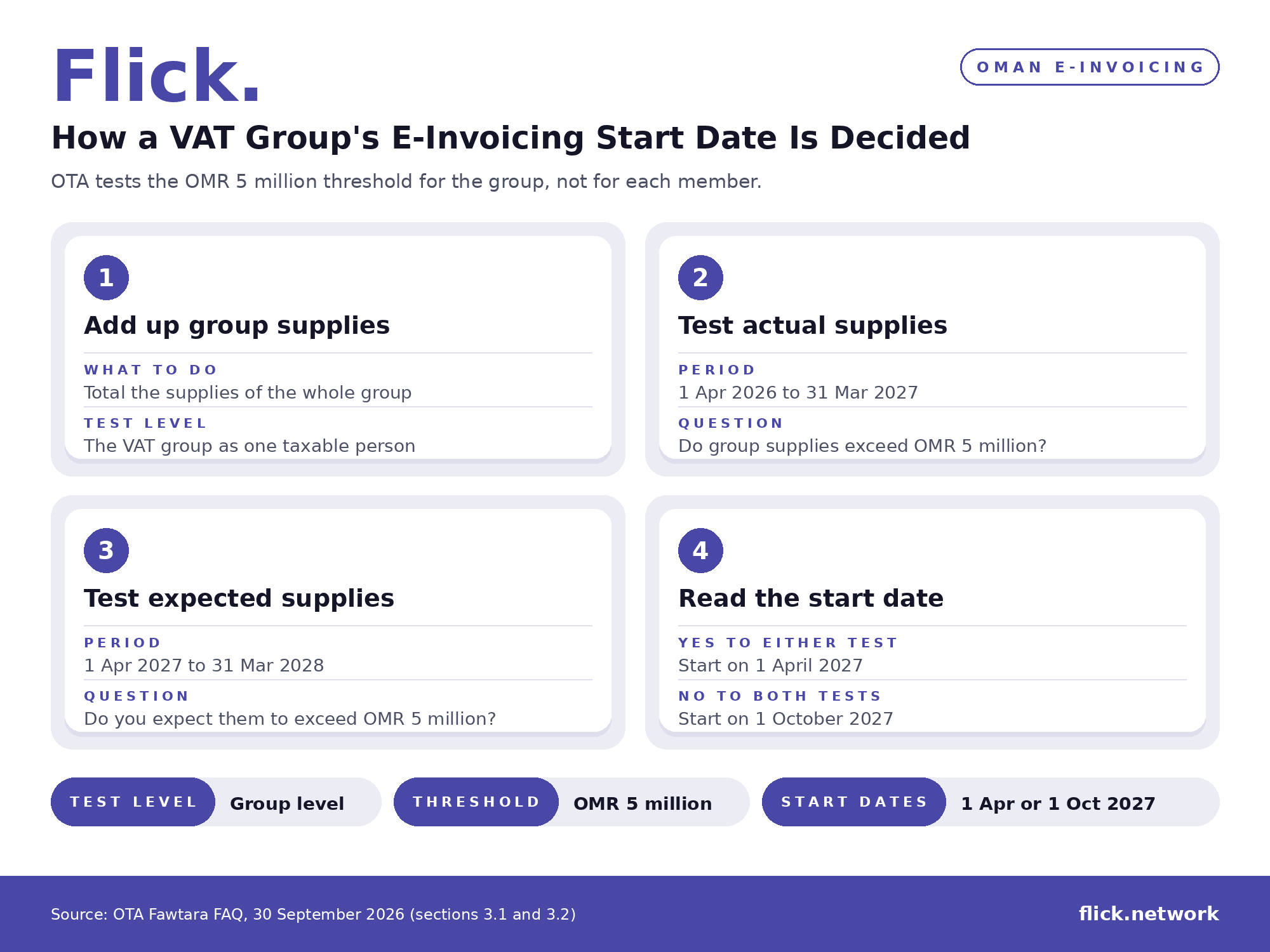
The group-level test reflects how the VAT Law treats a group. Under Article 58 of the VAT Law, a Tax Group is treated as a taxable person that is independent from all its members. It is therefore the group’s total that matters, not each member’s share. To calculate that total, include the group’s taxable supplies but exclude supplies of capital assets, goods and services subject to the reverse charge, and intra-GCC supplies. These are the group’s qualifying supplies. Using “combined supplies” without these exclusions could lead you to the wrong total. Here are the two tests the FAQ applies to that total:
Actual supplies: the group's supplies from 1 April 2026 to 31 March 2027 exceed OMR 5,000,000.
Expected supplies: the group's supplies expected from 1 April 2027 to 31 March 2028 exceed OMR 5,000,000.
Example: How a VAT Group's Start Date Moves to April 2027
Consider three Omani businesses that form a VAT group. Each made OMR 2 million in supplies to outside customers between 1 April 2026 and 31 March 2027, and each expects similar supplies the following year. The figures in this example are qualifying supplies. Tested alone, none of them would exceed OMR 5 million, so each would start e-invoicing on 1 October 2027.
Tested as a group, their supplies total OMR 6 million, so the whole group starts on 1 April 2027. This example is illustrative and leaves out supplies between members, because OTA has not said whether those count towards the threshold. If your group has significant intra-group supplies, raise the point with OTA before relying on your calculation.
How Are VAT Group Members Identified on an E-Invoice in Oman?
An e-invoice in Oman identifies the seller and the buyer by their VAT identification numbers (VATINs). Fawtara invoices follow PINT OM Billing v1.0.1, OpenPeppol's specification for Oman, and its Oman-specific validation checks make no reference to VAT group membership. Each invoice can carry only one seller VATIN, so your team needs to know which VATIN a member should enter when it invoices a customer. Flick's PINT OM specification guide explains the wider field structure.
Oman’s Peppol Authority Specific Requirements, section 1, state that VAT group members register on the Peppol network using their originally issued VATIN, not the group VATIN, under scheme 0248. This is the Peppol participant identifier, which identifies each member on the network. It is separate from the seller VATIN field on the tax invoice, so the participant rule alone does not decide every invoice field. Neither the specification nor OTA’s published guidance answers the invoice field question, which makes it the central open point for Oman VAT group invoicing. Ask OTA in writing before you configure your billing systems. For invoices between members, OTA’s FAQ gives one instruction: if e-invoices are issued for intra-group transactions, “the details on the e-invoice must follow the current practice.” Check how your current VAT invoices between members show these details, and use that format as your reference. The PINT OM checks that affect VAT group invoices are:
| Invoice element | What PINT OM requires | PINT OM check |
| Seller VATIN | Mandatory, except for certain import, reverse-charge and profit margin self-invoice types | IBR-006-OM |
| Number of seller VATINs | At most one per invoice | ALIGNED-IBRP-SR-12 |
| VATIN format | 12 characters: "OM" followed by ten digits | IBR-003-OM |
| Buyer identification | A buyer identifier or buyer VATIN for several types, including full tax and export invoices | IBR-016-OM |
| Self-billed invoices | Buyer VATIN mandatory | IBR-017-OM |
| VAT group details | No check refers to a tax group or VAT group | None |
Fawtara VAT Group Requirements: Who Is Responsible for What?
Fawtara VAT group requirements come from two places. The VAT Law (Articles 18 and 58) sets out how a group is treated and who carries its tax liability, while OTA's Fawtara FAQ sets the duties attached to each e-invoice. In practice, tax liability sits with the group and its members, QR codes sit with whoever issues the invoice, and validation sits with the issuer's accredited service provider.
Existing VAT guidance already makes the representative member responsible for the group’s tax obligations, while all members remain jointly and severally liable, so the group’s underlying responsibility is not in question. One gap in OTA’s guidance affects several of these Fawtara duties. The FAQ refers to the “taxpayer” without saying whether, for a VAT group, that means the group, the representative member or each member. The answer decides who connects to the service provider and who keeps the archive, so add it to your questions for OTA. The responsibilities confirmed by official sources are given below:
| Party | Responsibility | Official source |
| VAT group | Treated as a taxable person independent from all its members | VAT Law, Article 58 |
| Representative member | Responsible for the group’s tax obligations | VAT Executive Regulations, Article 128(1) |
| Each member | Jointly and severally liable for the group’s tax obligations that arise during its membership | VAT Law, Article 58 |
| Supplies between members | Not subject to VAT, except deemed supplies | VAT Law, Article 18(1) |
| Invoice issuer | Generates the QR code, which appears on the human-readable invoice and is mandatory for all B2C transactions | Fawtara FAQ, section 4.1 |
| Taxpayer | Stores and archives e-invoices as required by VAT legislation | Fawtara FAQ, sections 2.3 and 3.3 |
| Issuer's accredited service provider | Validates every e-invoice against the Oman schematron | Fawtara FAQ, sections 3.3 and 4.2 |
| Taxpayer | Connects to one service provider at a time through theFawtara Portal | Fawtara FAQ, section 6.1 |
Oman E-Invoicing Questions OTA Has Not Answered for VAT Groups
Decision 189/2026 does not mention VAT groups, and several practical questions about Oman e-invoicing for VAT groups have no published answer yet. Each one affects how your group configures its systems or connects to a service provider. Send these questions to OTA, keep the written replies on file, and avoid building your setup on an assumption in the meantime. Here are the open questions, and what the official guidance currently says about each:
Seller VATIN: PINT OM allows one seller VATIN and none of its validation checks mention VAT groups, and OTA has not said which VATIN a member should enter when it invoices an outside customer.
Service provider connection: OTA’s FAQ states that “taxpayers can connect with one Service Provider in a given moment” (FAQ 6.1). Because Oman’s Peppol requirements confirm that VAT group members register individually under their originally issued VATINs, each member is identified on the network at member level. OTA has not said whether a VAT group connects once or each member connects separately to a service provider.
Supplies between members: OTA's FAQ says that if these are e-invoiced, the details "must follow the current practice" (FAQ 3.2), but it does not say whether they must be e-invoiced.
Threshold test: OTA assesses the threshold at group level (FAQ 3.1 and 3.2), but it has not said whether supplies between members count towards the OMR 5 million test.
Membership changes: No guidance was found on how a member joining or leaving the group affects the start date, so this remains unanswered.
VAT Group Preparation Checklist for Oman E-Invoicing
Use this checklist to put the guidance on Oman e-invoicing for VAT groups into practice. Steps 1 to 4 settle the group's position, and steps 5 to 9 prepare the invoices themselves. OTA's FAQ encourages taxpayers to start testing their systems and issuing e-invoices before their mandate date, and starting early also gives you time to act on OTA's answers. Work through the steps below before your start date:
Run both threshold tests: Total the qualifying supplies (taxable supplies excluding capital-asset supplies, reverse-charge supplies and intra-GCC supplies) of all members for each test period, and keep the workings and the basis for your expected figures on file.
Record the start date: Note whether your group starts on 1 April 2027 or 1 October 2027, and which test decided it.
Name one coordinator: Choose one person to lead Fawtara work across all members and to own contact with OTA on group questions.
Send the open questions to OTA: Ask in writing about the seller VATIN, the service provider connection and supplies between members.
List every invoicing member: Record each member's VATIN, billing or ERP system, and the document types it issues, such as credit notes and self-billed invoices.
Choose an accredited service provider: Ask how the provider connects a VAT group with several invoicing members, given that a taxpayer can connect to only one provider at a time.
Map invoice data: Match each member's system fields to PINT OM, starting with the seller and buyer VATIN fields.
Test real transactions: Validate sales to outside customers, credit notes, any self-billed invoices and any invoices between members well before your start date.
Agree the archive: Decide where e-invoices, validation results and QR-coded human-readable invoices are stored, and which members can access them.
How Flick Network Helps with Oman VAT Group Invoicing
Flick Network is an OTA-accredited service provider in Oman, operating under the legal name Advanced Information Technology Company LLC. Its Oman e-invoicing solution supports steps 5 to 8 of the checklist, when each member's system is connected, mapped and tested. When you discuss your setup, bring your list of invoicing members, sample transactions between members and any written answers from OTA. Here are the Flick capabilities most relevant to a VAT group:
Accredited service provider: Flick validates and exchanges e-invoices as an OTA-accredited service provider within the Fawtara network.
System connection: Flick connects to the existing invoicing, billing, ERP or POS systems that each group member already uses.
Validation before submission: Flick checks invoice data against OTA technical and compliance requirements before each invoice is submitted to the Fawtara network.
Conclusion
Oman e-invoicing for VAT groups begins with one confirmed fact: OTA tests the OMR 5 million threshold on the whole group, so every member may have to start on 1 April 2027, even if its own sales are small. Because OTA has not yet said which VATIN a member should use on its invoices, the most practical step is to run both threshold tests now and put your open questions to OTA in writing. With your start date confirmed and those answers on file, your team can map each member's invoice data and test it well before the deadline. To discuss your VAT group's Fawtara setup, contact Flick Network at sales@flick.network.
Frequently Asked Questions
1. Does a VAT Group Below OMR 5 Million Still Need Oman E-Invoicing?
Yes. A group that meets neither threshold test must implement e-invoicing from 1 October 2027. The threshold decides when your group starts, not whether e-invoicing applies to it.
2. Can VAT Group Members Start E-Invoicing Before the Mandate Date?
Yes. OTA's Fawtara FAQ encourages taxpayers to start testing their systems and issuing e-invoices before their mandate date. Early testing also gives your group time to resolve open questions with OTA.
3. Is a PDF Invoice Enough for a VAT Group Member?
No. OTA states that "a PDF invoice is not an e-invoice," so members need structured invoices that follow PINT OM. Each e-invoice must also be validated by the issuer's accredited service provider.
4. Who Generates the QR Code on a VAT Group Member's Invoice?
OTA's FAQ states that the QR code is generated by the taxpayer issuing the invoice. It is required only on the human-readable invoice, not on the e-invoice itself, and it is mandatory for all B2C transactions.
5. Who Keeps E-Invoice Records in a VAT Group?
OTA’s FAQ places the responsibility for storing and archiving e-invoices on the taxpayer, in line with VAT legislation. Under existing VAT guidance, the representative member is responsible for the group’s tax obligations and all members remain jointly and severally liable. What OTA has not said is whether, for Fawtara purposes, the representative member or each member holds the e-invoice archive, so agree this internally and confirm it with OTA.
6. Can a VAT Group Change Its Service Provider?
Yes. A taxpayer may disconnect from one service provider and connect with another through the Fawtara Portal, but only one provider can be connected at a time. OTA has not said whether, for a VAT group, this applies to the group as a whole or to each member.
Quick Navigation
Book a Demo
Learn more by booking a demo with our team. We'll guide you step by step.