Oman E-Invoicing Self-Billing: Imports and Reverse Charge
Last updated at
November 10, 2026
Book a Demo
Learn more about this by booking a demo call with us. Our team will guide you through the process and answer any questions you may have.
Book NowOman E-Invoicing Self-Billing: Imports, Reverse Charge and Buyer-Issued Invoices
Introduction
Under Fawtara, the e-invoice for an import comes from the buyer, not the supplier. This is Oman e-invoicing self-billing, and the Oman Tax Authority (OTA) requires it for imported goods and services alike. The obligation starts on each business's Fawtara go-live date: 1 April 2027 for businesses with annual supplies above OMR 5 million, and 1 October 2027 for all other VAT-registered businesses. From that date, each import needs a self-billed e-invoice prepared from the buyer's own records.
Self-billing also covers domestic arrangements in which a buyer issues invoices on its supplier's behalf with OTA approval. Both cases use the same document types, but their legal basis, data requirements and tax treatment differ. This guide explains when each applies, how imports of goods and services differ, how reverse charge fits in, and what the official PINT OM specification requires.
What Is Self-Billing in Oman E-Invoicing?
Self-billing separates two roles that usually sit with the same party: issuing the invoice and claiming payment. The PINT OM Self-Billing specification, published by OpenPeppol for Oman, assigns them as follows: the customer acts as the invoice issuer and sender, and the supplier acts as the invoice receiver. The supplier remains the taxable party and the creditor, even though it did not create the document.
The specification uses the same data model as PINT OM Billing, with additional constraints for self-billing. It supports two document types: the self-billed invoice (code 389) and the self-billed credit note (code 261).
Supplier-Issued vs Buyer-Issued E-Invoices in Oman
The table below compares a standard e-invoice with a document issued under Oman e-invoicing self-billing:
| Point of comparison | Supplier-issued e-invoice | Buyer-issued self-billed document |
| Who issues and sends it | The supplier (seller) | The customer (buyer) |
| Who receives it | The customer | The supplier |
| Document type codes | Tax invoice (380) and credit note (381) | Self-billed invoice (389) and self-billed credit note (261) |
| Official specification | PINT OM Billing | PINT OM Self-Billing |
| Taxable party | The supplier | The supplier, except where reverse charge makes the customer liable |
| Typical use | Ordinary sales of goods and services | Agreed self-billing arrangements and imports |
When Does Self-Billing Apply in Oman?
Self-billing in Fawtara has two triggers. The first is a choice: an Omani buyer and its supplier agree that the buyer will issue the invoices. The second is not: the business imports goods or services.
The OTA sets this out in two places. Its Fawtara FAQ states that taxpayers shall report imports with self-billing, and its Service Provider FAQ states that self-billed invoices must be raised for imports of goods and services.
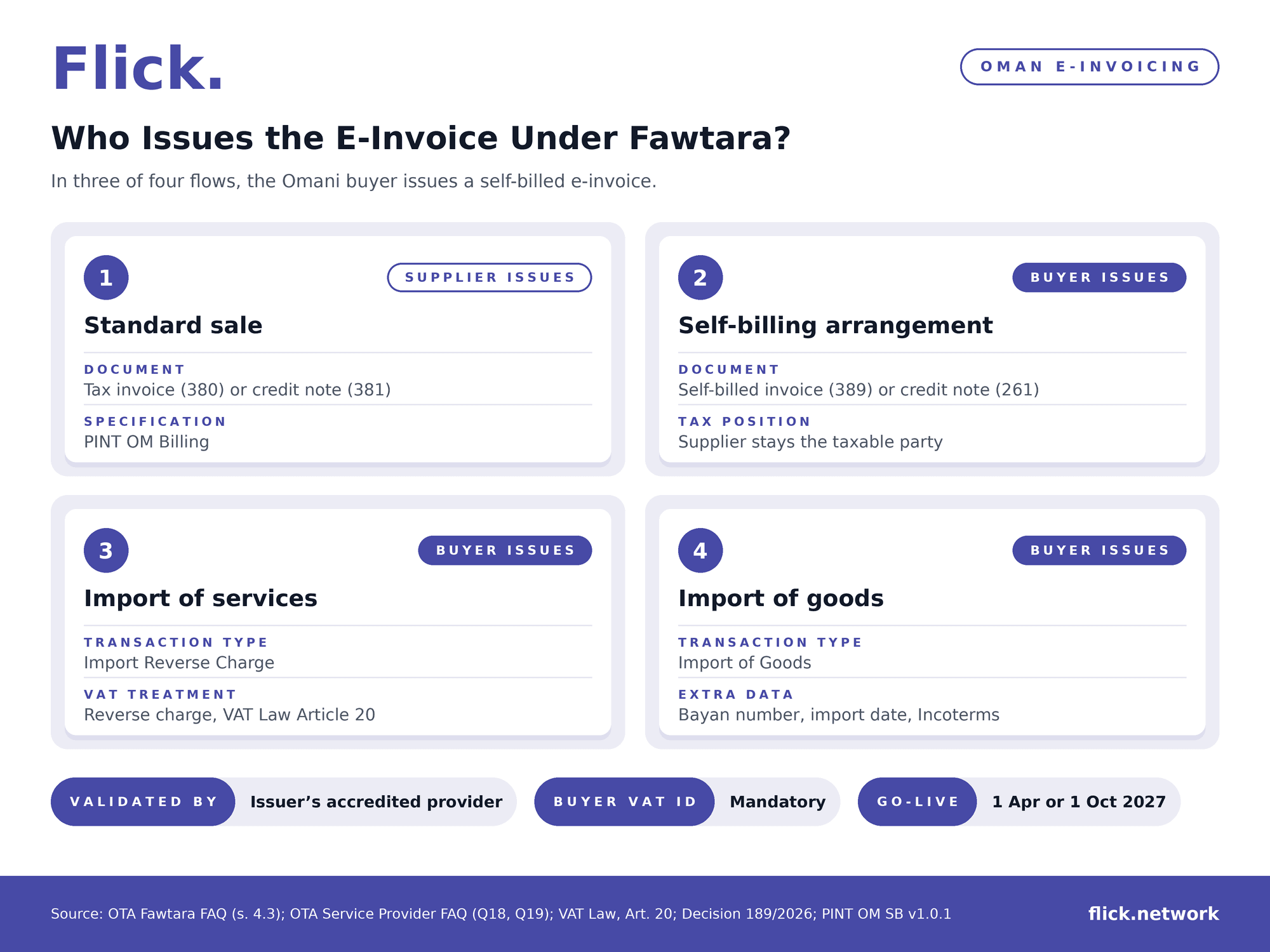
The buyer issues the e-invoice in the following three situations:
Self-billing arrangements: The buyer issues the self-billed invoice (389) on behalf of a supplier under a written agreement approved by the OTA.
Imports of services: The Omani recipient issues a self-billed e-invoice for services from a supplier with no place of residence in any GCC state, taxed under the reverse charge mechanism.
Imports of goods: The Omani importer issues a self-billed e-invoice for goods cleared through customs, with the customs data added to the document.
Self-Billing Arrangements With Omani Suppliers
In a domestic Oman e-invoicing self-billing arrangement, the buyer prepares the invoice data that the supplier would normally prepare. The supplier receives the self-billed invoice instead of sending one, and reviews and approves it to confirm that it correctly reflects the underlying transaction.
The VAT Law allows a tax invoice to be issued by a third party on behalf of the taxable person once the OTA approves (Article 67). Here are the conditions that Articles 153 and 154 of the VAT Executive Regulation set:
OTA approval: The supplier applies on the OTA’s form with a copy of the agreement. The OTA decides within 15 days, and an application not decided in that time is treated as rejected.
Taxable customer: The party issuing the invoices must be a taxable customer.
Written agreement: The buyer and the supplier sign a written agreement that describes which supplies it covers.
One invoice per supply: The supplier does not issue its own tax invoice for the same supply.
Tax liability statement: Each invoice states that the supplier is liable to pay any tax due on the supply.
Copy and supplier approval: The buyer provides the supplier with a copy of each self-billed invoice, and the supplier approves it.
Ending the arrangement: Either party can end it by written notice, and each must tell the other if it stops being registered for VAT.
Fawtara keeps this separate from agent invoicing. PINT OM does not allow the Self-Billed type to be combined with the Third Party type, so an invoice issued through an agent is not a self-billed document.
How a Reverse Charge E-Invoice Works in Oman
Reverse charge moves the tax obligation from the supplier to the customer. Under the Oman VAT Law, the taxable customer pays the tax in place of the supplier and takes on the related obligations.
Article 20 applies it in two cases. A taxable person that receives services from a supplier with no place of residence in any GCC state is treated as if it had supplied those services to itself. The same treatment applies to goods or services received from a supplier resident in another GCC state. However, OTA guidance states that this intra-GCC provision is not currently applied, because other GCC states are treated as non-implementing states. Goods arriving from those states follow import treatment, and qualifying services follow reverse charge. The customer pays the tax as the recipient under Article 81, and it can deduct the related input tax under Article 41 where the usual conditions are met.
Fawtara adds a document to this process. The OTA states that self-billed e-invoices must be issued for reverse charge transactions, and that a specific transaction type exists for them. In PINT OM, that type is Import Reverse Charge, added to a full or simplified base type. Every Oman reverse charge e-invoice is therefore a buyer-issued document, prepared from the business's own purchase records.
Fawtara Import Invoices: Goods vs Services
Imports of goods and imports of services both fall under Oman e-invoicing self-billing, but the VAT behind them works differently. Import of goods means goods entering Oman from outside the GCC under the Common Customs Law, and, for now, goods arriving from other GCC states such as the UAE, because those states are treated as non-implementing states. Businesses should therefore not exclude imports from GCC countries when identifying import invoices. The tax is due on the date of import or of entry at the first point of entry. The Directorate General of Customs collects it, although a taxable person may request to defer payment until the VAT return for the period of import.
Imported services have no customs step, so the tax arises through reverse charge instead. For goods, the OTA also asks businesses to report the bayan number, so Fawtara import invoices for goods carry customs data that service imports do not.
The table below separates the two types of Fawtara import invoices:
| Point of comparison | Import of goods | Import of services |
| Legal basis for VAT | VAT Law, Articles 12(3), 25 and 29 | VAT Law, Articles 12(2) and 20 |
| How the VAT is paid | Collected by customs at import, or deferred to the VAT return on request (Articles 84 and 86) | Accounted for by the Omani recipient under reverse charge (Article 81) |
| Taxable value | Customs value plus taxes and charges due on import (Article 34) | Value of the consideration without the tax (Article 31) |
| PINT OM transaction type | Import of Goods (position 13) | Import Reverse Charge (position 9) |
| Extra mandatory data | Import date (BTOM-020), customs declaration number (BTOM-021) and Incoterms (BTOM-022) | No customs data required |
| Combination not allowed | Import of Goods with E-Commerce | Import Reverse Charge with Export |
Self-Billing Examples for Omani Businesses
The following examples show how Oman e-invoicing self-billing works in practice, using assumed figures for illustration. Each assumes the business is VAT-registered, live on Fawtara and linked to an accredited service provider.
Example 1: Consulting Services From a UK Supplier
A Muscat trading business engages a UK consulting firm, which has no place of residence in any GCC state, for a project worth OMR 10,000. Under Article 20, the business is treated as supplying the service to itself. It accounts for OMR 500 of output tax at 5% and claims the matching input tax where the deduction conditions are met.
Its ERP raises a self-billed e-invoice with the Import Reverse Charge type and the business's own VAT number as buyer. Its accredited service provider then validates the document against the Oman schematron.
Example 2: Machinery Imported From Germany
A Sohar manufacturer imports machinery from Germany with a customs value of OMR 20,000 and assumed import duties of OMR 1,000. Under Article 34, the taxable value is OMR 21,000 and the VAT is OMR 1,050.
The manufacturer pays this VAT at customs, or defers it to its VAT return where its request meets the conditions under Article 86. Its self-billed e-invoice uses the Import of Goods type and carries the bayan number, the import date and the agreed Incoterms code, such as CIF.
Example 3: Domestic Self-Billing for Scrap Metal
A Nizwa recycling business buys scrap metal from a VAT-registered Omani supplier. Because the recycler weighs and grades every load at its own yard, the two parties sign a written agreement for the recycler to issue the invoices, and the supplier obtains OTA approval for the arrangement.
Each month, the recycler issues self-billed invoices (389) that show the supplier as the seller and state that the supplier is liable for the tax due. The supplier reviews and approves each one against its delivery records. When a grading error is found later, the recycler issues a self-billed credit note (261) that references the original invoice.
Example 4: Re-Exporting Imported Goods
Self-billing can matter again when imported goods leave Oman. Where the reason for zero-rating an export is re-export, the export invoice must reference the original self-billed invoice issued when the goods were imported.
PINT OM requires both the reference number and the UUID of that import document. Use the dummy UUID only when the referenced import invoice was issued outside the e-invoicing system before mandatory implementation and has no valid UUID. If a valid UUID exists, use it.
What the PINT OM Self-Billing Specification Requires
PINT OM Self-Billing sets the data every self-billed document must carry, and the Oman schematron rejects documents that break these rules. Finance and IT teams can check the following points before go-live:
| What to check | What PINT OM Self-Billing requires |
| Specification identifier | CustomizationID urn:peppol:pint:selfbilling-1@om-1 with ProfileID urn:peppol:bis:selfbilling |
| Document type | 389 for self-billed invoices and 261 for self-billed credit notes |
| Transaction type (BTOM-001) | A 20-character code with a full or simplified base type plus the applicable subtypes, such as Self-Billed, Import Reverse Charge or Import of Goods |
| Invoice UUID (BTOM-002) | A valid version 5 UUID on every document |
| Buyer VAT ID | Mandatory for self-billed, import and reverse charge transactions |
| Seller details | Mandatory, except for the Import of Goods, Import Reverse Charge and Profit Margin Self-Invoice types |
Correcting a Self-Billed E-Invoice With a Credit Note
An issued e-invoice cannot be edited, so any adjustment is made through an electronic credit or debit note. For a self-billed invoice, the correcting document is the self-billed credit note (261).
The credit note must carry the original invoice ID, issue date and UUID, with a reason code where applicable. All monetary values in PINT OM must be zero or above, so a self-billed invoice is reversed through a credit note rather than a negative invoice. Where the original document was issued outside the e-invoicing system before go-live, the dummy UUID 00000000-0000-0000-0000-000000000000 replaces the missing value. Where a valid UUID exists, the actual UUID must be used.
Fawtara Go-Live Dates for Self-Billed E-Invoices
Oman e-invoicing self-billing follows the same rollout as every other Fawtara document. Under Tax Authority Decision No. 189/2026, which amends the VAT Executive Regulation, businesses whose annual supplies exceed OMR 5 million go live on 1 April 2027, and all other VAT-registered businesses go live on 1 October 2027.
The OTA expects each taxpayer to be integrated with its accredited service provider on or before its go-live date. Every self-billed e-invoice in Oman, including import and reverse charge documents, therefore needs a working flow by that date. The threshold test and full timeline are covered in the Oman e-invoicing guide.
How Flick Network Helps With Oman E-Invoicing Self-Billing
Flick Network supports businesses preparing for Oman e-invoicing self-billing through the following capabilities:
OTA-accredited service provider in Oman: Flick is accredited for Oman e-invoicing under its legal name, Advanced Information Technology Company LLC, and reports the tax data to the OTA on your behalf.
Certified Peppol Access Point: Flick holds Peppol Access Point certification for exchange across the Oman 5-corner model.
ERP integration: Flick's in-house integration team connects your existing ERP to the Fawtara network through standard APIs and maps invoice data to PINT OM.
Validation, status and error tracking: Flick validates invoice data, including self-billed and import documents, before transmission and returns statuses and error details, so your finance team can correct and resubmit.
Security and continuity: Flick holds ISO/IEC 27001:2022 and ISO 22301:2019 certifications.
Conclusion
Oman e-invoicing self-billing puts invoice issuance in the buyer's hands, whether through an OTA-approved domestic arrangement or through an import. Imports of services follow the reverse charge mechanism, while imports of goods add customs data. With Fawtara go-live on 1 April or 1 October 2027, finance and IT teams can use the time ahead to map these purchase flows in the ERP and test each document. To discuss an Oman e-invoicing solution, contact Flick Network at sales@flick.network.
Frequently Asked Questions
1. Does a Foreign Supplier Need to Join Fawtara?
Not for the import itself. The Fawtara FAQ places the reporting of imports on the Omani taxpayer, who reports each one with self-billing. The self-billed e-invoice is prepared in the Omani buyer's system and validated by the buyer's own accredited service provider.
2. Does Self-Billing Shift VAT Liability to the Buyer?
Not in a domestic arrangement. The VAT Executive Regulation requires each self-billed invoice to state that the supplier is liable to pay any tax due, and PINT OM keeps the supplier as the taxable party. The tax position changes only when the purchase itself falls under reverse charge, such as services bought from a non-resident supplier.
3. Who Validates a Self-Billed E-Invoice in Oman?
Every e-invoice must be validated by the issuer's accredited service provider, and under Oman e-invoicing self-billing the issuer is the buyer. Responsibility for a non-compliant invoice still stays with the taxpayer, even though the service provider runs the schematron validation.
4. Can Exports Be Self-Billed in Oman?
No. PINT OM does not allow the self-billed type to be combined with the export type. For an export, the supplier shares the invoice with the overseas customer under its current process, while the tax data flows from the supplier to its service provider and then to the OTA.
5. Can a Self-Billed E-Invoice Be Issued in a Foreign Currency?
Yes. The VAT Law allows a tax invoice in Omani rials or any other currency, but the tax must be calculated in Omani rials, using the average rate published by the Central Bank of Oman on the tax due date. In PINT OM, an invoice in another currency must also carry the exchange rate, with up to 7 decimal places, and show the VAT amount in OMR.
6. Which PINT OM Self-Billing Version Applies?
Version 1.0.1 is the current version on the OpenPeppol Oman site, released with PDK 1.4.4 on 29 July 2026. It covers two transactions, the self-billed invoice and the self-billed credit note, and each has its own data model, code lists and schematron.
Quick Navigation
Book a Demo
Learn more by booking a demo with our team. We'll guide you step by step.