Oman Peppol 5-Corner Model: How E-Invoicing Works
Last updated at
September 8, 2026
Book a Demo
Learn more about this by booking a demo call with us. Our team will guide you through the process and answer any questions you may have.
Book NowOman Peppol 5-Corner Model: How Peppol E-Invoicing Works in Oman
Oman's Fawtara e-invoicing system becomes mandatory from 1 April 2027 under Decision No. 189/2026. Under this system, businesses in Oman no longer exchange invoices directly with their buyers. Instead, Fawtara follows the Oman Peppol 5-corner model, where accredited service providers validate each invoice and route it to the buyer, while reporting the tax data to the Oman Tax Authority. The model gives businesses a standardised route for invoice exchange that meets Omani technical and legal requirements.
Key Takeaways
The Oman Tax Authority is a registered Peppol Authority and governs the national e-invoicing network under Fawtara.
The five corners are the seller, the seller's service provider, the buyer's service provider, the buyer and the Tax Authority.
Businesses cannot connect directly to the Tax Authority and must exchange e-invoices through an accredited service provider.
XML is the mandatory structured format in Oman, and a conventional PDF invoice does not qualify.
A QR code is mandatory for every B2C transaction and is generated by the taxpayer at Corner 1.
B2B e-invoices are submitted in real time, while B2C transactions carry a 24-hour submission window.
Electronic tax invoices become mandatory from 1 April 2027 and 1 October 2027 under Decision No. 189/2026
What Is the Peppol 5-Corner Model in Oman?
Fawtara uses the Peppol network for invoice exchange, in the same way as several other markets. However, Oman introduces one important change to the standard four-corner arrangement used elsewhere. The Oman Tax Authority joins the exchange as a fifth participant, which is why the framework is called the Peppol 5-corner model.
That additional participant is what creates continuous transaction control across the Omani network. In a conventional Peppol network, two trading parties exchange documents through two certified access points, and the tax authority inspects the records much later. In Oman, transaction data reaches the Authority at the same time the commercial document travels to the buyer.
The Tax Authority describes the model as an internationally recognised structure for secure and standardised invoice exchange between businesses, service providers and the Authority. The same network carries B2B, B2C and B2G documents once each rollout takes effect. The Authority has also confirmed that no industry exceptions apply, so every taxable person complies according to its own date.
Oman Peppol E-Invoicing Framework and the Peppol Authority
The Oman Tax Authority appears on the official OpenPeppol register of Peppol Authorities, listed against the Fawtara e-invoicing project. As the national Peppol Authority, it accredits every service provider on the network and applies its own criteria above Peppol certification. It also publishes the national specifications through OpenPeppol, which is why the Omani documentation sits on the official Peppol documentation site rather than a separate portal, and it monitors provider performance and acts where compliance requirements are not met.
The Tax Authority operates a single centralised Service Metadata Publisher for the whole network, and it controls that directory in a way that differs from most Peppol countries. Accredited service providers may not run or maintain a Service Metadata Publisher of their own, which keeps every lookup on the network under one authority.
How Does Peppol Work in Oman?
Peppol is not a government portal or a software product supplied by the Tax Authority. It is a network and specification framework, implemented by certified service providers, where documents move directly between access points rather than through a central store. Every participant carries an identifier made up of an identification scheme and a unique value, and routing depends on it.
The Service Metadata Publisher records what each participant can receive, while the Service Metadata Locator points senders to the correct publisher. Security sits at the transport layer, so access points are certified before joining and communication stays encrypted throughout. OpenPeppol issues the certificates that make this possible, and in Oman the Publisher interfaces authenticate over mutual TLS.
The Five Corners of Peppol E-Invoicing in Oman
The Oman Tax Authority assigns each of the five corners a specific function in the exchange:
| Corner | Party | Responsibility |
| Corner 1 | Seller or invoice issuer | Produces the invoice data from the billing system and generates the QR code |
| Corner 2 | Seller's accredited service provider | Creates the PINT OM compliant e-invoice, validates it and transmits it onward |
| Corner 3 | Buyer's accredited service provider | Receives the e-invoice, delivers it to the buyer and reports the reception |
| Corner 4 | Buyer or invoice receiver | Receives the e-invoice in the format agreed with its service provider |
| Corner 5 | Oman Tax Authority | Receives the Tax Data Document reporting the issued and the received invoice |
The Invoice Exchange Process Under Oman's Peppol 5-Corner Model
Every invoice issued under Fawtara generates two documents that move in parallel across the network, one commercial and one regulatory. The PINT OM documentation sets out the exact sequence in which both are created and transmitted:
The seller at Corner 1 passes invoice data to its service provider in the format agreed between them.
Corner 2 creates a PINT OM compliant e-invoice and validates it against the Omani Schematron requirements.
Corner 2 transmits the e-invoice across the Peppol network to the buyer's service provider at Corner 3.
Corner 2 also creates a Tax Data Document reporting the issued invoice to the Tax Authority.
Corner 3 forwards the invoice to the buyer at Corner 4 in the agreed format.
Corner 3 then submits its own Tax Data Document reporting reception of that same invoice.
Peppol 4-Corner Model Compared With the Oman Peppol 5-Corner Model
Businesses already exchanging documents over Peppol elsewhere will recognise most of the structure. The table below sets out what changes once the fifth corner applies:
| Aspect | Peppol 4-corner model | Oman Peppol 5-corner model |
| Parties involved | Seller, two access points and buyer | Seller, two accredited service providers, buyer and Tax Authority |
| Tax authority role | No participation in the document exchange | Receives tax data alongside the commercial exchange |
| Documents carried | Commercial documents such as invoices and credit notes | Commercial documents plus a separate Tax Data Document |
| Reporting model | Post-audit inspection at a later date | Continuous transaction control close to the point of supply |
| Provider approval | Peppol certification through OpenPeppol | Peppol certification plus accreditation by the Oman Tax Authority |
| Service Metadata Publisher | Operated by individual service providers | Operated centrally by the Oman Tax Authority |
PINT-OM Specification for Peppol E-Invoicing in Oman
The Peppol 5-corner model only works if every participant follows the same technical standard. If businesses exchanged invoices in formats of their own choosing, the network could not route or validate anything. For this reason, Oman has adopted PINT-OM, the Omani specialisation of the Peppol International model for billing, published by OpenPeppol.
PINT-OM defines the semantic data model, the syntax binding, the code lists and the Schematron validations applied to Omani documents. Three specifications make up the current set, covering PINT OM Billing, PINT OM Self-Billing and the Oman Tax Data Document Process. XML is the mandatory structured format under the framework, and a conventional PDF invoice does not qualify as an e-invoice.
PINT-OM sets a fixed identifier for each document type, shown in the table below:
| Element | Value under PINT-OM |
| Invoice and credit note specification identifier | urn:peppol:pint:billing-1@om-1 |
| Invoice and credit note business process | urn:peppol:bis:billing |
| Tax invoice | Document type code 380 |
| Credit note | Document type code 381 |
| Self-billing invoice | Document type code 389 |
| Self-billing credit note | Document type code 261 |
| VAT accounting currency | OMR, with an exchange rate required for other invoice currencies |
| Standard rated supplies | VAT category S, applied at the 5% VAT rate |
Peppol BIS Billing and PINT-OM in Oman
Peppol BIS Billing defines the structure, the data elements and the business requirements for invoices exchanged on the network. Oman follows the billing business process, carried in each document as urn:peppol:bis:billing, but applies the PINT-OM specialisation rather than the European billing profile.
This distinction matters most for multinational groups running a single invoicing template across several markets. A document built to a European specification identifier will fail validation in Oman, even though the underlying business process is the same.
PINT-OM Validation Requirements for Omani E-Invoices
Oman adds validation rules on top of the base PINT specification, covering the transaction bitmap, UUID formats and VAT treatment described below:
The transaction type is a 20-character bitmap that drives conditional requirements and the applicable VAT treatment.
Position one marks a full tax invoice and position two marks a simplified invoice, one of which must apply.
Certain combinations are rejected outright, including self-billed with third party and export with import reverse charge.
The invoice UUID must be a version 5 identifier, generated deterministically from a namespace and a name.
The seller UUID may be either a version 4 or a version 5 identifier.
VAT categories E, O and Z must always carry a VAT amount of zero across the document.
Import transactions must carry the customs declaration number, the import date and the applicable Incoterms.
Amounts follow a three-decimal Baisa model, with document-level VAT amounts expressed at two decimals.
Oman Tax Data Document in the Peppol 5-Corner Model
The Tax Data Document is the report that reaches Corner 5 in every in-scope transaction. It is a regulatory document submitted to the Tax Authority for VAT reporting under continuous transaction control, and it is never exchanged between the invoice issuer and the invoice receiver. Either the issuer or the receiver may submit it, depending on the reporting obligation.
One consequence of that separation is easily missed during an implementation project. Delivering the commercial invoice successfully does not discharge the reporting obligation, and submitting the report does not replace delivery of the invoice. The two flows run alongside each other and are tracked separately by service providers.
The report is built on its own schema, published under the namespace urn:peppol:schema:om-taxdata:1.0, and carries the specification identifier urn:peppol:taxdata:om-1. It may also be transmitted at a different time from the invoice itself. The specification divides each Tax Data Document into the three sections listed below:
Metadata identifying the specification, the parties, the dates and the reporting role of the sender.
Key data values extracted from the reported invoice for tax reporting and compliance purposes.
The full reported invoice, included as extended XML without any embedded attachment content.
Peppol Access Point Accreditation Requirements in Oman
A Peppol access point is a certified service provider that connects a business to the network. In Oman, it also needs accreditation from the Tax Authority in addition to Peppol certification, because it carries tax reporting to Corner 5 on the taxpayer's behalf. Taxpayers may connect with any accredited access point from the current list published on the Fawtara Portal. A business that meets the criteria and passes the prescribed tests may also be accredited and act as its own service provider.
Accreditation depends on the following criteria published by the Oman Tax Authority:
Commercial registration in mainland Oman covering at least two activities related to information technology services.
Paid-up capital of at least OMR 6,000, evidenced by audited financial statements or commercial registration.
At least two years of operational experience, reduced to one year for Riyada card holders.
A notarised declaration confirming no bankruptcy, insolvency or criminal proceedings against the applicant business.
Confirmation that the applicant is not subject to a tax debt collection process in Oman.
A technical design document covering architecture, hosting location, backup arrangements and retention policy.
Multifactor authentication, encryption at rest, encryption in transit and continuous security monitoring evidence.
A valid ISO/IEC 27001 certificate covering the information security management system of the applicant.
Successful completion of the eDelivery Test Suite and the PINT OM Test Suite on the Peppol Testbed.
Local Presence Requirements for Peppol Service Providers in Oman
Providers based outside the Sultanate cannot serve Omani taxpayers without a local presence. The Tax Authority allows three routes into the Omani market, as set out below:
Establishing a subsidiary company registered in Oman under the required commercial activities.
Establishing a branch of the existing business within the Sultanate of Oman.
Appointing a local distributor whose legal base is established inside the Sultanate of Oman.
Submission Timelines and QR Code Requirements Under Peppol Oman
Fawtara applies distinct requirements to B2B and B2C transactions, covering both submission timelines and QR code obligations. The table below sets out the exact positions confirmed by the Oman Tax Authority:
| Requirement | Position confirmed by the Oman Tax Authority |
| B2B submission timing | Real time, through the accredited service provider network |
| B2C submission timing | A 24-hour window applies for submission of the tax data |
| B2C start date | Implemented at the same time as B2B and B2G transactions |
| QR code generation | Generated by the taxpayer at Corner 1 rather than the provider |
| QR code placement | Required on the human-readable invoice and not on the e-invoice |
| QR code scope | Mandatory for all B2C transactions, whether full or simplified |
| Consolidated invoices | Not allowed for B2C, as each transaction needs a separate e-invoice |
| Archiving responsibility | Held by the taxable person under the existing VAT legislation |
Special Transactions Under the Oman Peppol 5-Corner Model
Not every transaction travels the full five-corner route from start to finish. The variations arise wherever one party sits outside the network, and the Tax Authority has clarified the main scenarios: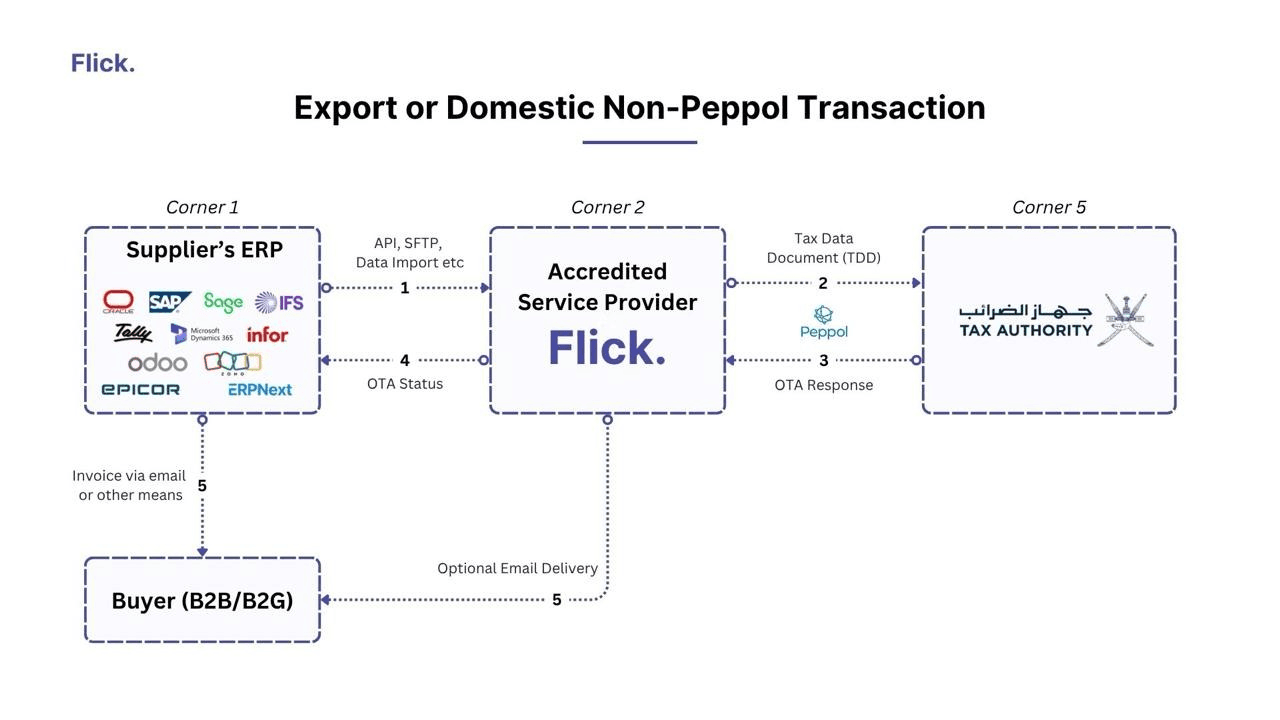
Export transactions follow a shortened route of Corner 1 to Corner 2 to Corner 5 only.
B2C sales where the buyer holds no service provider require tax data submission to Corner 5 alone.
Imports of goods and of services are reported through self-billed invoices raised by the Omani taxable person.
Reverse charge transactions also require a self-billed e-invoice, using the transaction type reserved for that scenario.
Where a supplier has not yet reached its rollout date, existing invoicing arrangements may continue between both parties.
Adjustments after issuance are made by issuing an electronic credit note or debit note.
Historical invoices issued before the mandate do not need to be submitted to the Tax Authority.
Oman Peppol E-Invoicing Deadlines Under Decision No. 189/2026
The Oman Tax Authority describes an earlier four-phase rollout that began in August 2026. Decision No. 189/2026 has since replaced those phases with the two deadlines below:
| Category of taxable person | Mandatory compliance deadline |
| Annual supplies exceeding OMR 5,000,000 | 1 April 2027 |
| Annual supplies not exceeding OMR 5,000,000 | 1 October 2027 |
How the OMR 5 Million Threshold Applies in Oman
The OMR 5 million threshold decides which deadline applies to each business, based on its own annual supplies rather than a cohort assigned by the Authority. The Tax Authority has published the following basis for that calculation, which every business can apply itself:
The key reference point is the total value of annual supplies as measured at 31 March 2027.
Compliance starts on 1 April 2027 where supplies from 1 April 2026 to 31 March 2027 exceed OMR 5,000,000.
The same date applies where supplies expected between 1 April 2027 and 31 March 2028 exceed that figure.
The calculation covers taxable supplies excluding capital assets, reverse charge transactions and intra-GCC supplies.
For VAT groups the threshold is assessed at group level rather than per member.
Non-resident taxable persons calculate the threshold using supplies made within the Sultanate of Oman only.
Penalties for E-Invoicing Non-Compliance in Oman
Decision No. 189/2026 attaches no penalty schedule of its own, and the Tax Authority has stated that penalties apply under the VAT legislation once the mandate begins. The obligations to issue a tax invoice and to retain records already sit in the VAT Law itself.
Article 100 of the VAT Law, promulgated by Royal Decree No. 121/2020, sets out the general penalties for invoicing and record-keeping failures, which would apply to e-invoicing non-compliance in the same way:
| Offence or obligation under the VAT Law | Consequence or period |
| Deliberately refraining from issuing a tax invoice when required | Imprisonment of two months to one year, a fine of OMR 1,000 to OMR 10,000, or both |
| Deliberately failing to retain tax invoices and documents for the required period | Imprisonment of two months to one year, a fine of OMR 1,000 to OMR 10,000, or both |
| Repeat offences | The court may double the prescribed penalty on recurrence |
| Retention period under Article 70 | Ten years from the end of the tax year in which the return is filed |
| Retention period for real estate related records | Fifteen years, as an extension of the standard period |
Benefits of the Peppol 5-Corner Model for Omani Businesses
Beyond the compliance obligation, the Tax Authority has identified the following operational benefits of the model:
Lower operating costs: Printing, posting and manual handling are removed from the invoicing process once exchange is structured.
Simpler auditing: Every document carries its own validation and transmission history, so a tax audit takes less time to complete.
Better data accuracy: Validation happens before transmission, catching structural errors early rather than after the invoice has been issued.
Fewer manual errors: Accounts teams no longer rekey invoice data manually, since it flows into finance systems automatically.
Easier system integration: A billing or ERP platform connects once to an access point, rather than separately to each trading partner.
Secure archiving: Electronic retention keeps documents in a form that can still be verified long after the transaction closes.
Real-time reporting: The Authority receives transaction data promptly, allowing faster verification of the VAT positions businesses report.
How Businesses Should Prepare for the Peppol 5-Corner Model in Oman
Once a business has confirmed its commencement date, preparation for the Peppol 5-corner model proceeds through the following stages:
Calculate annual supplies against the OMR 5,000,000 threshold and confirm which commencement date applies.
Check whether the existing billing or ERP system can produce XML output aligned to PINT-OM.
Map every mandatory, conditional and optional business term in the specification against current master data.
Review coverage of exports, imports, self-billing, prepayments and special zone supplies within the transaction bitmap.
Select an accredited service provider from the published list and request connection through the Fawtara Portal.
Arrange QR code generation at Corner 1 for every B2C invoice issued in human-readable form.
Confirm archiving arrangements, since responsibility for retaining e-invoices stays with the taxable person.
Conclusion
The Peppol 5-corner model is now the foundation of e-invoicing in Oman, and Decision No. 189/2026 has established compliance as a matter of timing rather than choice. Businesses that select an accredited service provider and map their data against PINT-OM early will meet their deadline without disruption. For support with mapping, validation, exchange and reporting, Omani businesses can reach Flick Network at sales@flick.network.
FAQs
Who acts as the fifth corner in the Oman e-invoicing framework?
The Oman Tax Authority acts as the fifth corner and receives a Tax Data Document for every in-scope transaction. The accredited service providers submit that report rather than the taxable persons themselves.What is the Peppol 4-corner model?
It is the standard invoice exchange structure used across the wider Peppol network, made up of the seller, the seller's access point, the buyer's access point and the buyer. Oman adds a fifth participant, the Tax Authority, which the standard four-corner model does not include.Which format is mandatory for e-invoices in Oman?
XML is the mandatory structured format for e-invoices issued in Oman under the Fawtara framework. A conventional PDF invoice is not treated as an e-invoice for tax purposes.How is a Peppol access point for Oman approved?
The provider must meet the accreditation criteria of the Tax Authority covering registration, capital, experience and security controls. It must also pass the eDelivery Test Suite and the PINT OM Test Suite.When does Peppol e-invoicing become mandatory for businesses in Oman?
Electronic tax invoices become mandatory from 1 April 2027 for taxable persons with annual supplies above OMR 5,000,000. All remaining taxable persons must comply from the later date of 1 October 2027.What are the penalties for e-invoicing non-compliance in Oman?
Article 100 of the VAT Law sets imprisonment of two months to one year, a fine of OMR 1,000 to OMR 10,000, or both. The court may also double the prescribed penalty where an offence recurs.
Quick Navigation
Book a Demo
Learn more by booking a demo with our team. We'll guide you step by step.