Oman Fawtara Deadline 2027: April vs October (Decision 189/2026)
Last updated at
September 20, 2026
Book a Demo
Learn more about this by booking a demo call with us. Our team will guide you through the process and answer any questions you may have.
Book NowOman Fawtara Deadline 2027: April & October (Decision 189/2026
Oman has made electronic invoicing mandatory for VAT-registered businesses through Tax Authority Decision No. 189/2026, published in Official Gazette issue 1660. Businesses whose annual supplies exceed OMR 5 million must comply from 1 April 2027, while those whose annual supplies do not exceed that figure follow from 1 October 2027. The decision amends the Executive Regulation of the VAT Law, converting previously announced implementation phases into binding legal obligations for taxpayers.
Key Takeaways
- Decision No. 189/2026 amends the Executive Regulation of the VAT Law to mandate electronic tax invoices.
- VAT-registered businesses with annual supplies above OMR 5 million must comply from 1 April 2027.
- VAT-registered businesses with annual supplies of OMR 5 million or less comply from 1 October 2027.
- Paper invoices, PDF invoices and emailed invoice images will not qualify once the amendments take effect.
- Invoices must be issued through a system connected to a service provider accredited by the Authority.
- New Article 143 bis 2 allows the Chairman to grant a temporary exemption from electronic issuance.
What Is the Oman E-Invoicing Mandate?
The Oman e-invoicing mandate requires VAT-registered businesses to issue, transmit and store tax invoices in an approved electronic format. Decision No. 189/2026 places that obligation inside the Executive Regulation of the VAT Law, giving it direct legal force. The system operates under Fawtara, the national e-invoicing programme run by the Oman Tax Authority.
The decision draws its authority from the VAT Law promulgated by Royal Decree No. 121/2020 and the Executive Regulation issued under Decision No. 53/2021. Nasser bin Khamis bin Ali Al Jashmi, Chairman of the Tax Authority, signed the decision on 3 August 2026. Publication followed in Official Gazette issue 1660 on 9 August 2026, and the decision repeals anything conflicting with its provisions.
Idris bin Hamoud Al Rashdi, Director of the Electronic Invoicing Project at the Tax Authority, described the initiative as a significant step in developing Oman's tax system. According to his statement, the programme aims to strengthen tax compliance, increase transparency in commercial transactions and improve the efficiency of tax procedures. The project forms part of Oman Vision 2040 and the National Digital Transformation Strategy.
Oman E-Invoicing Deadlines Under Decision 189/2026
The value of annual supplies decides which of the two compliance dates applies to a business. Decision No. 189/2026 fixes both dates in the Executive Regulation rather than in guidance material. The compliance dates that VAT-registered businesses must plan against are set out below:
| Taxpayer category | Compliance date |
| VAT-registered businesses with annual supplies above OMR 5 million | 1 April 2027 |
| VAT-registered businesses with annual supplies of OMR 5 million or less | 1 October 2027 |
| The 100 pilot participants selected by the Tax Authority | Voluntary participation from the end of August 2026 |
What Is the OMR 5 Million Threshold in Oman E-Invoicing?
The OMR 5 million threshold is the figure that decides which compliance date applies to a VAT-registered business. It measures the value of annual supplies, the same measure Oman used when phasing VAT registration itself. The decision separates the two phases by whether annual supplies exceed that figure or do not exceed it. A business sitting precisely on OMR 5 million therefore falls into the later October 2027 phase.
One question stays open in the published text, and it matters for businesses close to the line. The decision does not state which reference period fixes the annual supply figure, nor how supplies crossing the threshold between phases are treated. Anyone near OMR 5 million should therefore prepare against the earlier April 2027 date until further guidance arrives.
Oman E-Invoicing Timeline Revised Under Decision 189/2026
Decision No. 189/2026 replaces a schedule that still appears across published material and project documentation. Earlier Tax Authority communications described three phases, starting with large taxpayers in August 2026, then all large VAT-registered companies in February 2027, and all remaining VAT-registered taxpayers in August 2027. The decision drops that structure and splits taxpayers into two phases measured by the value of annual supplies.
The August 2026 wave is now a voluntary pilot rather than a mandatory first phase. Any project plan built around February 2027 or August 2027 therefore needs checking against the new dates.
The differences between the previously announced schedule and the schedule confirmed by the decision are compared below:
| Element | Previously announced schedule | Position under Decision 189/2026 |
| First wave | Around 100 large taxpayers from August 2026 | Voluntary pilot from the end of August 2026 |
| Second wave | All large VAT-registered companies from February 2027 | Annual supplies above OMR 5 million from 1 April 2027 |
| Third wave | All remaining VAT-registered taxpayers from August 2027 | Annual supplies below OMR 5 million from 1 October 2027 |
| Basis of segmentation | Taxpayer size categories defined by the Tax Authority | Value of annual supplies measured against OMR 5 million |
| Legal status | Announced through workshops and published materials | Binding through the Executive Regulation of the VAT Law |
Who Must Comply With the Oman E-Invoicing Mandate?
Every business registered for VAT in Oman must issue tax invoices electronically through the system approved by the Tax Authority. The obligation therefore follows VAT registration rather than company size, with the value of annual supplies affecting only the applicable compliance date. Businesses below the VAT registration threshold fall outside the Fawtara network for now.
Scope guidance published by the Tax Authority also distinguishes between different categories of supply. Zero-rated taxable supplies remain within the electronic invoicing framework, since those transactions sit inside the VAT system. Exempt supplies currently fall outside the mandate, although the Tax Authority has indicated that this position may change at a later stage.
Oman E-Invoicing Pilot Programme in 2026
Ahead of mandatory implementation, the Tax Authority selected 100 companies to take part voluntarily in a pilot programme. The pilot begins at the end of August 2026 and will test the system while assessing readiness across participating businesses. Some participants have already started integrating their systems ahead of the launch date.
Participation is described as voluntary in every published announcement, and no separate obligation before April 2027 has been stated for those companies. Some industry trackers cite a larger participant figure of around 153 companies, drawn from earlier rollout material rather than from the announcement accompanying the decision.
Oman E-Invoicing Formats and Technical Requirements
Electronic invoices in Oman are generated in XML so that systems can process invoice data automatically. That format comes from Tax Authority guidance rather than from the decision, which requires only an approved and secure electronic format. Fawtara runs on the Peppol five-corner model, following the Authority's approval as a Peppol Authority in January 2026 and the PINT OM specification published in April 2026. Invoices therefore travel between seller and buyer through accredited service providers while tax data reaches the Authority platform.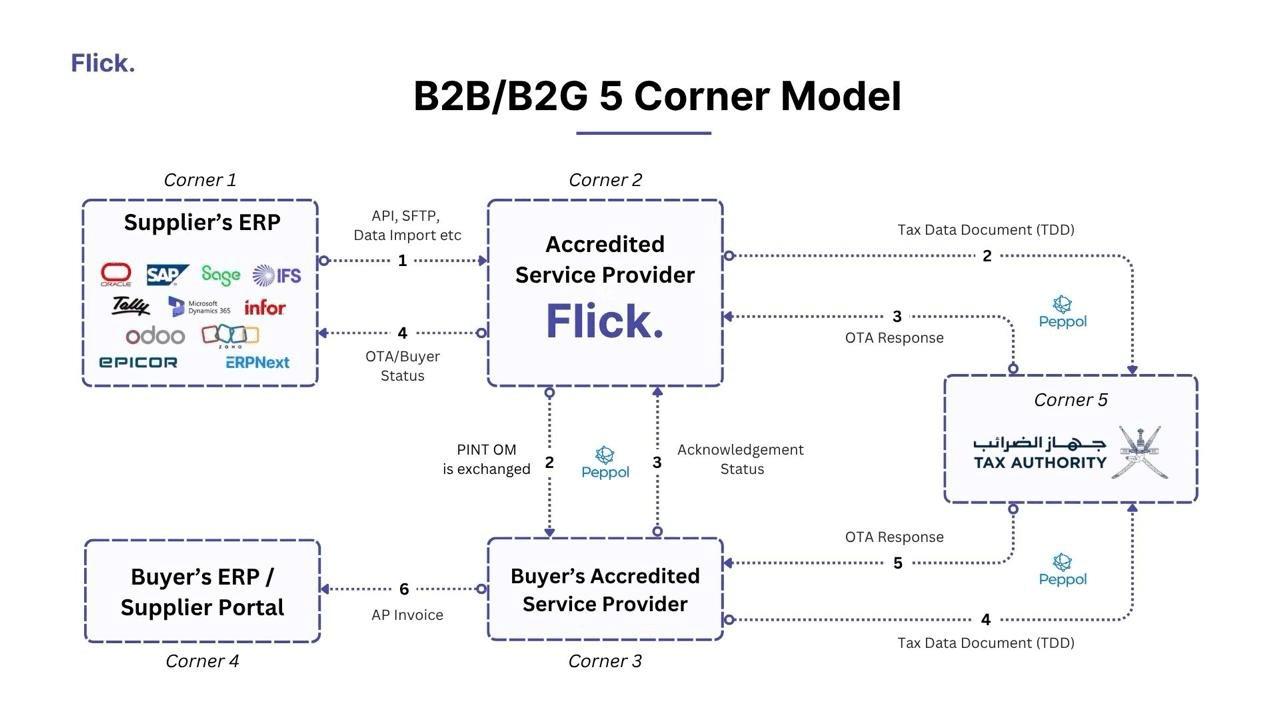
The invoice characteristics required under the Oman e-invoicing mandate are listed below:
- Invoices must be issued, transmitted and stored in an approved and secure electronic format.
- The format must maintain the integrity, security and verifiability of the invoice data.
- Invoices must contain every mandatory particular specified under the VAT Law and its Executive Regulation.
- Invoices must additionally satisfy the technical specifications published by the Oman Tax Authority.
- Generation must take place through a system connected to an accredited e-invoicing service provider.
- Connection to that provider must be in place before the applicable compliance date arrives.
- Business-to-business invoices are exchanged almost instantly between seller and buyer systems.
- A QR code is required on the human-readable invoice for business-to-consumer transactions.
- Tax Authority guidance extends the QR code requirement to full and simplified consumer invoices alike.
- The supplier at the first corner generates the QR code before the invoice reaches the customer.
Invoice Formats No Longer Accepted in Oman
An invoice that looks electronic is not necessarily structured, and the decision separates the two clearly. Several formats in daily use today will stop qualifying as tax invoices once the amendments take effect. Businesses still using them face a system change rather than a simple process adjustment.
The document types that will not qualify as electronic tax invoices are listed below:
- Paper invoices issued and delivered to the customer in physical form remain outside the definition.
- PDF invoices produced by accounting software carry no structured invoice data and therefore do not qualify.
- Digital images of invoices, including scanned copies sent by electronic mail, fall outside the definition.
What Decision 189/2026 Changes in the Executive Regulation
The amendments annexed to the decision replace two existing articles and introduce three entirely new ones. Understanding those provisions matters more than the headline dates, because they define the obligation itself. The changes made to the Executive Regulation of the VAT Law are summarised below:
| Provision | Effect of the amendment |
| Article 143 replaced | Requires an approved and secured electronic format safeguarding invoice integrity and storage under a unique number |
| Article 146 second paragraph replaced | Applies the Article 143 issuing deadlines to simplified tax invoices |
| Article 143 bis added | Tasks the Authority with announcing the companies licensed to provide approved electronic invoicing services |
| Article 143 bis 1 added | Imposes system security, continuity and data recovery obligations on the taxable person |
| Article 143 bis 2 added | Allows the Chairman to grant a temporary exemption from electronic issuance |
| Article 147 item 11 added | Adds any other data specified by the Authority to the required invoice particulars |
Oman Electronic Tax Invoice Requirements Under Article 143
The replaced Article 143 governs both the format of the invoice and the situations requiring one. The format must be approved and secured, safeguarding invoice integrity and storing each invoice under a unique number. Every invoice must also stay verifiable for authenticity of origin, authenticity of content and legibility, from the date of issue until the retention period ends.
The situations requiring an electronic tax invoice under the amended Article 143 are listed below:
- Making supplies, including supplies to a person who is not a taxable person.
- Making supplies to a taxable person who allocates them for personal purposes.
- Making deemed supplies as defined under the VAT Law and its Executive Regulation.
- Receiving consideration in whole or in part before the date of the supply.
- Any further situations specified elsewhere within the Executive Regulation of the VAT Law.
Oman E-Invoicing Deadline and Penalties for Late Tax Invoices
The amended Article 143 requires the tax invoice within fifteen days of the triggering situation. Article 146 applies that same deadline to simplified tax invoices, so consumer-facing documents follow no separate timetable. Electronic issuance changes the format of the invoice without extending the time available to produce it.
Existing penalty exposure continues alongside the electronic requirement rather than replacing it. Advisory commentary indicates that failure to issue valid tax invoices on time can attract penalties of OMR 500 to OMR 5,000. Integration delays therefore carry a compliance cost rather than a purely technical one.
System Security Obligations Under Article 143 bis 1
The new Article 143 bis 1 places responsibility for the invoicing system itself on the taxable person. Compliance therefore extends beyond invoice format into how the underlying system is protected and maintained. The system obligations imposed on taxable persons by Article 143 bis 1 are listed below:
- Adopting the measures necessary for secure issuance of electronic tax invoices through an electronic system.
- Complying with the technical specifications prescribed for protecting that system from breach or unauthorised access.
- Taking the procedures needed to address emergencies, malfunctions or technical failures affecting the system.
- Putting mechanisms in place for recovering data or information lost for any reason whatsoever.
- Maintaining continuity of operation so that the system continues functioning efficiently and effectively.
Exemption From Electronic Invoicing Under Article 143 bis 2
The decision creates a route out that no press coverage of the announcement mentioned. Under the new Article 143 bis 2, the Chairman may exempt a taxable person from issuing electronic tax invoices for a period the Authority determines. The taxable person must apply to the Authority with supporting documents and with reasons the Authority accepts.
Two conditions attach to any exemption granted under this provision, and both concern ordinary compliance behaviour. The conditions governing an exemption under Article 143 bis 2 are listed below:
- Filing the tax return within the legally prescribed deadlines, complete in the form and data specified.
- Paying the tax due within the deadlines prescribed under the VAT Law and its Executive Regulation.
Archiving Requirements Under Oman E-Invoicing
Electronic invoicing alters the format of the record without altering the period for which it must be retained. Article 70 of the Oman VAT Law continues to govern retention, requiring every VAT-registered taxpayer to keep tax invoices, accounting books and customs documents for ten years. That period is counted from the end of the tax year in which the return was filed, extending to fifteen years for records relating to real estate.
Those records may be retained electronically, provided the conditions covering authenticity, legibility and reproducibility are met. Meeting them matters in practice, because the Tax Authority may call for the records at any point within the retention period.
How to Prepare for the Oman E-Invoicing Mandate
Preparation depends on the value of annual supplies, current system capability and the readiness of existing invoicing processes. The steps that VAT-registered businesses can act on now are listed below:
- Confirm which compliance date applies by measuring annual supplies against the OMR 5 million threshold.
- Review whether current invoicing output can produce structured XML aligned with the PINT OM specification.
- Select an accredited service provider early, since integration and testing consume several weeks.
- Map master data across customers, suppliers and tax codes before technical integration begins.
- Check that business-to-consumer invoice templates carry the required QR code.
- Confirm that structured invoices can still reach customers within the fifteen-day issuing window.
- Confirm that invoicing output stores every tax invoice under a unique invoice number.
- Assess system security, continuity and data recovery arrangements against Article 143 bis 1.
- Review archiving arrangements against the ten-year retention period under Article 70.
- Monitor Tax Authority publications closely, since the technical specifications continue to develop.
How Flick Network Helps With Oman E-Invoicing Compliance
Flick Network supports businesses preparing for the Fawtara mandate alongside other Gulf and European e-invoicing programmes. The platform capabilities relevant to Oman e-invoicing compliance are listed below:
- PINT OM format generation: Production of structured XML invoices aligned with the Oman Peppol specification published by the Tax Authority.
- Peppol network connectivity: Certified Access Point and SMP capability supporting invoice exchange across the five-corner model.
- Validation before transmission: Schema and Schematron checks applied at creation, so errors surface before invoices reach the buyer.
- ERP integration: Connectors for SAP, Oracle, Microsoft Dynamics and other systems, so invoicing continues inside existing finance processes.
- B2C invoice handling: QR codes and readable invoice copies for customers, meeting the requirements for consumer transactions.
- Compliant archiving: Retention of invoice records across the statutory period with audit-ready retrieval.
Conclusion
Decision No. 189/2026 converts Oman's electronic invoicing programme from an announced plan into a binding obligation with fixed dates. VAT-registered businesses with annual supplies above OMR 5 million must comply by April 2027, and all others by October 2027. Format readiness, system security arrangements and service provider selection all deserve early attention now. For help with Oman e-invoicing compliance, reach out to Flick Network at sales@flick.network
FAQs
- When does e-invoicing become mandatory in Oman?
Electronic invoicing becomes mandatory on 1 April 2027 for VAT-registered businesses with annual supplies above OMR 5 million. All remaining VAT-registered businesses must comply from 1 October 2027 instead. - What is Decision No. 189/2026 in Oman?
Decision No. 189/2026, published in Official Gazette issue 1660 on 9 August 2026, amends the Executive Regulation of the VAT Law to mandate electronic tax invoices. - Does a PDF invoice count as an electronic invoice in Oman?
A PDF invoice does not qualify, because it carries no structured invoice data. Paper invoices and scanned copies sent by electronic mail are excluded for the same reason. - Can a business be exempted from electronic invoicing in Oman?
Article 143 bis 2 allows the Chairman to grant an exemption for a set period. The taxable person must apply with supporting documents, file returns on time and pay tax due on time. - What are the penalties for invoicing non-compliance in Oman?
Advisory commentary indicates penalties of OMR 500 to OMR 5,000 for tax invoices not issued on time. The amended Article 143 sets that deadline at fifteen days from the triggering situation.
Quick Navigation
Book a Demo
Learn more by booking a demo with our team. We'll guide you step by step.