Oman E-Invoicing Advance Payments Guide | Flick Network
Last updated at
October 22, 2026
Book a Demo
Learn more about this by booking a demo call with us. Our team will guide you through the process and answer any questions you may have.
Book NowHandling Advance Payments Under Oman E-Invoicing
Oman e invoicing advance payments need to be documented before delivery when the customer pays for a future supply. For an ordinary taxable sale, receiving part of the price can bring forward the VAT due date for that amount and require a tax invoice.
The later invoice must connect the supply with the payment already received. Otherwise, the customer’s balance can be overstated, or VAT already accounted for can be counted again.
This guide explains the VAT trigger, prepayment references and paid-amount fields, with a worked example using a 30% advance. The electronic-field explanations follow published PINT OM Billing v1.0.1. Businesses should apply them within their applicable Fawtara requirements.
When Does an Advance Payment Trigger VAT and Invoicing?
For Oman e invoicing advance payments, start with the payment’s purpose and timing. Article 26 of Oman’s VAT Law makes VAT due at the earliest of supply, tax invoice issuance, or receipt of consideration. When payment is received first, the receipt triggers VAT to the extent of the amount received.
Article 67 also requires a tax invoice when consideration is received, wholly or partly, before supply. A bank receipt alone does not fulfil that tax-invoice requirement.
Article 143, as amended by Decision 456/2022, sets a maximum 15-day issuance window from the relevant event. That includes receiving payment before supply. Decision 189/2026 retains this window in the amended electronic-invoicing framework as it takes effect for the relevant taxpayers.
The issuance deadline does not postpone the VAT tax point. Record the receipt date separately from the date the invoice is generated.
Check Whether an Earlier Invoice Already Created the Tax Point
Receiving an advance is not always the first event. If a tax invoice was already issued, its date may have brought the VAT obligation forward.
Before issuing another document, check the existing invoice, what it covered, and how VAT was recorded. Avoid creating a second tax charge simply because a previously invoiced amount has now been paid.
This article’s example assumes an ordinary domestic sale with no earlier tax invoice. Continuous supplies and arrangements involving successive invoices or payments can follow Article 27’s separate timing rules.
What Should the Advance-Payment Record Contain?
Handling Oman e invoicing advance payments starts with a usable link between the receipt, customer order, and invoice.
Keep the following information together:
- Supply reference: The order or contract to which the payment relates.
- Receipt details: The amount, currency, receipt date, and payment reference.
- Tax calculation: The net advance, applicable VAT treatment, and VAT amount.
- Invoice identity: The advance invoice’s number and issued UUID.
- Allocation: How much of that payment is applied to the later invoice.
These are working records for reconciliation, not a claim that every item belongs in one mandatory XML group. The electronic invoice must also contain the normal party, supply, and tax information required for its transaction.
Make the description specific enough to identify the future supply. “30% advance for office equipment under order PO-104” gives finance a clearer connection than “payment received.”
How Is an Oman Prepayment Invoice Classified?
An Oman prepayment invoice is identified through the Oman transaction-type model. BTOM-001 is a 20-character bitmap, with the prepayment classification at position 15.
The classification sits alongside the applicable base invoice type. Selecting prepayment does not remove the requirement to identify the document as full or simplified.
The published transaction-type list describes prepayment as an invoice for an advance, deposit, instalment or prepayment against a future supply.
For Oman e invoicing advance payments, also check classification compatibility. IBR-176-OM prohibits combining the prepayment flag with a summary invoice, deemed supply, or profit-margin self-invoice.
Confirm the document type and transaction flags with your provider. The advance document and later settlement document have different purposes; a final invoice should not automatically inherit every flag from the advance invoice.
PINT Oman Prepaid Amount and Reference Fields
The PINT Oman prepaid amount information has two levels: the total already paid and the breakdown of payments. Prepayment invoice references identify the earlier documents supporting that settlement.
| Information | PINT Oman field or group | What it represents |
| Total paid amount | IBT-113 | Total amounts paid in advance, including tax. Mapped to LegalMonetaryTotal/PrepaidAmount. |
| Individual paid amount | IBT-180 within IBG-35 | A payment amount in the invoice currency. |
| Payment identifier | IBT-179 | A reference to the payment, such as a bank-transfer identifier. |
| Receipt date | IBT-181 | The date the seller received the prepaid amount. |
| Prepayment invoice references | BGOM-03: BTOM-027 and BTOM-014 | The advance invoice’s number and UUID. |
| Remaining amount due | IBT-115 | The amount the customer still needs to pay. |
IBR-093 requires the total paid amount when the payment breakdown contains a paid amount. The total and breakdown should therefore be reconciled as part of your integration checks.
Store the Advance Invoice Number and UUID
For Oman e invoicing advance payments, keep the identifiers from the document actually issued.
When the later invoice includes a prepaid amount, include the advance invoice’s number and UUID in the PDR reference group. Keep these invoice identifiers alongside the payment records so your system can link the advance to the final invoice.
Technical note: IBR-058-OM’s description refers to the individual paid amount, IBT-180, but its executable test checks the invoice-level prepaid amount, IBT-113. Your integration should therefore provide the required references when IBT-113 is present, even if no individual payment breakdown is included.
PINT OM v1.0.1 maps BGOM-03 to AdditionalDocumentReference, with document type code PDR. The release notes identify this as a change from the earlier mapping. Do not rely only on a bank-transfer reference or a note saying “advance adjusted.” Neither identifies the earlier invoice in the prescribed prepayment-reference fields.
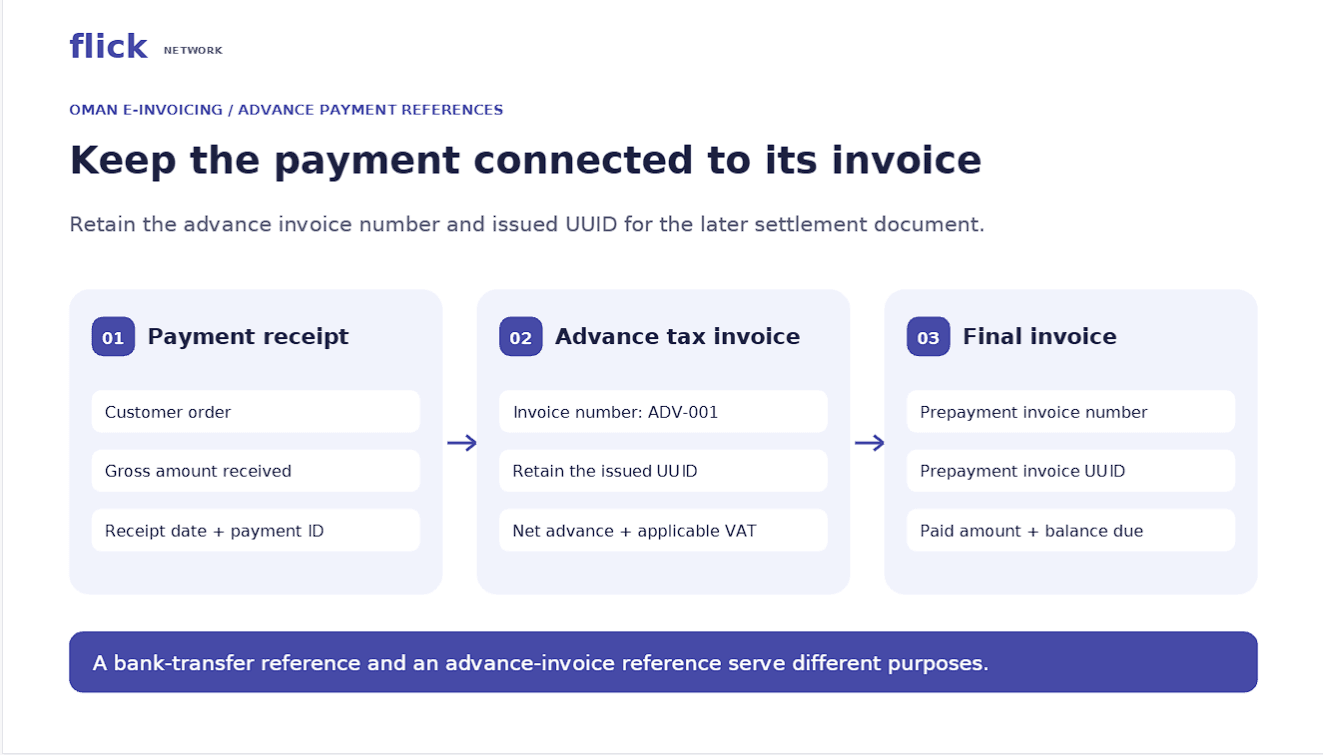
Alt text: Connecting an advance payment, its tax invoice and the final invoice using the prepayment invoice number and UUID.
Oman E Invoicing Advance Payments: A Worked Example
Assume a VAT-registered Omani supplier sells office equipment for OMR 10,000.00 excluding VAT. The domestic supply is standard-rated at 5%.
The customer pays a 30% advance before delivery. There are no discounts, charges, refunds, or rounding adjustments, and no tax invoice was issued before receipt.
Stage 1: Receive and Invoice the Advance
The advance is OMR 3,000.00 plus OMR 150.00 VAT. The supplier receives OMR 3,150.00 on 5 November and issues advance invoice ADV-001 for that portion.
The invoice has its own issued UUID, which the supplier retains for later reference. The receipt brings OMR 150.00 into the VAT accounting for the relevant period, under the assumptions above.
Record whether the agreed advance is tax-exclusive or tax-inclusive. Here, “30% advance” means 30% of the OMR 10,000.00 net price, with VAT added.
Stage 2: Supply the Equipment and Prepare the Final Invoice
The equipment is delivered on 20 December. In this illustration, the final invoice presents the full supply value and deducts the gross amount already paid.
| Calculation | Advance invoice | Final invoice showing the full supply |
| Net value covered | OMR 3,000.00 | OMR 10,000.00 |
| VAT at 5% | OMR 150.00 | OMR 500.00 |
| Total including VAT | OMR 3,150.00 | OMR 10,500.00 |
| Advance already paid against the final invoice | — | OMR 3,150.00 |
| Remaining customer balance after applying the advance | — | OMR 7,350.00 |
The final document’s IBT-113 is OMR 3,150.00, including the VAT paid with the advance. Its amount due is:
OMR 10,500.00 − OMR 3,150.00 = OMR 7,350.00
It also references ADV-001 and that advance invoice’s UUID in the prepayment document-reference group. If a payment breakdown is provided, it records the advance receipt and its payment details.
Stage 3: Reconcile VAT Already Accounted For
Oman e invoicing advance payments need a tax reconciliation as well as a customer-balance calculation.
The total VAT on this supply is OMR 500.00. OMR 150.00 was already accounted for at the advance stage, leaving OMR 350.00 attributable to the remaining consideration, assuming no other earlier tax point or adjustment.
The final document’s full-supply VAT figure does not mean another OMR 500.00 should be added to the VAT already recorded. That would produce OMR 650.00 for a supply carrying OMR 500.00 VAT.
The table illustrates invoice presentation and payment settlement; it is not a complete TDD or VAT-return mapping. Finance and the provider should test how linked advance and final documents feed the tax-reporting process.
Avoid Treating the Advance as a Discount
For Oman e invoicing advance payments, the amount already received settles part of the customer’s liability. It does not, by itself, reduce the agreed selling price.
In the example, the equipment still costs OMR 10,000.00 excluding VAT. The OMR 3,150.00 receipt reduces the amount due.
Entering that receipt as a document discount would change the taxable-value calculation. Deducting only OMR 3,000.00 from the gross total would also leave the customer owing OMR 150.00 more than the correct balance.
Keep payment allocation separate from any genuine price discount. If your system invoices only the remaining portion instead, review that presentation and its references with your provider; do not apply the advance again to an already reduced balance.
What If There Are Several Advances or a Cancellation?
Several Advance Payments
For Oman e invoicing advance payments received in stages, retain each receipt and its invoice identifiers. IBG-35 supports repeated payment groups, while BGOM-03 supports repeated prepayment document references.
For a final invoice, reconcile the amount applied from each advance with the total paid amount. Keep track of unapplied balances, especially when one advance is allocated across more than one delivery.
Cancelled Orders or Changed Prices
A refund or price change may require adjustment of the invoice already issued. Article 155, as amended by Decision 456/2022, requires an adjustment document when a previously issued invoice needs amendment, with references to the invoice and tax being adjusted.
Record the refund and invoice adjustment together. Do not delete the advance invoice or silently overwrite it. The appropriate VAT correction depends on what changed and how the original transaction was treated.
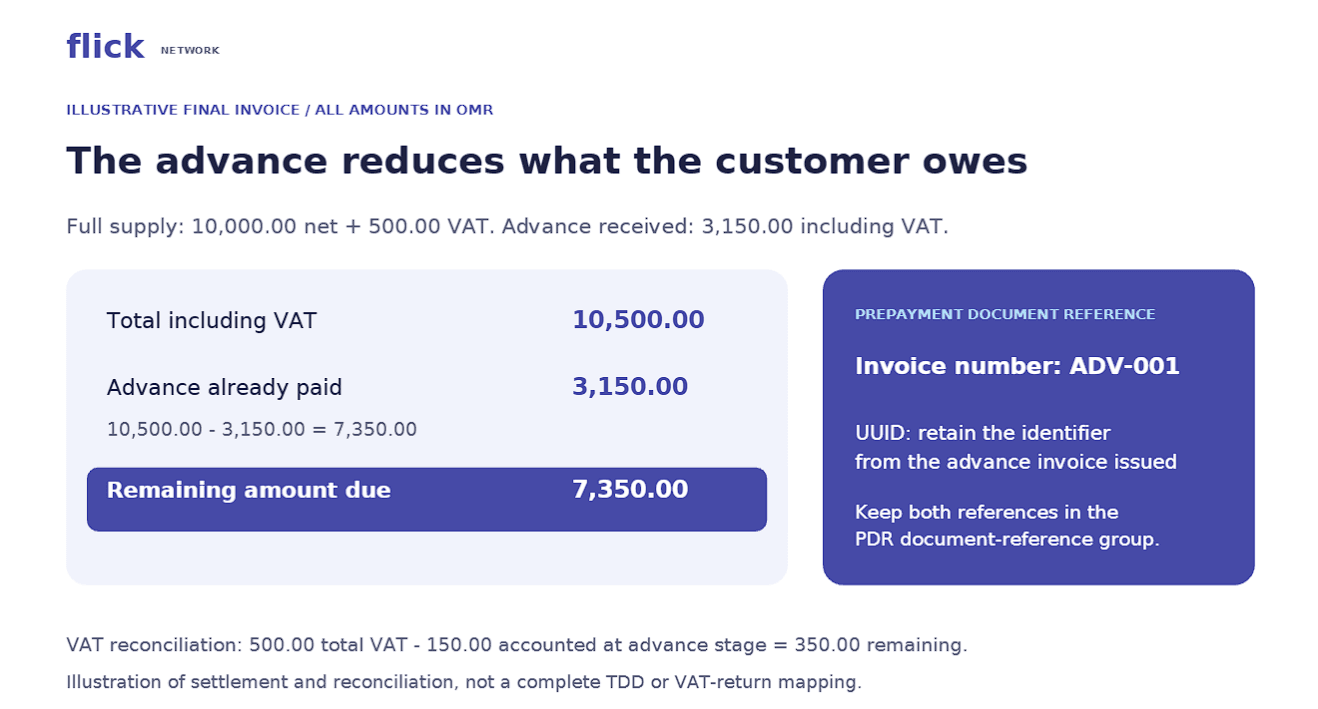
Alt text: Final Oman invoice showing the gross advance deducted from the total and linked to its original prepayment invoice.
Checks Before Sending the Final Invoice
Use these checks for Oman e invoicing advance payments:
- Confirm the payment belongs to the customer order being invoiced.
- Check whether an earlier tax invoice already established a tax point.
- Include VAT in the total prepaid amount where applicable.
- Match each applied payment with its retained invoice number and UUID.
- Reconcile payment breakdowns, total paid amount, and amount due.
- Check that the advance has not also been entered as a discount.
- Reconcile VAT already accounted for before preparing tax reporting.
- Validate the structured document, then check exchange and reporting statuses.
Flick’s Oman Peppol 5-corner model guide explains invoice exchange and tax reporting. For advances in another currency, its foreign-currency invoice guide covers conversion and rounding checks.
Flick Network provides e-invoicing and integration tools. Its Oman e-invoicing solution supports ERP integration, invoice validation, and tax reporting. For Oman e invoicing advance payments, test your receipt-to-final-invoice process with real examples before using it for regular billing.
Frequently Asked Questions
Q1. How Are Oman E Invoicing Advance Payments Handled Before Delivery?
Receiving consideration before supply can trigger VAT for the amount received and require a tax invoice. Check whether a tax invoice or another relevant event created an earlier tax point.
Q2. Does the Prepaid Amount Include VAT?
Yes. PINT defines IBT-113 as the total amount paid in advance, including tax. In the example, it is OMR 3,150.00, rather than the OMR 3,000.00 net advance.
Q3. Which Advance Invoice References Should the Later Invoice Keep?
The prepayment invoice number and UUID are carried through BTOM-027 and BTOM-014. In v1.0.1, their reference group uses AdditionalDocumentReference with document type code PDR.
Q4. Can a Bank Receipt Replace the Advance Tax Invoice?
A bank receipt proves payment. It does not replace the tax invoice required when consideration is received before supply.
Q5. Is a Final Invoice’s Prepaid Amount a Discount?
No. It represents payment already made. A discount changes the selling price; a prepaid amount reduces the outstanding balance.
Q6. Can I Wait Until Delivery to Account for VAT on the Advance?
For the ordinary taxable-sale example, the receipt creates the tax point for the advance when no earlier tax invoice or supply has done so. Waiting for delivery would miss that earlier point.
Quick Navigation
Book a Demo
Learn more by booking a demo with our team. We'll guide you step by step.