Full vs Simplified Tax Invoices: What Oman E-Invoicing Requires
Last updated at
October 15, 2026
Book a Demo
Learn more about this by booking a demo call with us. Our team will guide you through the process and answer any questions you may have.
Book NowFull vs Simplified Tax Invoices: What Oman E-Invoicing Requires
A full tax invoice in Oman requires more buyer information than a simplified invoice. Both formats still need supplier details, supply information, and VAT figures. The usual simplified-invoice value test applies to supplies worth less than OMR 500 excluding VAT.
Fawtara adds requirements for the electronic document and its reporting. Choosing a simplified format does not remove every buyer field or VAT check. Businesses need to establish eligibility, collect the right information, and apply the B2C requirements where the customer is a consumer.
When Can You Use a Simplified Tax Invoice in Oman?
Article 146, as amended by Decision No. 456/2022, permits a simplified tax invoice when the supply value is less than OMR 500 excluding VAT, or in other cases determined by the Oman Tax Authority.
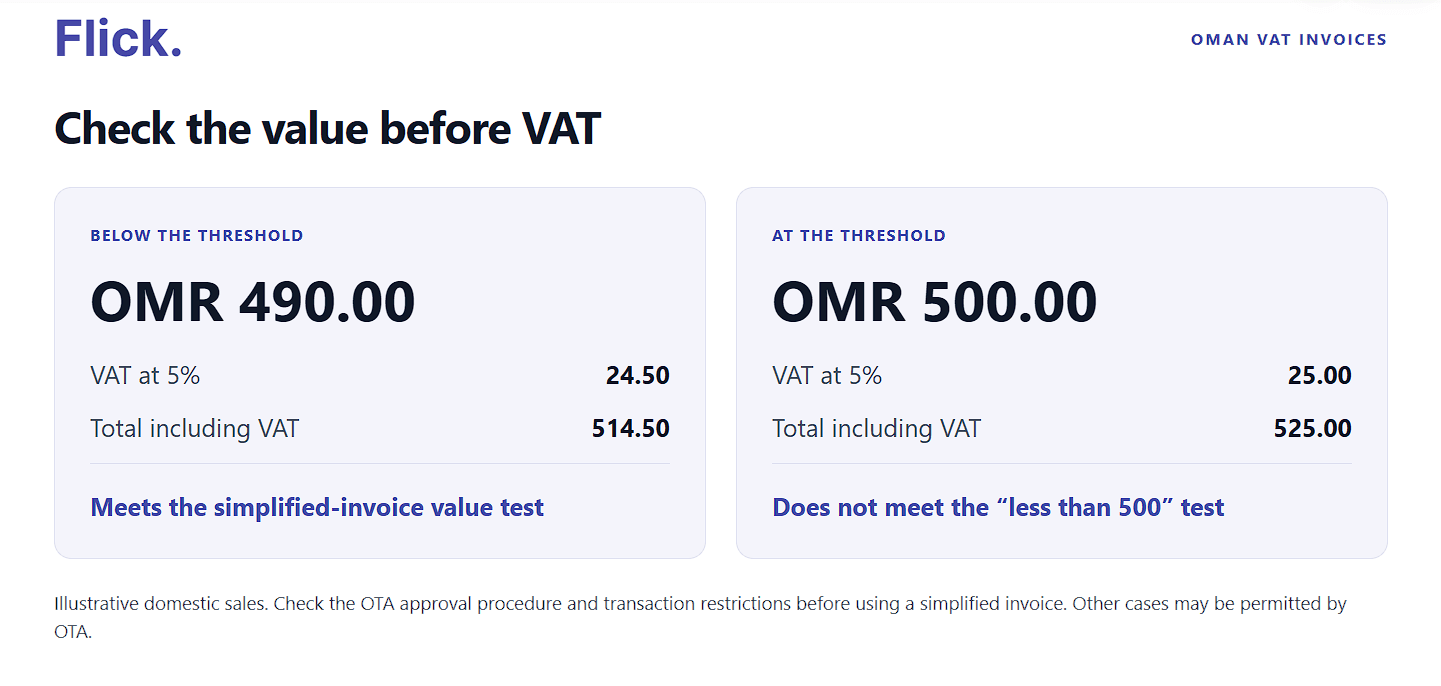
The threshold applies to the supply value before VAT. A domestic sale of OMR 490 plus OMR 24.50 VAT meets the value test, although the customer pays OMR 514.50. A sale of exactly OMR 500 before VAT does not meet it.
This matters when your billing system starts with VAT-inclusive prices. The customer’s final payment cannot be compared directly with the OMR 500 threshold. Establish the value excluding VAT before deciding which format is available.
The amended provision appears in the decisions available through OTA’s VAT Law and Executive Regulations. Use the amended Article 146 when checking eligibility, as older explanations may reproduce the original 2021 conditions.
The value test also needs to be read alongside the approval procedure. Article 148 contains an application process, and the government continues to publish its simplified tax invoice approval service. Confirm your approval position with OTA before changing your billing process.
The 2022 amendment removed the express prior-approval condition from Article 146. However, Article 148 and the government’s approval service remain published, so confirm OTA’s current procedure. Keep that confirmation with your billing procedures. It gives the team a documented basis for using the format, particularly when several branches or billing systems issue invoices.
A full invoice remains available for low-value sales. Article 149 requires a supplier approved to issue simplified invoices to provide a full tax invoice when the customer requests one. Your billing process should therefore support that request.
Full vs Simplified Tax Invoices: The Main Differences
The main difference under the VAT particulars is the level of buyer information. Most supplier, supply, and VAT information remains necessary in both formats.
The table separates those particulars from the requirements of the electronic document. This prevents a reduced customer-facing template from being treated as permission to remove mandatory electronic fields.
| Requirement | Full tax invoice | Simplified tax invoice |
| Eligibility | Use where simplified treatment is unavailable or a full invoice is required or requested. | Check the less-than-OMR-500 value test, approval procedure and transaction restrictions. |
| Invoice label and identification | “Tax Invoice”; sequential invoice number and prescribed electronic identifiers. | “Simplified Tax Invoice”; electronic invoices still need an invoice number and prescribed identifiers. |
| Buyer particulars under VAT rules | Customer’s full name, address and tax identification number, if any. | These customer particulars are not listed in Article 147. |
| Buyer information in PINT | Buyer name, required address information and a buyer identifier or VATIN. | Shared buyer fields remain required; other transaction types can trigger additional information. |
| VAT particulars | Taxable value, applicable VAT rate, VAT due and relevant adjustments. | The same core VAT particulars remain required. |
| Electronic VAT detail | Separate line VAT amount and the required VAT breakdown. | Separate line VAT amount may be omitted; a standard-rated VAT breakdown remains required. |
| B2C requirements | QR code on the human-readable invoice and the published 24-hour submission window. | The same B2C requirements apply. |
The VAT particulars follow OTA’s published invoice guidance and Article 147. The electronic differences follow the published PINT Oman rules.
Both formats also need the supplier’s full name, address and tax identification number, descriptions of the goods or services, and quantities of goods. Include the issue date, supply date and applicable payment information.
Retain the consideration excluding VAT, taxable value and relevant discounts, reductions or subsidies. Simplified invoices still need enough information to explain what was supplied and how the VAT was calculated.
What the Electronic Invoice Still Needs
The VAT particulars describe information on the invoice. PINT Oman also defines the data and validation requirements for the electronic document. A billing team needs to check both when configuring its templates.
Buyer Information Cannot Be Removed As A Whole
Shared PINT rules require buyer name, a buyer postal-address group, and buyer country code. These requirements remain relevant even though Article 147 does not list the same buyer particulars as a full tax invoice.
For full invoices, Oman’s IBR-016-OM requires either a buyer identifier or buyer VATIN. IBR-019-OM also requires the specified buyer address lines, city, and postal code. Collect these details before generating the electronic invoice.
This is particularly relevant when issuing a full invoice to a consumer who has no VAT registration number. The identification rule allows a buyer identifier as an alternative. The absence of a VATIN does not remove the identification requirement.
Other transaction types can also trigger buyer information. E-commerce is included in IBR-016-OM, so a simplified online sale should not automatically inherit the same data requirements as an ordinary walk-in sale.
Agree the consumer-data mapping with your service provider. Check how your billing system will populate the required fields, and resolve missing information before production use. Avoid invented names, addresses, or identifiers used simply to make a file pass validation.
Line VAT and the VAT Breakdown Have Different Rules
IBR-038-OM allows a simplified invoice to omit the separate line VAT amount. That exception does not remove the VAT particulars required on the invoice or the standard-rated VAT breakdown in the electronic document.
For a domestic standard-rated sale, your system must still calculate VAT correctly and include the required breakdown. Check that the taxable value, VAT amount and invoice totals agree, even when the separate line VAT field is omitted.
Category-specific exceptions also exist for certain exempt, outside-scope and zero-rated breakdowns. Apply the published rule for the actual VAT category rather than treating all breakdown information as optional on simplified invoices.
Simplified classification also provides exceptions from the goods/services indicator, goods HS-code and item industrial-classification requirements that otherwise apply under IBR-078-OM, IBR-079-OM and IBR-081-OM.
Some Transactions Cannot Use Simplified Classification
IBR-149-OM prevents simplified classification from being combined with exports, summary invoicing, self-billing, import reverse charge, profit-margin transactions and imports of goods. The transaction type therefore needs checking alongside the value threshold.
For example, an export worth OMR 200 cannot use simplified classification under this rule. Its low value does not override the export restriction. A rule based only on invoice amount would make the wrong decision.
The published Oman invoice validation rules provide the requirements for each transaction. Flick’s PINT Oman specification guide explains the broader format and field structure.
What Fawtara Requires for B2C Invoices
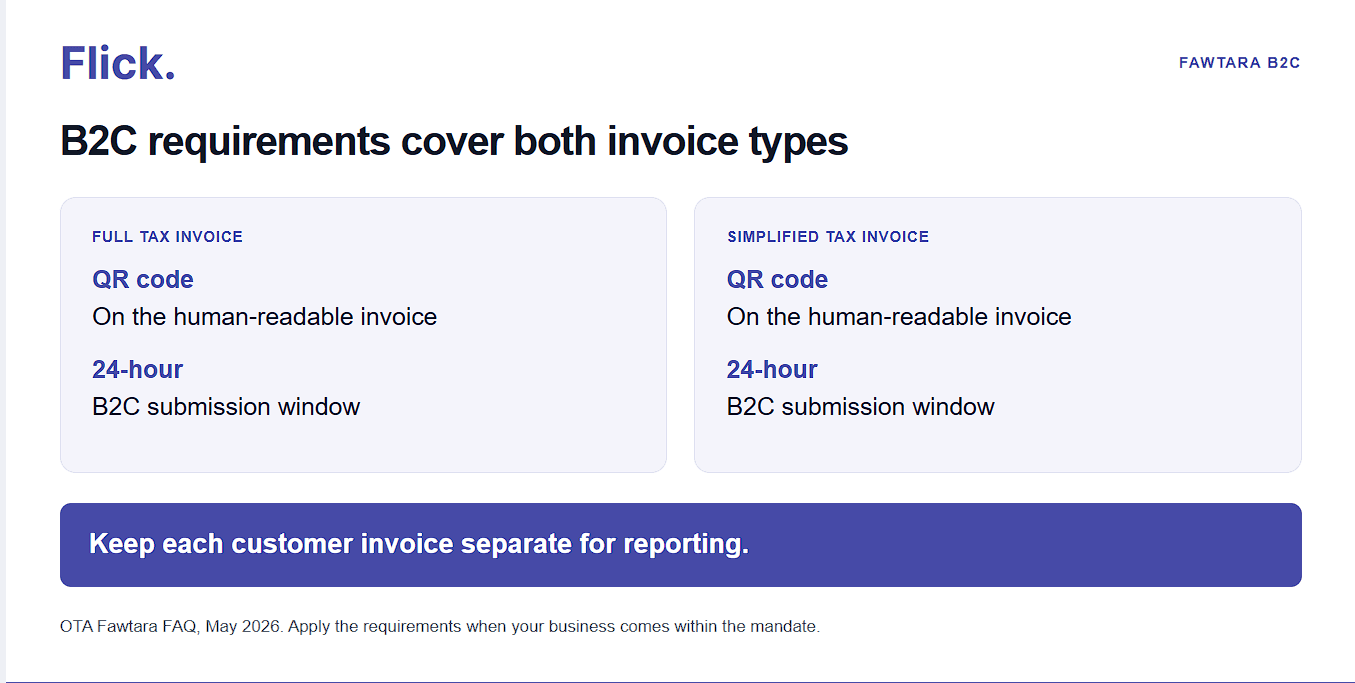
OTA’s published FAQ requires a QR code for both full and simplified B2C invoices. The taxpayer generates the code, which appears on the human-readable invoice. A full invoice issued to a consumer still needs this B2C control.
The FAQ gives B2C invoices a 24-hour submission window and prohibits consolidated B2C invoices. Keep each invoice separate rather than replacing individual invoices with a daily sales total.
Customer delivery and tax reporting are separate steps. For a consumer outside the network, OTA describes delivery through the existing customer process and tax-data submission through the service provider. These requirements appear in the OTA Fawtara FAQ.
The submission window is also separate from the invoice-issuance deadline. Decision No. 189/2026 retains the requirement for simplified invoices to follow Article 143’s issuance deadlines. Article 143 specifies issuance within 15 days of the relevant event, including a supply or receipt of advance consideration.
The decision sets mandatory application from 1 April 2027 for taxable persons whose annual supplies exceed OMR 5 million, and 1 October 2027 for those whose annual supplies do not exceed that amount.
Use the Official Gazette copy of Decision No. 189/2026 when checking these legislated dates. Plan the B2C process around your applicable date, covering customer delivery, QR generation, and reporting.
Examples of Choosing and Preparing the Invoice
These examples assume domestic supplies subject to 5% VAT, with no discounts, additional charges, or special VAT treatment. They show the format decision and the information the billing team needs to check.
Consumer Purchase of OMR 490 Before VAT
The supplier sells goods for OMR 490. VAT is OMR 24.50, bringing the customer’s total to OMR 514.50. The supply meets the simplified-invoice value test because its value excluding VAT is below OMR 500.
After confirming approval and transaction eligibility, the supplier can prepare the simplified format. Include the required supplier details, goods description, quantity, dates, and VAT figures. Check the electronic buyer fields and standard-rated breakdown separately.
When Fawtara applies, the consumer-facing invoice also needs its QR code. Keep the individual electronic invoice available for reporting.
Consumer Purchase of OMR 500 Before VAT
The supplier sells goods for OMR 500. VAT is OMR 25.00, and the total is OMR 525.00. This supply does not meet the “less than OMR 500” test.
Unless another OTA-permitted case applies, prepare a full invoice. Collect the required buyer information and check the electronic identifier and address fields. Because the customer is a consumer, the full format still carries the relevant B2C requirements.
Business Purchase of OMR 200 Before VAT
A business buys goods for OMR 200 and requests a full tax invoice. VAT is OMR 10.00, bringing the total to OMR 210.00. The supplier can issue a full invoice despite the low value.
Capture the customer’s legal name, address, and tax identification information, as applicable. Then check the electronic buyer identifier and other mandatory fields before issuing the invoice. Article 149 addresses full-invoice requests where the supplier is approved to issue simplified invoices.
What to Check Before Using the Templates
Test the decision process as well as the document layout. A template can display the correct label while the system selects the wrong transaction classification or leaves required electronic fields unpopulated.
Use examples from your actual billing process to check:
- Eligibility: The supply value excluding VAT, approval position, and transaction restrictions.
- Classification: The correct full or simplified base classification. PINT Oman requires one and prohibits selecting both.
- Buyer information: The fields needed for the invoice format and any additional transaction type.
- VAT calculation: The category, rate, taxable value, tax amount, breakdown and totals.
- B2C processing: The QR code, customer copy, and separate submission of each invoice.
- Records: The invoice, supporting transaction evidence, approval correspondence, and reporting records.
The classification requirement follows the published PINT Oman rules.
Include an invoice just below the threshold, one exactly at it, a low-value transaction restricted from simplified classification, and a customer request for a full invoice. These examples test decisions that a single ordinary sale would miss.
For business purchases, retain evidence of the actual recipient and correct VAT treatment. OTA’s input tax deduction guide recognises valid simplified invoices, subject to the normal deduction conditions.
Flick Network supports e-invoicing and ERP integration. Bring examples of your full and simplified invoices to discuss field mapping, validation and OTA reporting. This helps the implementation reflect the transactions your business actually issues.
Frequently Asked Questions
Can a business recover input VAT using a simplified invoice?
A valid simplified invoice can support input VAT deduction. The purchase must meet the normal deduction conditions, and the records must establish the recipient, business purpose, and correct VAT treatment.
Does “simplified” mean several customer invoices can be combined?
No. Simplified describes the invoice format. Summary invoicing is a separate arrangement, and OTA’s Fawtara FAQ prohibits consolidated B2C invoices.
Can I issue a simplified invoice for exactly OMR 500?
A supply worth exactly OMR 500 excluding VAT does not meet the “less than OMR 500” test. Use a full invoice unless another case permitted by OTA applies.
Does a full invoice issued to a consumer need a QR code?
Yes. Under Fawtara’s published B2C requirements, both full and simplified invoices need a QR code on the human-readable invoice.
Can I issue a full invoice for a sale below OMR 500?
Yes. A low-value sale can use a full invoice. Article 149 also requires suppliers approved to issue simplified invoices to provide a full invoice when the customer requests one.
Quick Navigation
Book a Demo
Learn more by booking a demo with our team. We'll guide you step by step.