Oman E-Invoicing Readiness Checklist 2027 for Finance and IT
Last updated at
November 3, 2026
Book a Demo
Learn more about this by booking a demo call with us. Our team will guide you through the process and answer any questions you may have.
Book NowOman E-Invoicing Readiness Checklist: Are Finance and IT Teams Ready for Fawtara?
Introduction
In Oman, a tax invoice will soon need more than the right figures to be valid. It must be issued in XML, follow the PINT OM specification and pass validation by an accredited service provider. This applies from 1 April 2027 for businesses with annual supplies above OMR 5 million, and from 1 October 2027 for every other VAT-registered business.
For finance and IT teams, the difficulty often comes at the handover between them. IT may produce valid XML from the ERP while finance still has incomplete customer data, unmapped transaction types or an archive that relies on the provider. This Oman e-invoicing readiness checklist shows what to check in each of the eight areas, who owns it and what evidence proves it is ready.
Fawtara Go-Live Dates for 2027: Which One Applies?
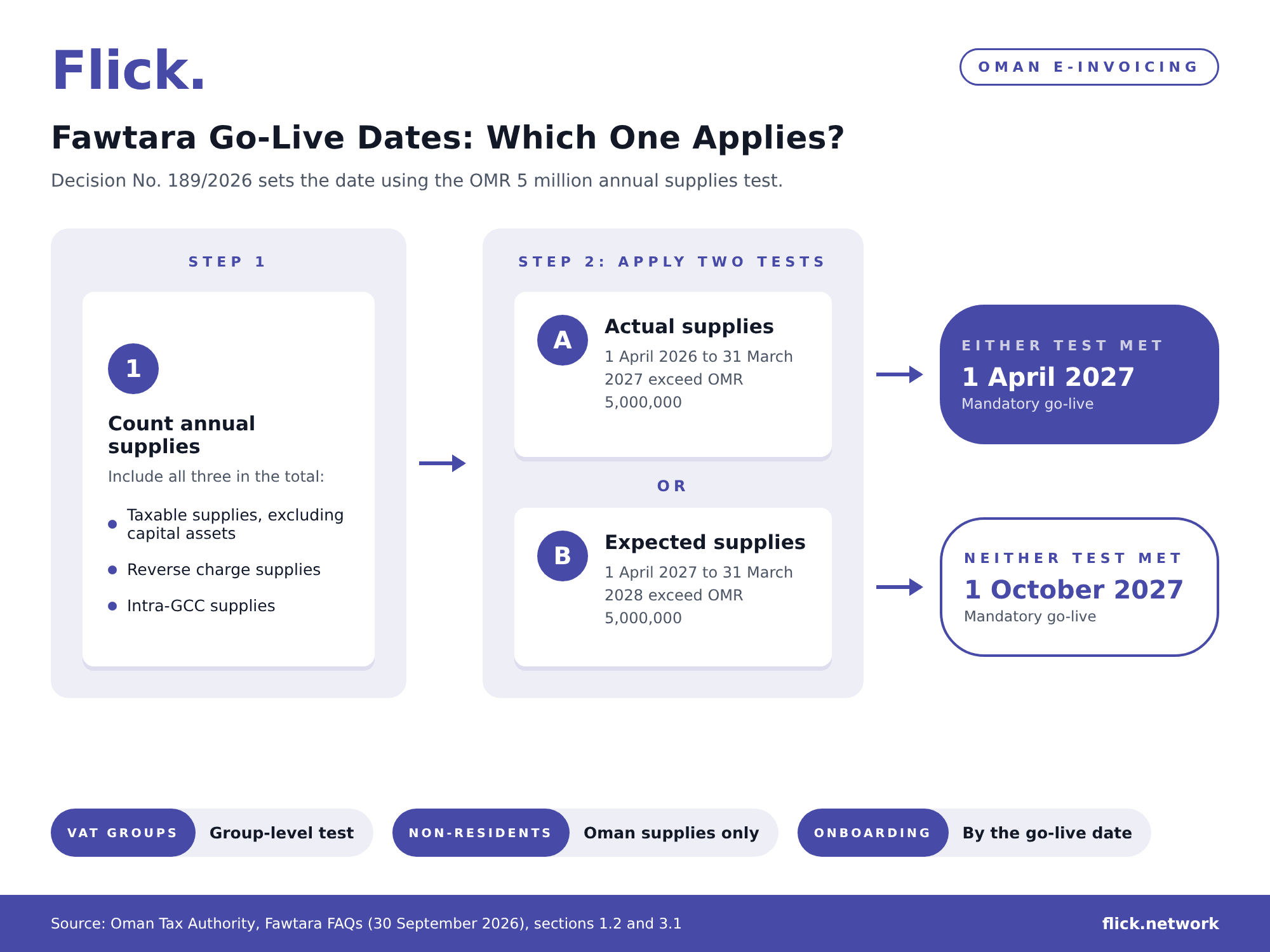
Decision No. 189/2026 amends the VAT Executive Regulation and sets two dates in the Oman e-invoicing timeline. Businesses that meet the OMR 5 million annual supplies test go live on 1 April 2027, and all other VAT-registered businesses go live on 1 October 2027. Each business is expected to be onboarded with its service provider on or before its go-live date.
Annual supplies include taxable supplies (excluding supplies of capital assets), reverse charge supplies and intra-GCC supplies. The April date applies if supplies from 1 April 2026 to 31 March 2027, or expected supplies from 1 April 2027 to 31 March 2028, exceed OMR 5,000,000. VAT groups are tested at group level rather than per member.
Fawtara Preparation Checklist: 8 Readiness Areas at a Glance
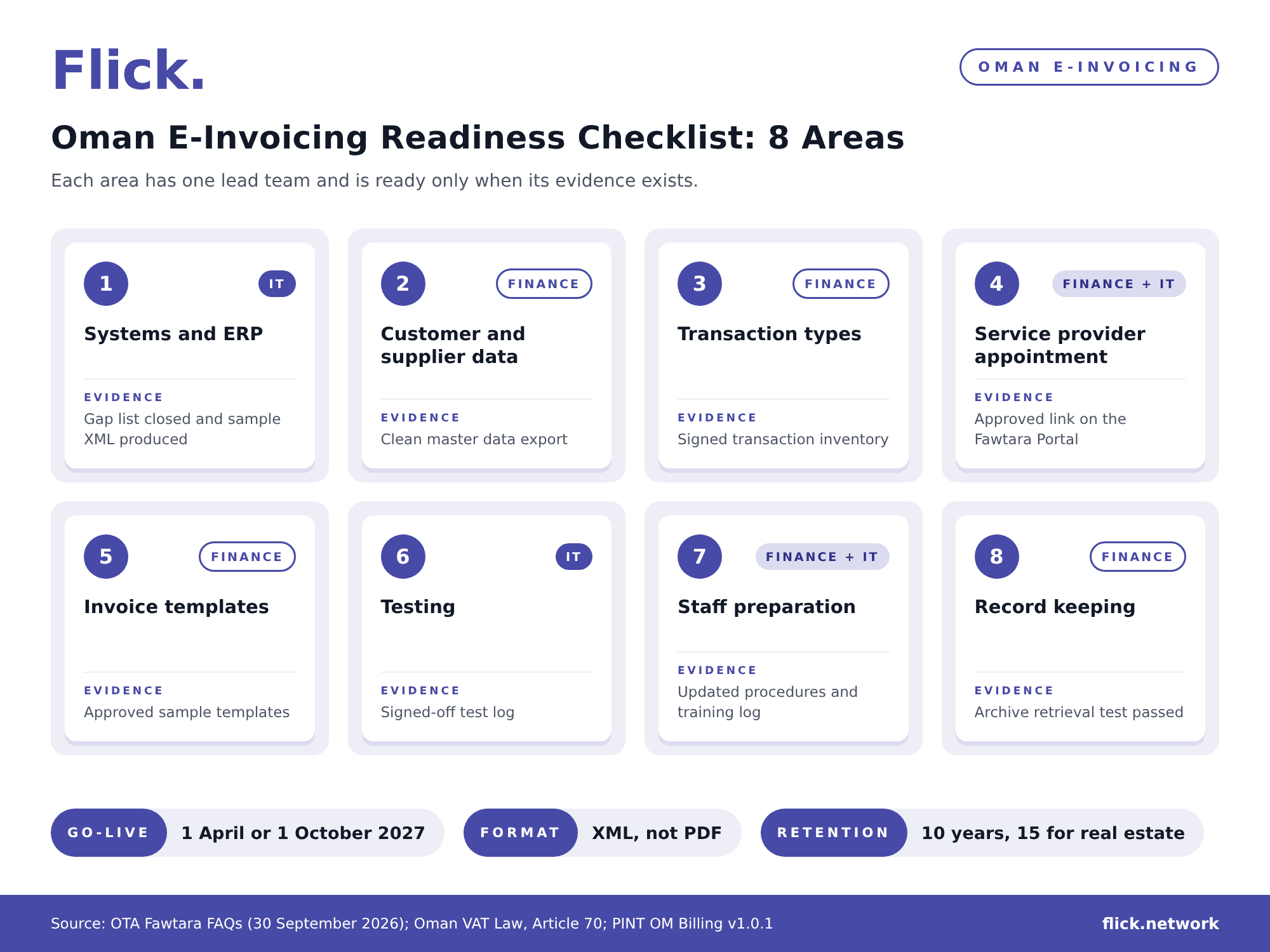
Finance and IT share most of the work, but each area needs one lead team that signs off its evidence. IT leads systems and testing; finance leads customer and supplier data, transaction types, invoice templates, and record-keeping; and both teams share the service provider appointment and staff preparation. Below are the eight areas of this Oman e-invoicing compliance checklist, with their lead teams and evidence of readiness:
1. Systems and ERP: Producing a Compliant E-Invoice from the Current ERP
Replacing the ERP is not required, since the OTA confirms that ERP systems can be retained based on the arrangement with the accredited service provider. What changes is the invoice data: every invoice must be issued in XML, the mandatory structured format, and meet the PINT OM specification. The OTA does not publish separate mapping guidance, so the PINT Oman e-invoicing specification is the reference for comparing ERP fields with the required business terms.
Here are the checks IT leads, with finance confirming invoice content:
ERP output converts into PINT OM XML, shown by sample XML produced from live ERP data.
ERP fields are compared with PINT OM business terms, with every gap on the gap list closed or assigned.
A version 5 UUID is created for every invoice, and sample invoices pass the UUID check.
B2B invoices are sent in real time and B2C invoices within 24 hours, confirmed by timestamps in the test log.
Purchase e-invoices can be received through the service provider, with a test purchase invoice received and posted.
2. Customer and Supplier Data: Closing Gaps Before Validation
An e-invoice fails validation when party data is missing. PINT OM makes the buyer electronic address and buyer country code mandatory, and requires a buyer identifier or a buyer VAT identifier depending on the transaction type.
Here are the checks finance leads (AR for customers, AP for suppliers), with IT correcting the data fields:
Every customer is marked as a VAT-registered business, a non-registered business or a consumer, with the customer-type field populated in the customer master.
VAT identification numbers are recorded for every VAT-registered customer, with no blank VAT number fields.
Buyer electronic address and country code are recorded for each business customer, with no blank values in the customer master export.
The business's own VAT number, legal name and address are correct in the ERP, and seller details on a sample invoice match the OTA registration.
Customers already live on Fawtara are identified, with the customer list tagged by rollout status.
Customers and Suppliers Not Yet Live on Fawtara
Where a customer is not yet part of the rollout, the service provider submits the Tax Data Document to the OTA, and the invoice reaches the customer through the current process and format. Where a VAT-registered supplier is not yet part of the rollout, its invoices can still arrive the current way, and input VAT can be claimed under the existing eligibility conditions. AP teams therefore need to accept both e-invoices and current-format invoices until all suppliers are live.
3. Transaction Types: Mapping Every Sales and Purchase Flow to PINT OM
The transaction type (BTOM-001) drives PINT OM validation, because it decides which fields become mandatory, which combinations are allowed and which VAT treatment applies. Every invoice must first be marked as either a full tax invoice or a simplified invoice. The tax team should own a transaction inventory that maps each sales and purchase flow in the ERP to a PINT OM type, using the conditional data listed in the PINT OM Billing specification, and sign it off before testing.
The subtypes below are added to the full or simplified base type:
| PINT OM transaction type | What finance looks for in its own transactions |
| Self-billed | Invoices the business issues on behalf of its suppliers |
| Third party | Invoices issued through an agent |
| Summary invoice | Several supplies billed on one invoice within the same calendar month |
| Continuous supply | Contracts billed by period, such as rent or subscriptions |
| Export | Supplies qualifying as exports under Oman VAT rules |
| Deemed supply | Cases treated as a supply under Articles 14 and 17 of the VAT Law |
| Import reverse charge | Supplies received under the reverse charge mechanism |
| Import of goods | Goods cleared through customs |
| Profit margin and profit margin self-invoice | Supplies taxed on the profit margin, including self-invoiced cases |
| E-commerce | Sales made through e-commerce channels |
| Special zone | Supplies from, to or within special economic zones |
| Prepayment | Advance payments invoiced before the supply |
Document Types, Adjustments, Exports and Imports
The transaction inventory should also cover the following document types and special flows:
PINT OM supports four document types: tax invoice (380), credit note (381), self-billing invoice (389) and self-billing credit note (261).
An issued e-invoice is adjusted through an electronic credit or debit note, not by editing the original.
An export invoice goes to the overseas customer through the current practice, while tax data flows from the supplier to its service provider and then to the OTA (C1 → C2 → C5).
Imports of goods and services are reported as self-billed invoices.
Some combinations are not allowed: self-billed with third party, self-billed with export, summary with continuous supply, export with import reverse charge, and import of goods with e-commerce.
4. Appointing an Accredited Service Provider in Oman
Every e-invoice must be validated by the issuer's accredited service provider, so this appointment comes before any testing. Businesses can connect only with a Peppol Access Point accredited by the OTA, and the accredited list is published on the Fawtara Portal. The link request is also made on the portal, and a business can be linked to one provider at a time, with the option to disconnect and switch later. Each provider defines its own technical linking process, as the OTA has not standardised it. A business that meets the criteria and passes the OTA tests can also become its own accredited service provider.
Below are the appointment checks, shared by finance and IT, with finance handling procurement and tax and IT reviewing the integration approach:
The provider appears on the accredited list on the Fawtara Portal, recorded with a screenshot of the listing.
The pricing model is agreed in a signed commercial agreement, noting that the OTA charges no fees and sets no provider pricing.
The integration method and data responsibilities are agreed with the provider in an integration plan with named owners.
The link request is made on the Fawtara Portal and shows as approved.
5. Invoice Templates: QR Code, Language and Currency Changes
The XML file is the e-invoice, but businesses still produce a human-readable version for customers. The QR code belongs on that human-readable invoice rather than inside the e-invoice, and the business generates it. The OTA intends to use the QR code to verify the authenticity of e-invoices through a mobile app.
Here are the invoice template checks, approved by finance, with IT updating the print layouts:
A QR code is printed on all B2C invoices and on invoices to buyers not registered for VAT, whether full or simplified, with approved samples for both.
QR code content follows Appendix D of the Peppol Oman Architecture v1.0.2, with IT sign-off against Appendix D.
Bilingual layouts, where used, still meet the Oman VAT legislation, with an approved Arabic and English sample.
Recommended: foreign currency layouts show VAT in OMR alongside the invoice currency, matching the e-invoice data, with an approved sample.
Recommended: credit note layouts show the original invoice number, issue date and UUID, matching the e-invoice references, with an approved sample.
6. Testing Before Go-Live: A Recommended Test Plan
The OTA Fawtara FAQ encourages taxpayers to join the pilot and to start testing and issuing e-invoices before their mandate date. Schematron validation sits with the service provider, but responsibility for a non-compliant invoice stays with the taxpayer. Testing real business scenarios before go-live is therefore the main proof of readiness.
IT runs the tests and finance checks the tax result of each one. The plan below is recommended preparation, not a legal requirement:
| Test scenario | Pass evidence |
| One sample of each document type the business issues | All samples accepted by the service provider |
| One sample of each transaction type in the transaction inventory | All samples accepted with the correct transaction type code |
| Mixed VAT categories (S, Z, E and O) on one invoice | VAT totals match the tax team's calculation |
| Invoice with a known data error | Rejection shown to the user, corrected and resubmitted |
| B2C sale and sale to a non-registered buyer | Accepted by the service provider and printed on the approved template |
| Customer not yet in the rollout | Tax Data Document accepted by the service provider |
| Purchase e-invoice received from a supplier | Invoice received, posted and archived |
| Credit note against a pre-go-live invoice | Credit note accepted with the correct UUID reference. The dummy UUID set in PINT OM (00000000-0000-0000-0000-000000000000) is used only when the original invoice was issued outside the e-invoicing system before go-live and has no valid UUID. If the original invoice already has a valid UUID, that actual UUID must be used, even if it predates mandatory go-live. |
7. Staff Preparation: What Changes for Billing, AP and IT Teams
Daily invoicing habits change at go-live. Only invoices issued under the Oman e-invoicing specifications count as valid, so an invoice issued manually and entered into the system later is not accepted. The OTA supports taxpayers with workshops, user manuals and pre-recorded training videos, and its Taxpayers page collects the guides and awareness material.
Below is what each team prepares, led jointly by finance and IT under one named go-live owner:
AR and billing: Issue invoices through the compliant system within the invoice-issuance deadlines prescribed by Oman VAT legislation, recording the correct issue date and date of supply, backed by an updated billing procedure and trained staff.
AP: Receive e-invoices and current-format invoices side by side during the rollout, with an AP intake procedure that covers both channels.
Tax team: Review validation rejections and warnings and own each fix, with a named reviewer and an agreed response time.
IT and support: Route technical issues to the service provider and portal issues to the OTA through a Fawtara Portal ticket, ticketing@taxoman.gov.om or 1020, with escalation contacts in the support runbook.
All teams: Attend OTA awareness sessions and use the OTA manuals, with attendance and training logged.
8. Record Keeping: Archiving E-Invoices for the VAT Retention Period
Storage stays with the business. The taxpayer is responsible for storing and archiving e-invoices under the VAT legislation, the OTA does not provide invoice information to taxpayers or service providers, and Peppol does not store documents. Tax invoices, accounting records and customs documents are kept for 10 years after the end of the tax year in which the VAT return is filed, or 15 years for real estate records. Historical invoices issued before go-live do not need to be submitted to the OTA.
Here are the archive checks, with finance owning the policy and IT owning storage and retrieval:
Every issued and received XML e-invoice is stored by the business, not left with the provider alone, under an archive policy naming the storage location.
The archive keeps records for the full VAT retention period of 10 years, or 15 years for real estate.
Human-readable copies and credit notes stay linked to their XML invoices, shown by retrieving a sample invoice with its credit note.
Records can be produced quickly when the OTA requests them, confirmed by a retrieval test within the agreed time.
Pre-go-live invoices stay in the current archive, with the legacy archive confirmed as unchanged.
How Flick Network Helps Businesses Prepare for Oman E-Invoicing
Flick Network supports Oman e-invoicing readiness through the following capabilities:
Accredited Service Provider in Oman: Flick Network operates in Oman as Advanced Information Technology Company LLC, an OTA-accredited service provider.
In-house integration team: Flick's integration team connects the business's existing ERP to the Fawtara network.
Validation before exchange: Flick validates each invoice against the Oman schematron before exchange, and error details go back to the finance team for correction.
Certified Peppol Access Point: Flick exchanges e-invoices over Peppol and reports tax data to the OTA.
Information security certification: Flick holds ISO/IEC 27001:2022 certification for information security management.
Proven experience: Flick has over 6 years of global e-invoicing experience and generates more than 350 million e-invoices annually.
Conclusion
Fawtara readiness is shared work: finance owns customer and supplier data, transaction types, templates and records; IT owns systems and testing; both share the provider link and staff preparation. Each area is ready only when its evidence exists, such as an approved portal link, a signed-off test log or a working archive. Onboarding is due by 1 April or 1 October 2027, so preparation should start now. To discuss an Oman e-invoicing solution, contact Flick Network at sales@flick.network.
Frequently Asked Questions
1. Is There a Transition Period After the Fawtara Go-Live?
The OTA Fawtara FAQ does not describe a transition period after go-live. Instead, it encourages businesses to join the pilot so they understand the requirements before their mandatory date.
2. Do Penalties Apply for Non-Compliance with Oman E-Invoicing?
Yes. The OTA states that penalties apply under the VAT legislation once the mandate begins. There are no industry exceptions, so every business must comply according to its rollout date.
3. Do Exempt or Out-of-Scope Supplies Need an E-Invoice in Oman?
An e-invoice is issued for any transaction where the VAT legislation requires an invoice. Exempt and out-of-scope flows should therefore be checked against those invoicing requirements, and any flow that needs an invoice should appear in the transaction inventory.
4. Do Non-Resident Taxpayers Follow the Same Fawtara Timeline?
Yes. The timeline applies to both resident and non-resident taxpayers. For the OMR 5 million test, a non-resident counts only supplies made in the Sultanate of Oman.
5. Does B2C E-Invoicing in Oman Start on a Separate Date?
No. B2C, B2B and B2G e-invoicing all start on the same go-live date. The OTA confirms there is no separate implementation timeline for B2C transactions.
6. Can Input VAT Be Claimed When a Non-Registered Seller Charges VAT?
No. A seller that is not VAT-registered is not allowed to collect VAT, so the buyer has no input VAT to claim. Businesses can report such invoices to the OTA where they include VAT.
7. How Are E-Invoices Within an Oman VAT Group Handled?
E-invoices issued for transactions between members of a VAT group follow the current practice for buyer and seller details. No separate party-detail rules apply to intra-group e-invoices.
Quick Navigation
Book a Demo
Learn more by booking a demo with our team. We'll guide you step by step.