Philippines Invoice vs Official Receipt: EOPT Rules
Last updated at
November 17, 2026
Book a Demo
Learn more about this by booking a demo call with us. Our team will guide you through the process and answer any questions you may have.
Book NowInvoice vs Official Receipt in the Philippines: What Businesses Should Issue
A customer asks for an official receipt. Your business has already issued an invoice. Should you provide another document? Under the Philippines’ EOPT invoicing rules, the answer depends on whether you are recording the sale or acknowledging its payment.
The invoice is now the primary sales document for both goods and services. An Official Receipt, or OR, serves as supplementary proof of payment. Businesses still need to distinguish VAT from Non-VAT requirements and check any old receipt stock carefully, because the transition rules did not give every document the same deadline.
Philippines Invoice vs Official Receipt: The Main Difference
An invoice records the sale, including a sale made on credit. An Official Receipt acknowledges money collected. Receiving payment later does not create another sale.
| Point of comparison | Invoice | Official Receipt |
| Main purpose | Evidence of a sale of goods or services | Acknowledgement of payment |
| Credit transaction | Issued for the sale even when payment is outstanding | May be issued when payment is collected |
| Role under EOPT | Primary sales document | Supplementary document |
| Input VAT | A qualifying VAT invoice supports a claim, subject to applicable conditions | An ordinary OR does not replace the required VAT invoice |
This replaced the familiar practice of using sales invoices for goods and official receipts as the primary documents for services. The distinction now follows the document’s purpose.
An OR properly converted into an invoice under the transition rules is a separate case, covered below.
What Should VAT and Non-VAT Businesses Issue?
VAT-registered businesses
A VAT-registered seller must issue a duly registered VAT invoice for every sale of goods or services, regardless of the amount.
The invoice must reflect the applicable VAT treatment. A VAT-registered business can have VATable, VAT-exempt and zero-rated transactions, so registration alone does not mean every transaction carries 12% VAT.
Where different treatments appear on one invoice, the relevant sales amounts and VAT must be distinguished.
Non-VAT businesses
A Non-VAT seller must issue a duly registered Non-VAT invoice for a transaction of ₱500 or more. It must also issue one for a smaller transaction when the buyer requests it.
For sales below ₱500, the Tax Code requires an end-of-day aggregate invoice when the combined amount reaches at least ₱500. For example, three otherwise uninvoiced ₱200 sales total ₱600 and require an aggregate invoice.
These rules come from Section 237, as amended by the EOPT Act. The threshold is subject to periodic adjustment, so it should not be described as permanently fixed.
A Non-VAT business should use its Non-VAT invoice. A customer’s request for a VAT invoice does not change the seller’s registration.
Service businesses and professionals
Service providers also issue invoices. Depending on the transaction, the document may be called an Invoice, Service Invoice, Billing Invoice or another permitted descriptive name.
The word “Invoice” must appear prominently. A document labelled only “Billing Statement” or “Statement of Account” remains supplementary unless validly converted under the applicable rules.
When Should the Invoice Be Issued?
For an ordinary completed service billed on credit, the business should issue the invoice when billing the customer. It should not postpone the invoice until collection.
The EOPT changes moved VAT and percentage-tax treatment of services to a gross-sales, accrual basis. Payment and billing therefore need to be tracked separately. Historical receivables for services rendered before the implementing rules took effect have specific transition treatment and should be reviewed separately.
Example: A service completed today and paid later
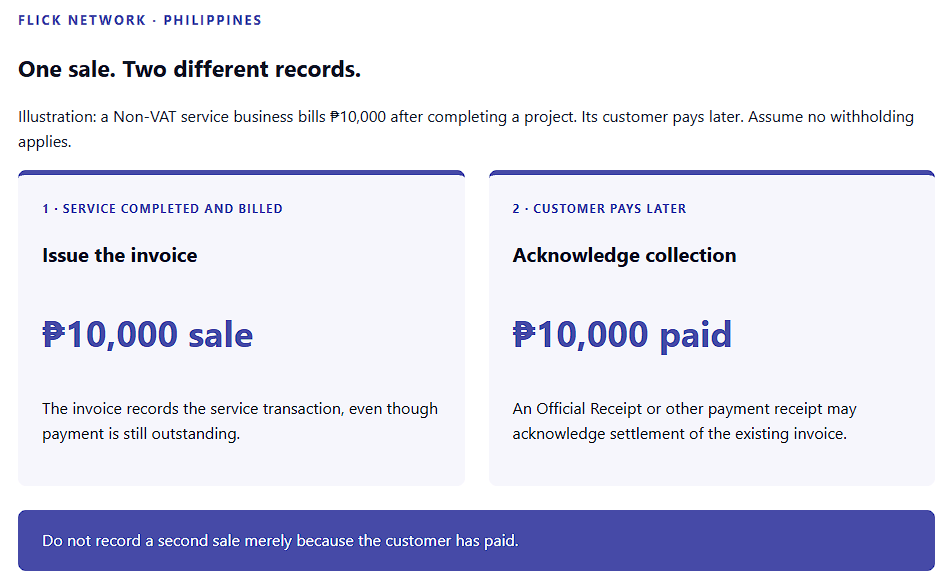
Assume a Non-VAT design business completes and bills a ₱10,000 project on 5 November. Its customer pays on 20 November. For simplicity, assume no withholding applies.
- 5 November: The business issues its Non-VAT invoice for the completed service.
- 20 November: It records the collection against that invoice and may issue an Official Receipt or another payment receipt.
The second document acknowledges settlement. Issuing another sales invoice merely because payment arrived could cause the same sale to be recorded twice.
For a cash sale, the sale and payment happen together. The business still issues the appropriate invoice; the timing does not make an OR a substitute.

Can Businesses Still Use Official Receipts Under EOPT?
Yes, as supplementary payment documents.
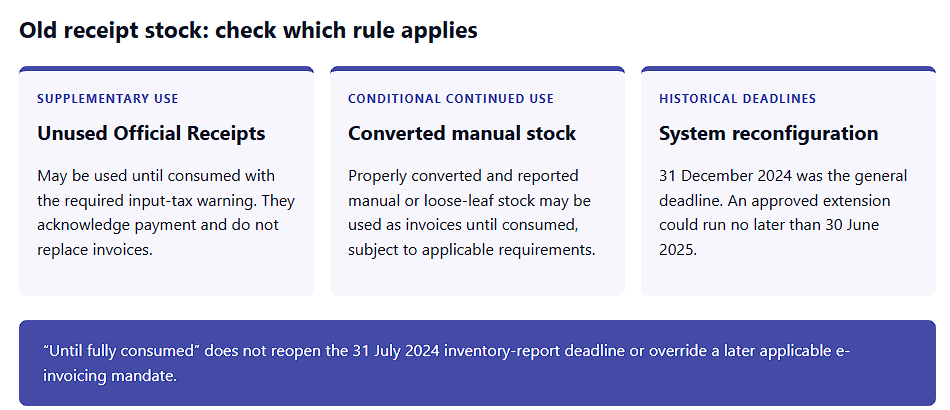
Remaining unused ORs may be used in that capacity until consumed, provided they carry the required statement:
“THIS DOCUMENT IS NOT VALID FOR CLAIM OF INPUT TAX.”
That statement explains the document’s limitation. It does not remove the seller’s obligation to issue an invoice for the underlying sale. RR 11-2024 also recognises Collection Receipts, Acknowledgement Receipts and Payment Receipts as payment evidence.
A practical approach is to keep the invoice and payment record linked. Accounts receivable staff can then see which invoice was settled, when the customer paid and whether any balance remains.
EOPT Transition Rules for Old Official Receipts
Older articles often discuss conversion options and deadlines in the present tense. Before applying that advice, identify the document involved.
Converted manual or loose-leaf ORs: conditional continued use
RR 11-2024 allowed unused manual or loose-leaf ORs to be converted into invoices and used until fully consumed.
Conversion required striking through the old title, stamping an appropriate invoice title and including the required information. The inventory-report deadline was 31 July 2024.
Properly converted and reported stock should not be described as automatically expiring on 31 December 2024. Equally, “until fully consumed” does not reopen the reporting deadline or give a business permission to start an undocumented conversion now.
Machine and accounting-system adjustments: expired deadlines
The general deadline for the relevant system reconfiguration or enhancement was 31 December 2024.
An extension required approval and could not exceed six months beyond that date, meaning 30 June 2025 at the latest under that provision. These dates are historical, not a current grace period for continuing to issue ORs as primary sales documents.
Later requirements still apply
Continued use of eligible old stock does not override a later requirement applicable to the taxpayer, such as mandatory electronic invoicing.
The useful distinction is between permission to finish qualifying document stock and permission to delay a required system change. They are different provisions.
BIR Invoice Requirements Under EOPT: What to Check
An invoice title alone is insufficient. Review the registered document and its transaction details, including:
- Seller identification and applicable buyer details.
- Transaction date and invoice number.
- Description of goods or nature of services.
- Quantity, unit cost and sales amount, as applicable.
- VAT details and the correct treatment of the transaction.
Business style is no longer mandatory, although a business may still display its trade name for identification.
For input VAT, avoid assuming that every omission has the same consequence. RMC 77-2024 identifies essential information, including the sales and VAT amounts, both parties’ registered names and TINs, the goods or service description, and transaction date. Seller noncompliance and the buyer’s input-tax entitlement require separate consideration.
For the full field list for e-invoices, see our Philippines e-invoice requirements guide.
Creditable Withholding Tax on Invoices
RR 6-2026 added the requirement to show applicable Creditable Withholding Tax (CWT) separately on the invoice.
RMC 112-2026 clarifies that this applies when the particular transaction is subject to CWT. A B2B transaction does not automatically attract withholding merely because both parties are businesses.
Where applicable, the invoice shows the sale and the separate withholding amount, with the resulting net amount payable. CWT should not be treated as a sales discount or a reduction of the VAT base.
This update concerns invoice information. It does not restore the OR’s former role as the primary document for services.
How Does This Connect With E-Invoicing in the Philippines?
EOPT determines the invoice’s role as the sales document. The electronic invoicing framework adds requirements concerning how covered taxpayers generate and issue that invoice.
Under RMC 98-2026, manually creating a document in Word or Excel does not make it a qualifying electronic invoice. The applicable system and structured-data requirements must be met.
Issuing an electronic invoice and electronically reporting sales data to the BIR are also separate obligations. Sending the customer an invoice should not be described as completing BIR sales reporting.
Our Philippines e-invoicing guide explains the broader framework.
Keep Sales and Collections Clear
The most useful process check is simple: can your team identify the document recording the sale and the record showing its payment?
Review invoice templates, collection documents and any remaining converted stock together. This helps prevent delayed invoicing, duplicate sales records and reliance on an expired transition deadline.
For businesses reviewing their software, Flick’s global e-invoicing platform provides a starting point for discussing billing workflows and integration requirements.

Invoice vs Official Receipt FAQs
Q1. Are official receipts no longer allowed in the Philippines?
They remain usable as supplementary payment documents under the applicable rules. They generally do not replace the invoice required to document a sale.
Q2. Should a service business issue an invoice or an official receipt?
It should issue an invoice for the service transaction. An OR or another payment receipt may acknowledge subsequent collection.
Q3. Does a Non-VAT business have to issue invoices?
Yes. Non-VAT status does not remove invoicing obligations. The transaction threshold, buyer-request rule and daily aggregation requirement apply.
Q4. Did all converted official receipts expire on 31 December 2024?
No. Properly converted and reported manual or loose-leaf stock was allowed until fully consumed, subject to applicable requirements. The system-reconfiguration deadline was a different provision.
Q5. Can a business wait until a credit customer pays before invoicing?
For an ordinary completed and billed sale, it should not delay the invoice until collection. The later payment settles the existing invoice.
Q6. Does emailing an official receipt satisfy electronic invoicing requirements?
Email delivery alone is insufficient. The document and the system generating it must satisfy the applicable electronic invoice requirements.
Quick Navigation
Book a Demo
Learn more by booking a demo with our team. We'll guide you step by step.