Philippines Electronic Invoicing vs Sales Reporting
Last updated at
October 28, 2026
Book a Demo
Learn more about this by booking a demo call with us. Our team will guide you through the process and answer any questions you may have.
Book NowElectronic Invoicing vs Electronic Sales Reporting in the Philippines
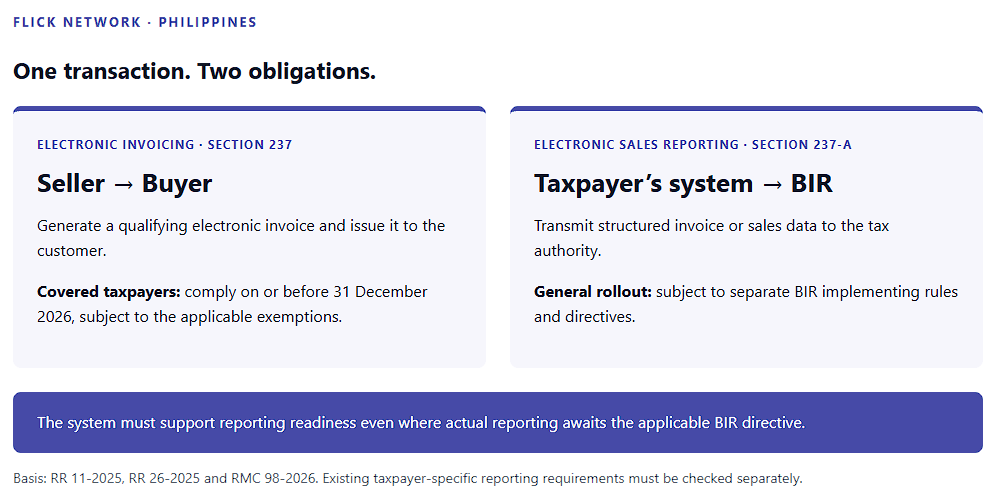
Sending an invoice to a customer and reporting its data to the Bureau of Internal Revenue (BIR) are two different actions. A business can prepare for electronic invoice issuance while its obligation to transmit sales data follows a separate implementation requirement.
That distinction matters when planning for the Philippines’ electronic invoicing deadline. Covered taxpayers must comply with electronic invoice issuance requirements on or before 31 December 2026. That date does not automatically become the general start date for electronic sales reporting.
The two obligations share the same underlying invoice data, but their recipients, authorizations, and implementation conditions differ. Businesses need to understand both before deciding what their accounting system must do and when.
Philippines Electronic Invoicing vs Electronic Sales Reporting: Key Differences
Electronic invoicing concerns the invoice issued to the buyer. Electronic sales reporting concerns structured data transmitted to the BIR. Preparing the customer-facing document is therefore only one part of the wider system design.
| Point of comparison | Electronic invoicing | Electronic sales reporting |
| Main purpose | Generate and issue a qualifying electronic invoice | Report structured invoice or sales data to the BIR |
| Recipient | Buyer, purchaser or client | BIR |
| Tax Code provision | Section 237 | Section 237-A |
| Implementation | Covered taxpayers must comply on or before 31 December 2026, subject to applicable exemptions | General implementation depends on separate BIR rules and directives |
| Relevant authorization | Permit to Issue (PTI) Electronic Invoice | Permit to Transmit (PTT), when required by the Commissioner’s notification or directive |
RMC No. 98-2026 expressly separates these obligations. Its distinction is useful for businesses assessing whether they need to change invoice generation, customer delivery, reporting capability or all three.
What Makes an Invoice a Qualifying Electronic Invoice?
A document does not qualify simply because it appears on a screen or arrives by email. The system producing it, its delivery method, and its underlying data all matter.
RR 11-2025 establishes the structured-data framework. RMC 98-2026 sets out three requirements:
- System generation: The invoice comes from duly registered, approved or accredited accounting or invoicing software or a system, in a structured electronic format.
- Electronic issuance: It is generated and transmitted digitally to the buyer through an accepted channel, such as email, online viewing, a QR code, an application or a web platform.
- Extractable data: Its information can be electronically extracted, processed and transmitted to the BIR for sales reporting.
These are requirements for the invoicing system and invoice. They should not be read as a statement that every commercial software provider holds BIR accreditation.
Can a PDF Be Used?
The file extension alone does not decide whether the invoice qualifies. A PDF generated through a compliant invoicing system may serve as the buyer-facing document when the underlying structured data and other requirements are satisfied. Manually creating an invoice in Word or Excel and converting it to PDF does not meet the electronic invoicing requirements.
Printed copies are also permitted under the circular’s conditions. Providing a printed copy does not remove the need for a qualifying electronic invoice and the required system capabilities.
Must the Buyer Receive a JSON File?
The BIR’s existing EIS uses JSON for sales-data transmission. Businesses may use other structured formats internally if the required data can be converted into the format prescribed by the BIR.
The customer’s readable invoice and the reporting data therefore serve different purposes. A buyer may view an invoice through an application or receive it by email while the system retains structured information for processing and reporting.
Our guide to Philippines electronic invoice requirements covers the related system, permit, and invoice requirements in more detail.
What Does BIR Electronic Sales Reporting Involve?
BIR electronic sales reporting involves transferring structured invoice or sales information to the tax authority. Under RR No. 11-2025, the reporting process uses direct system-to-system data transfer without manual entry.
Emailing an invoice to the buyer does not complete that transfer. Equally, keeping a spreadsheet of sales does not establish that the required reporting process has been completed.
For implementation planning, businesses should distinguish three records:
- The invoice issued to the customer.
- The structured data retained by the invoicing system.
- The transmission record and response associated with reporting to the BIR, when applicable.
These records help answer different questions. Was the buyer invoiced? Does the system hold the correct transaction data? Was the required information successfully reported?
Reporting Readiness Is Required Before General Reporting Begins
A separate reporting timetable does not mean businesses can choose software that produces only a printable document.
The qualifying-invoice requirements already depend on data that can support electronic extraction, processing, and transmission. Businesses should therefore assess reporting capability while implementing invoice issuance, even where actual reporting awaits the applicable BIR rules or directive.
Existing Reporting Obligations Need Separate Attention
The Philippines already has an EIS framework and identified pilot taxpayers. Businesses already subject to specific reporting instructions should check those instructions and current BIR advisories.
The separate general rollout should not be interpreted as permission to stop an existing reporting obligation.
There is also an established BIR eSales system for reporting monthly sales associated with registered cash registers and POS machines. Businesses should distinguish that process from the structured invoice-data reporting discussed here.
Who Is Covered by Each Requirement?
Coverage depends on taxpayer classification, business activities and the systems used. A business may fall into more than one category.
Electronic Invoice Issuance by 31 December 2026
Under the current framework, the principal covered groups include:
- Small, medium, and large taxpayers engaged in e-commerce or internet transactions.
- Taxpayers under the jurisdiction of the Large Taxpayers Service.
- Taxpayers classified as large under the Ease of Paying Taxes Act and RR No. 8-2024.
- Taxpayers using a Computerized Accounting System (CAS), Computerized Books of Accounts (CBA) with accounting records and electronic invoicing, or other invoicing software.
RMC 98-2026 also provides for other taxpayers required by the Commissioner. It exempts micro taxpayers from the mandatory issuance requirement described in the circular, while allowing voluntary adoption subject to the applicable requirements.
Coverage can extend across the business. Where a covered activity is registered at a branch, the electronic invoicing requirement applies to the taxpayer’s head office and all branches.
Categories Subject to Further Implementation Conditions
RR No. 26-2025 retains conditional implementation for additional invoice-issuance categories:
- Exporters of goods and services.
- Registered Business Enterprises availing of the specified tax incentives.
- POS system users.
- Other taxpayers designated by the Commissioner.
These provisions depend on the BIR establishing the relevant system and issuing separate regulations.
However, exporters and qualifying incentivized enterprises should check whether they already fall under the CAS, CBA or other invoicing-software category. The regulation expressly distinguishes those businesses from exporters and enterprises covered only through the later provisions.
For example, an exporter using a CAS should assess its software-based coverage before concluding that all exporters can wait for a later rollout.
Electronic Sales Reporting Coverage
The reporting categories in RR 26-2025 include the principal groups above, together with exporters, the specified incentivized enterprises, POS users and other designated taxpayers.
Their inclusion identifies the intended scope. It does not, by itself, create one reporting start date for every business.
RMC 98-2026 states that the taxpayers it covers must comply with electronic sales reporting when the BIR issues the implementing policies, guidelines and procedures for that purpose.

PTI, EIS Certification and PTT: Which Does What?
These requirements address different parts of implementation. Treating them as interchangeable can lead to an incomplete preparation plan.
PTI Electronic Invoice: Authority to Issue
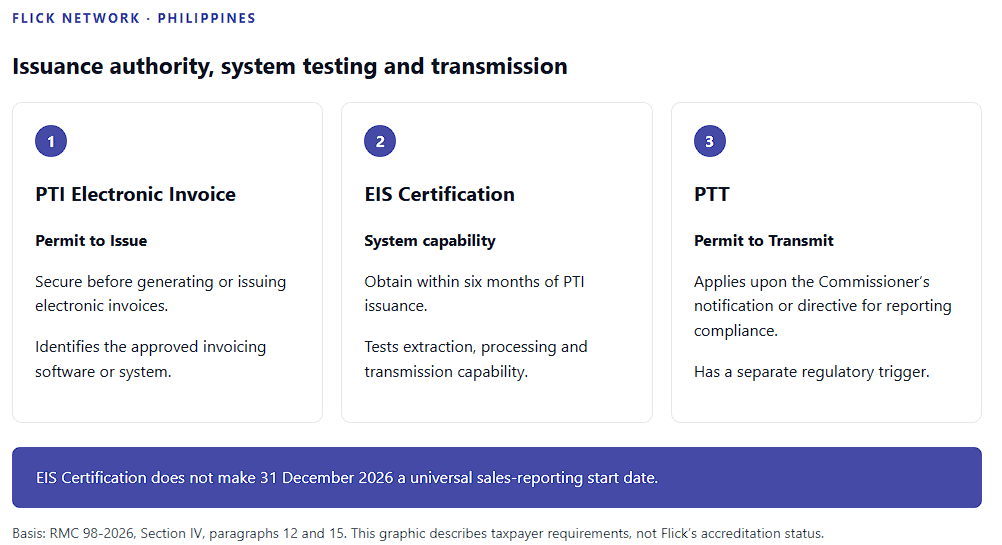
The Permit to Issue Electronic Invoice authorizes the taxpayer to issue electronic invoices through the approved invoicing software or system.
It must be secured before generating or issuing electronic invoices. An existing CAS Permit to Use or Acknowledgement Certificate does not, by itself, replace the PTI Electronic Invoice.
EIS Certification: Evidence of System Capability
EIS Certification validates the system’s ability to extract, process, and transmit sales data according to the BIR’s technical requirements.
Taxpayers required to issue electronic invoices must obtain this certification within six months of PTI issuance. Failure to do so is a ground for revocation of the PTI.
The six-month certification period is measured from PTI issuance. It should not be presented as a separate six-month extension of the electronic invoice issuance deadline.
PTT: Authorization Connected to Reporting
The Permit to Transmit applies upon notification or directive from the Commissioner requiring compliance with electronic sales reporting under Section 237-A.
A taxpayer should therefore track the issuance requirements, certification deadline and applicable reporting directive separately. Completing one does not automatically complete the others.
Example: One Sale, Two Different Processes
Consider a Philippine business that falls within mandatory coverage through its CAS. Assume it has secured the required PTI and issues a qualifying electronic invoice showing a total amount payable of ₱11,200.
Step 1: Issue the Invoice to the Buyer
The system generates the invoice with the required transaction and tax information. The buyer receives it through an electronic delivery channel.
The business retains the underlying structured data. This supports processing, record retrieval and reporting readiness.
Step 2: Handle BIR Reporting Under the Applicable Requirement
If the business is subject to an active reporting requirement, its reporting workflow must transmit the required data in accordance with that requirement.
If it is awaiting the general reporting rules and has no separate existing reporting obligation, issuing the invoice does not itself create a new obligation to transmit that sale immediately.
Step 3: Track Each Outcome Separately
Suppose the buyer receives the invoice, but a required reporting transmission fails. Customer delivery has occurred, while the reporting issue still needs attention.
Conversely, preparing a reporting file does not demonstrate that the invoice reached the buyer. A useful system keeps customer delivery and BIR transmission statuses separate so finance teams can identify the unfinished action.
What Businesses Should Prepare Now
A practical implementation review should cover the complete transaction process.
Check Coverage Across the Business
Record the basis for coverage, the taxpayer classification and the invoicing systems used by the head office and branches. Include overlapping categories, particularly where an exporter or incentivized enterprise already uses accounting or invoicing software.
Test the Invoice and Its Data Together
Choose representative transactions and check both the buyer-facing invoice and the structured information behind it.
For example, compare invoice numbers, dates, customer details, line amounts, discounts and applicable tax information. A readable document can still conceal missing or incorrectly mapped system data.
Assign Responsibility for Each Requirement
Identify who will manage the PTI, track EIS Certification and monitor reporting directives. Finance and IT should agree on responsibilities for customer delivery, data validation, failed transmissions and reconciliation.
Keep a Working Downtime Process
RMC 98-2026 requires BIR-authorized manual invoices when an outage or other qualifying disruption prevents electronic issuance.
Once the system is restored, those manual invoices must be replaced with corresponding electronic invoices referencing the manual invoice numbers. The process should preserve the link between the documents and prevent the same sale from being counted twice.
Assess Provider Capabilities and Regulatory Status Separately
A software demonstration can show functionality. Formal regulatory status requires its own evidence.
RMC No. 110-2026 sets out accreditation and continuing compliance requirements for electronic invoicing solutions of service providers. Businesses should assess the relevant solution, taxpayer permissions and implementation requirements separately.
Prepare the Invoice Workflow First, With Reporting in View
The distinction between electronic invoicing and electronic sales reporting affects more than terminology. It determines what the business must issue, what its system must support and which implementation conditions govern transmission to the BIR.
Start with taxpayer coverage, qualifying invoice generation, customer delivery and the required authorizations. Build reporting readiness into that work, while tracking the reporting rules that apply to the business.
To discuss your existing ERP, billing process, and implementation priorities, speak with Flick Network. A useful starting point is a sample transaction showing how invoice data moves from your accounting system to the customer and, when required, to the BIR.

FAQs
Q1. What is the difference between electronic invoicing and electronic sales reporting in the Philippines?
Electronic invoicing concerns generating and issuing a qualifying invoice to the buyer. Electronic sales reporting concerns transferring structured invoice or sales data to the BIR. They are separate obligations under Sections 237 and 237-A of the Tax Code.
Q2. Does the 31 December 2026 deadline apply to both obligations?
It applies to electronic invoice issuance by covered taxpayers, subject to applicable exemptions. It does not automatically start general electronic sales reporting. Reporting implementation depends on the relevant BIR rules and directives, while existing taxpayer-specific obligations must be considered separately.
Q3. Does emailing a PDF satisfy the electronic invoicing requirement?
Emailing a PDF alone is insufficient. The invoice must meet the system-generation, electronic-issuance and structured-data requirements. A PDF from a compliant system may serve as the buyer-facing document; a manually prepared invoice converted to PDF does not qualify on that basis.
Q4. Can a business wait for sales reporting rules before upgrading its invoicing system?
A covered business still needs to meet its electronic invoice issuance requirements. Its system must support structured data that can be extracted, processed and transmitted, even where actual reporting awaits the applicable implementation rules.
Q5. Are PTI and PTT the same permit?
No. PTI means Permit to Issue Electronic Invoice and concerns invoice issuance. PTT means Permit to Transmit and applies when the Commissioner directs compliance with electronic sales reporting.
Q6. Are all exporters outside the December 2026 issuance deadline?
No. An exporter may already be covered because it uses a CAS, qualifying CBA or other invoicing software. Businesses must assess every applicable coverage category before relying on the conditional provisions for exporters.
Q7. Does EIS Certification mean a software provider is BIR-accredited?
EIS Certification validates the relevant system’s technical capability. It should not be treated as proof of a provider’s or solution’s accreditation without the applicable accreditation evidence. Taxpayer permits, system certification and provider-solution accreditation serve different purposes.
Quick Navigation
Book a Demo
Learn more by booking a demo with our team. We'll guide you step by step.