E-Invoicing in the Philippines: BIR Rules, Deadlines & Compliance
Last updated at
August 21, 2026
Book a Demo
Learn more about this by booking a demo call with us. Our team will guide you through the process and answer any questions you may have.
Book NowE-Invoicing in the Philippines
The Philippines’ Bureau of Internal Revenue (BIR), under Revenue Regulations (RR) No. 11-2025, has introduced the national Electronic Invoicing / Electronic Sales Reporting System (EIS) in line with the CREATE MORE Act (Republic Act No. 12066). The system makes structured e-invoicing mandatory for selected taxpayers, changing how businesses issue, report, and validate invoices across the country.
The mandate requires all identified taxpayers, including e‑commerce businesses, large taxpayers under the BIR’s Large Taxpayers Service (LTS), and those using computerized accounting or invoicing systems, to issue invoices in a structured data format via a BIR‑registered/accredited system. Any invoice not issued in the required structured format is not considered an “electronic invoice” under the regulation.
E-invoicing is designed to improve transparency, reduce tax evasion, automate record-keeping for both businesses and the BIR. This blog explains the requirements of the system, key deadlines, technical process, benefits, and how providers like Flick Network help companies comply smoothly with the new law.
What Is E-Invoicing in the Philippines
E-invoicing in the Philippines refers to issuing, validating, and storing invoices electronically in a structured data format via a BIR-registered software or system rather than purely paper-based or unstructured digital formats. Each invoice is generated by a certified system (for example a Computerized Accounting System or Computerized Books of Accounts) in a structured format (such as JSON or another BIR-prescribed schema). It must be capable of transmitting the invoice data to the BIR’s EIS for reporting and validation.
Invoices that are merely scanned copies or photos of paper invoices do not qualify as electronic invoices under the regulation. Once issued in the required format and reported, the business retains the electronic record, making both supplier and the tax authority able to access and audit the transactions. The BIR platform or any certified third-party software connected to it enables businesses to generate, send and track invoices automatically. The process eliminates manual paperwork, ensures data accuracy, and provides traceability across business transactions in the Philippines.
Philippines E-Invoicing Timeline and Important Dates
The rollout of e-invoicing in the Philippines is phased, giving businesses time to prepare before full enforcement.
- 27 February 2025: The BIR issued RR No. 11-2025, implementing the structured e-invoicing and electronic sales reporting requirements.
- 14 March 2025: The regulation took effect (15 days after publication).
- 14 March 2026: Original deadline for covered taxpayers to start issuing structured e-invoices.
- 31 December 2026: The BIR extended the compliance deadline for certain taxpayers under RR No. 26-2025.
Who Must Follow the Philippines’ E-Invoicing Rules
The e-invoicing mandate applies to the following taxpayers under RR No. 11-2025:
- Taxpayers engaged in e-commerce or internet transactions (including sale of physical or digital goods, online services, platform-based services, social commerce).
- Taxpayers under the Large Taxpayers Service (LTS) of the BIR.
- Taxpayers classified as “large taxpayers” under the Ease of Paying Taxes Act (RA No. 11976) and related regulations.
- Taxpayers using Computerized Accounting Systems (CAS), Computerized Books of Accounts (CBA) with electronic invoicing, or other invoicing software capable of producing structured invoice data.
Once the BIR establishes a system capable of storing and processing the required data, further categories will be required to issue structured e-invoices:
- Exporters of goods and services
- Registered business enterprises (RBEs) availing tax incentives (under Section 304(D) of the Tax Code)
- Users of Point-of-Sale (POS) systems
- Other taxpayers as may be designated by the BIR Commissioner
If a business has a head office and branch offices, all parts must comply. Micro‑taxpayers are exempt from the mandatory structured e‑invoice requirement, though they may voluntarily opt‑in.
Technical Rules and E-Invoicing Process in the Philippines
Here are the key technical requirements and process points under the new mandate:
- Invoice Format: Invoices must be issued in a structured data format (for example JSON or XML) that adheres to the BIR’s schema so that data elements can be extracted and transmitted electronically.
- System Integration / Accredited Software: Businesses must use a BIR-registered/accredited system (CAS, CBA, invoicing software) capable of generating structured invoices and transmitting data to the BIR.
- Sales Data Transmission: Invoice data must be submitted to the BIR’s EIS via a sales data transmission system (API or other system‑to‑system interface). Data should be reported in real time or near‑real time and may not exceed three calendar days after the transaction (industry practice indicated).
- Archiving and Record‑Keeping: Providers shall keep an electronic invoice and its related information in an electronic archive that is accessible to the BIR during audits. Paper copies may be replaced by the electronic archive, depending on system readiness.
- Data Integrity: The system shall support the integrity of invoice data and secure transmission. Though the regulation does not make it compulsory to use a QR code stamp on an invoice, both the structured format and reporting process guarantee traceability.
Benefits of E-Invoicing in the Philippines
E-invoicing in the Philippines combines regulatory and operational benefits for both businesses and the tax authority:
- Efficiency: The system automates the issuance and reporting of business invoices, therefore reducing manual efforts and processing time of accounting teams.
- Accuracy: well-structured data means uniformity in invoices, which in turn minimizes human error in tax calculation and reporting.
- Compliance: The process enhances tax control and transparency, allowing the BIR to access transactional data in near-real time.
- Cost Savings: A move away from paper invoices and physical storage brings savings in printing, storage and audit preparation.
- Fraud Prevention: E-invoicing reduces manipulation of invoices and tax evasion through traceable digital records.
- Faster Reconciliation: The system accelerates accounting and payment cycles, improving cash-flow management of a company.
- Tax Incentive: Under CREATE MORE, taxpayers who comply or voluntarily adopt e‑invoicing and sales reporting may claim an additional deduction for the cost of implementing the system: 100% for micro & small taxpayers; 50% for medium & large taxpayers.
Consequences for Failing to Comply with E-Invoicing in the Philippines
Non-compliance with the e-invoicing requirement in the Philippines may create several risks for a business:
- Invalid Invoices: Invoices not issued in the required structured data format via a certified system may not qualify as electronic invoices under the regulation.
- Penalties: While the BIR emphasises transition and readiness, failure to comply may lead to sanctions or disallowance of certain deductions.
- Loss of Deduction: Businesses that do not adopt the system may forego the additional deduction for compliance‑system costs.
- Operational Disruptions: Delayed system integration or technical issues will disrupt billing and reporting workflows and affect smooth operation of a business.
- Audit Risk: Invoices not issued on a uniform basis or in a non-structured way may raise suspicions and make them more vulnerable during a tax audit.
How to Prepare for E-Invoicing in the Philippines
Here are steps businesses should take now to prepare:
- Assess Your Systems: Check if your ERP, billing or POS systems are BIR-registered/accredited and able to generate and transmit structured invoices.
- Choose a Solution Provider: Partner with a provider with a BIR-compliant solution, like Flick Network, for integration, validation, and transmission support that is set up to keep you in compliance.
- Integrate & Test: Connect your systems via the BIR-compliant solution;, either through API or submission of sample invoices, and confirm the mapping, data extraction, and reporting workflows.
- Staff Training: Train your finance and accounting staff regarding how to issue structured e-invoices, report data, store records, and manage the new workflow.
How Flick Network Helps Businesses with E-Invoicing in the Philippines
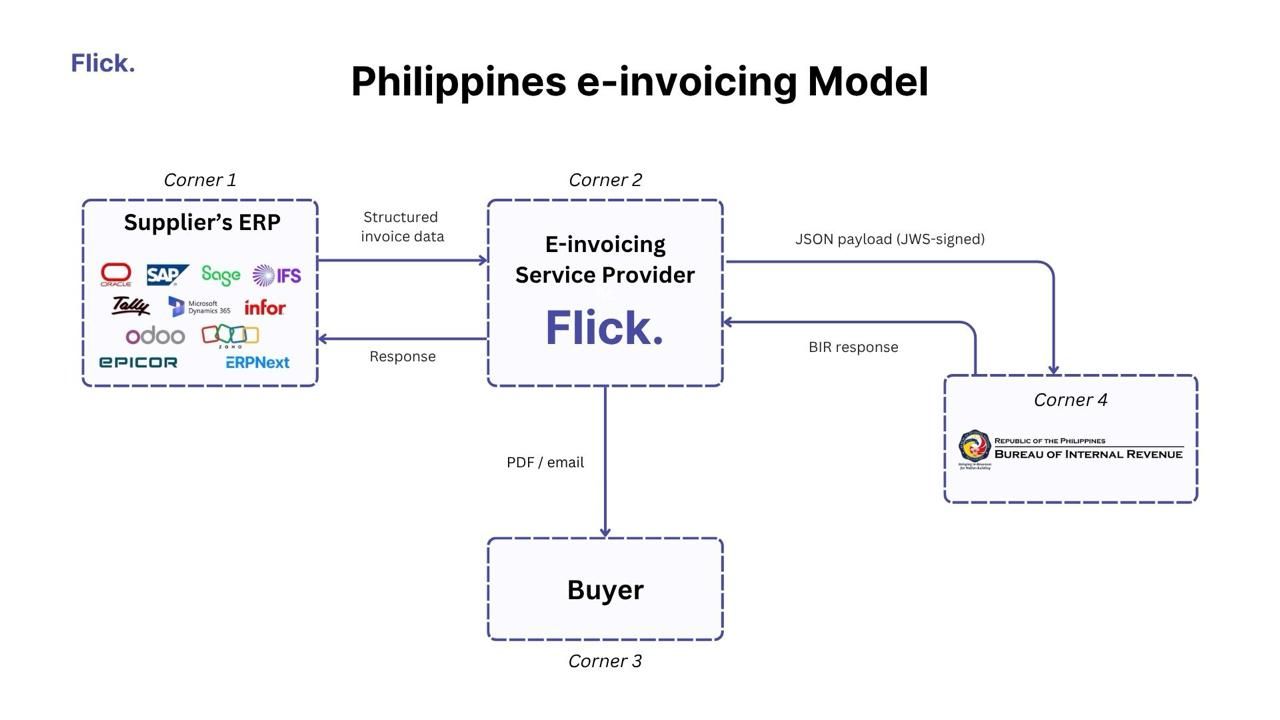
Flick Network provides a compliance-driven invoicing platform tailored for businesses of all sizes in multiple jurisdictions. For the Philippines context, the platform can support the transition to structured e-invoicing by offering:
- Structured Invoice Generation: Flick will format invoices automatically in structured data formats (JSON/XML) aligning with the BIR’s requirements for electronic invoicing.
- Submission and Reporting: The platform will help transmit invoice data to the BIR’s EIS through secure channels or API connection, supporting validation, tracking and archiving.
- Invoice Archiving and Tracking: All validated invoices and transmission logs will be stored digitally, with full traceability for audits, internal reporting and compliance monitoring.
- Integration with ERP/Billing Systems: Flick connects with existing ERP, POS or billing systems, reducing manual work, standardising invoice workflows and enabling scalability.
- Continuous compliance support; includes updating the regulations, data format compliance, versioning, and onboarding support required for alignment with rules laid down by BIR.
Conclusion
The Philippines’ transition to mandatory structured e‑invoicing under RR No. 11‑2025 is a major step in digitising tax compliance and business operations. From the extended deadline of 31 December 2026, selected taxpayers (e‑commerce businesses, large taxpayers, those using invoicing software) must issue invoices in a structured data format and report them to the BIR’s EIS.
By preparing early; registering systems, integrating software, training teams and archiving records properly - a company will streamline operations, reduce errors and stay fully compliant with the BIR’s regulations. Solutions like Flick Network help make the process smoother by managing generation, transmission, archiving and compliance end-to-end. Early adoption helps minimise disruption, avoid financial and operational penalties and benefit from a system of efficient, transparent and fully digital invoicing across the Philippines.
FAQs
- What is the BIR’s Electronic Invoicing System (EIS) in the Philippines?
It is the national platform where structured invoice data (e-invoices) must be submitted via system-to-system transfer, enabling electronic sales reporting under the BIR. - Who must comply with the e-invoicing mandate in the Philippines?
Taxpayers engaged in e-commerce or online transactions, large taxpayers under the LTS, those classified under the Ease of Paying Taxes Act, and businesses using computerized accounting/invoicing systems are required. - What happens if a business issues a scanned copy of a paper invoice in the Philippines?
Such a scanned copy does not qualify as an electronic invoice under RR No. 11-2025. Only system-generated structured invoices from a certified system count. - Is there a tax incentive for switching to e-invoicing in the Philippines?
Yes. Businesses that adopt the structured e‑invoicing and sales data reporting system (mandated or voluntarily) may claim an additional allowable deduction for the cost of implementing the system: 100 % for micro & small taxpayers; 50 % for medium & large taxpayers. - How long do I need to keep e-invoice records in the Philippines?
Structured invoice data must be stored in a retrievable digital format and available for future audits. While specific retention periods vary by audit guidance, the digital archive must be accessible for compliance purposes.
Quick Navigation
Book a Demo
Learn more by booking a demo with our team. We'll guide you step by step.