Philippines E-Invoicing for Online Sellers: BIR Rules
Last updated at
October 28, 2026
Book a Demo
Learn more about this by booking a demo call with us. Our team will guide you through the process and answer any questions you may have.
Book NowPhilippines E-Invoicing for Online Sellers and Digital Businesses
An online store, a freelance designer, and a creator earning subscription income can all fall within the BIR’s definition of e-commerce. Selling physical products through a marketplace is only one covered activity.
Philippines e-invoicing for online sellers depends on both business activity and taxpayer classification. Small, medium, and large taxpayers engaged in e-commerce or internet transactions must meet electronic invoice issuance requirements on or before 31 December 2026. Micro taxpayers are exempt from that mandatory requirement, subject to the rules on existing coverage and reclassification.
Who Needs to Prepare for Electronic Invoicing?
Start with two questions: does the business conduct an activity covered by the e-commerce definition, and how is the taxpayer classified?
A seller’s platform, trading name, or number of followers does not answer those questions. Neither does describing the work as a side business. The assessment concerns the taxpayer’s actual activities and applicable classification.
RMC No. 98-2026 identifies small, medium, and large taxpayers engaged in e-commerce or internet transactions among the covered groups. Other coverage categories include Large Taxpayers Service taxpayers and businesses using specified computerized accounting or invoicing systems.
Businesses should assess all applicable categories. An online business may be covered through its e-commerce activity and its accounting system.
What Counts as E-Commerce Under BIR Rules?
The regulatory definition extends to commercial transactions conducted through electronic channels. These include the sale, purchase, or lease of physical or digital goods and services through the internet, mobile phones, and other computer-mediated networks.
Transactions can be digitally ordered, digitally delivered, or enabled by a platform. A service does not have to be performed entirely online to fall within the definition.
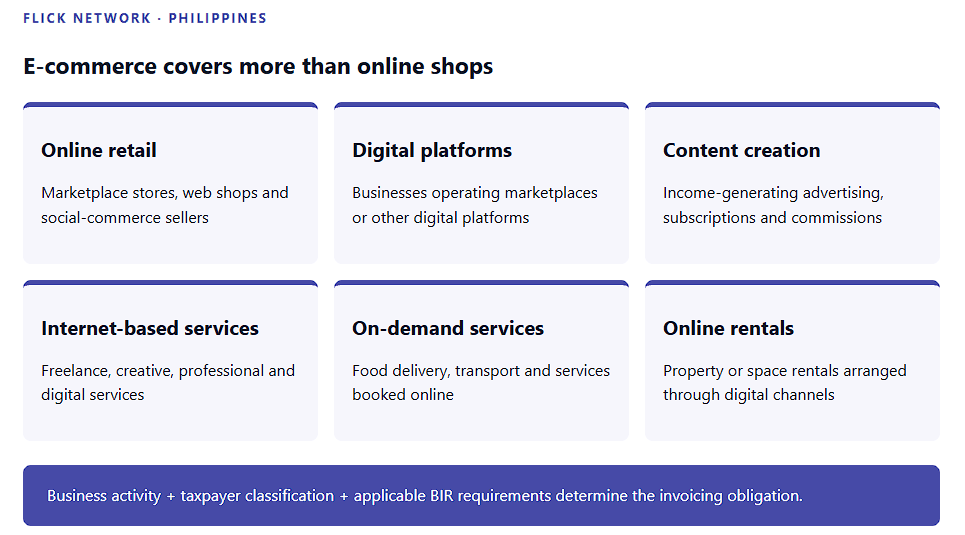
RR No. 11-2025 expressly includes online retail, digital platforms, income-generating content creation, internet-based professional services, on-demand services and online rental activities.
The examples below illustrate those categories. Being listed here does not automatically remove a taxpayer’s exemption.
| Business type | Illustrative activity | Why it falls within the definition |
| Online retailer | Selling clothing through a marketplace or website | Online sale of physical goods |
| Social-commerce seller | Taking product orders through a social-media account | Commercial activity conducted through an electronic channel |
| Digital platform operator | Operating a marketplace connecting sellers and customers | Operation of a digital platform |
| Content creator | Earning advertising, subscription or commission income from online content | Income-generating content creation and streaming |
| Freelancer or digital agency | Providing design, writing or other professional services over the internet | Internet-based creative, professional or freelance services |
| On-demand service or rental business | Accepting online bookings for delivery, cleaning or property rentals | Digitally arranged services or rental transactions |
Online Retail and Social-Commerce Sellers
A business can fall within e-commerce whether it sells through a marketplace, its own website or a social-media channel.
For example, a clothing seller accepting orders through a social-media page should assess the same activity and classification questions as a seller operating a web store. A separate shopping website is not necessary for an activity to be online commerce.
Payment method does not determine the answer on its own. An online order paid through cash on delivery remains an online selling transaction.
Digital Platforms and Marketplace Operators
RR 11-2025 includes businesses operating digital platforms, including e-marketplaces.
The platform operator and participating seller may have different transactions to document. A seller supplies goods or services to a customer, while a platform may charge fees or commissions for its own services.
Their invoicing arrangements should reflect the actual contractual roles. A platform’s order confirmation or settlement statement should not automatically be treated as the seller’s qualifying invoice.
Content Creators and Subscription Businesses
The regulation includes income-generating content creation and streaming, including advertising, blogging or vlogging, subscriptions and commissions.
A creator earning from paid content or advertising therefore needs to assess coverage. Having an online audience without a commercial transaction is a different situation.
For creators with several income streams, identify each arrangement separately. Advertising revenue, paid memberships and commissioned content may involve different customers, contracts and payment records.
Freelancers and Internet-Based Service Providers
Creative, professional, freelance and digital services supplied over the internet are expressly included.
A Philippine designer delivering paid work online or an agency providing internet-based services should assess its taxpayer classification and invoicing obligations. Working alone or from home does not, by itself, establish an exemption.
Employment is different. Salary earned under an employer-employee relationship should not be treated as freelance business sales simply because the employee works remotely.
Are Micro Online Sellers Exempt?
Micro taxpayers are exempt from the mandatory electronic invoice issuance requirement described in RMC 98-2026. They may adopt electronic invoicing voluntarily, subject to the applicable authorization and system requirements.
Under RR No. 8-2024, the taxpayer classifications are:
- Micro: Annual gross sales below ₱3 million.
- Small: Annual gross sales of ₱3 million to below ₱20 million.
- Medium: Annual gross sales of ₱20 million to below ₱1 billion.
- Large: Annual gross sales of ₱1 billion or more.
For classification, gross sales means total sales revenue excluding VAT, where applicable, without other deductions. Business and professional income are included; employment compensation is excluded.
Use the Taxpayer’s Sales, Not One Platform’s Payout
Marketplace payouts may already reflect commissions, fees, or other deductions. Do not substitute them for gross sales when assessing the classification thresholds.
Likewise, looking only at one storefront can give an incomplete picture. A taxpayer selling through several channels needs to consider the relevant business sales together.
Confirm the classification recorded with the BIR and follow its reclassification procedures where necessary. A calculation based on this month’s sales does not automatically change the taxpayer’s official category.
Exemption Does Not Remove Ordinary Invoicing Duties
An exemption from mandatory electronic invoicing does not mean the business can stop issuing invoices or maintaining records.
RR 11-2025 provides for registered manual invoices for micro taxpayers in the absence of electronic invoices. Other permitted arrangements remain subject to the applicable rules.
There is also an important qualification for existing users. RMC 98-2026 generally requires covered taxpayers to continue complying despite a later change in classification, unless the BIR expressly provides otherwise. A business should not stop electronic invoicing solely because its sales have fallen.
Three Examples of Online-Seller Coverage
These simplified examples assume that the stated BIR classifications are correct. They illustrate coverage rather than determine a particular business’s tax position.
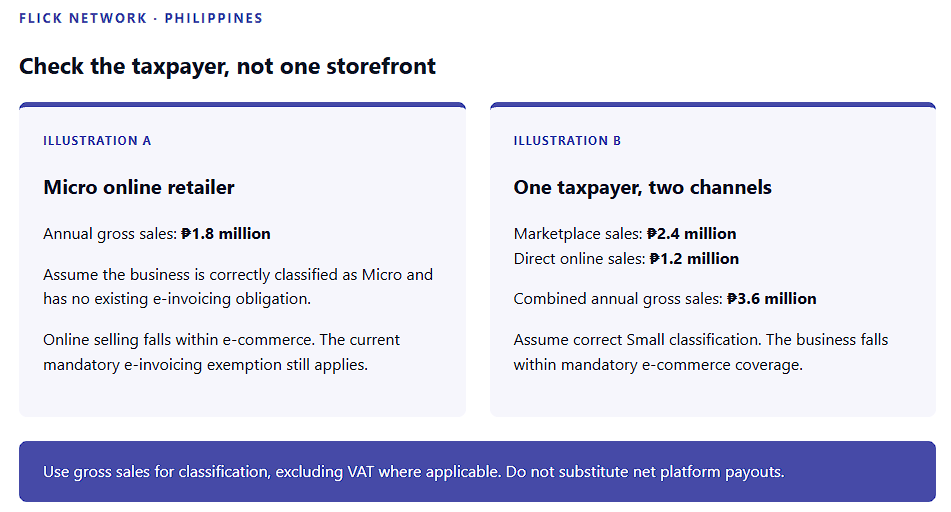
Example 1: A Micro Online Retailer
A retailer has annual gross sales of ₱1.8 million and is classified as Micro. Assume it has no existing obligation to continue electronic invoicing.
Its online selling activity falls within the e-commerce definition. However, the current micro-taxpayer exemption means it is not required to adopt electronic invoicing under this mandate.
The retailer must still follow its applicable registration, invoicing, record-keeping, and tax obligations.
Example 2: One Business Selling Through Two Channels
A business records ₱2.4 million in marketplace sales and ₱1.2 million in direct online sales during the taxable year. Assume these figures exclude VAT where applicable and represent sales of the same taxpayer.
Combined gross sales are ₱3.6 million. If correctly classified as Small, the business falls within the mandatory e-commerce category.
Assessing the marketplace account alone would miss the direct-sales channel and could produce the wrong conclusion.
Example 3: A Creator Earning Subscription and Advertising Income
A creator has ₱4.2 million in annual business gross sales from subscriptions and advertising and is classified as Small.
The relevant activity is income-generating content creation. The absence of physical products does not place the creator outside e-commerce coverage.
The creator should map each income stream to the relevant customer or contracting party and establish how invoices will be issued and reconciled with payment records.
What Must an Online Seller’s Electronic Invoice Do?
BIR e-commerce invoicing requirements concern both the document issued to the customer and the information retained by the system.
A qualifying electronic invoice must:
- Be generated through duly registered, approved, or accredited accounting or invoicing software or a system, using structured electronic data.
- Be issued electronically through an accepted channel, such as email, online viewing, a QR code, an application, or a web platform. The seller must also provide a printed copy if the buyer requests one.
- Contain data capable of electronic extraction, processing, and transmission to the BIR.
A manually prepared Word or Excel invoice does not become a qualifying electronic invoice merely because it is emailed or converted into PDF.
Conversely, a buyer-facing PDF should not automatically be rejected because it is a PDF. Its qualification depends on the underlying system, structured data, and other requirements.
Check What the Marketplace Actually Produces
An order summary, payment notification, and tax invoice serve different purposes.
Review whether the marketplace produces a qualifying invoice for the seller’s transaction or only supplies order and payment information. If the seller uses a separate invoicing system, establish how order details reach that system and how the invoice reaches the buyer.
Flick’s electronic invoice requirements guide explains the wider Philippine framework, including system requirements and taxpayer authorizations.

Electronic Invoicing and Sales Reporting Have Separate Requirements
For online sellers, issuing the customer’s invoice and transmitting sales data to the BIR remain separate obligations.
The 31 December 2026 deadline concerns electronic invoice issuance by covered taxpayers. RMC 98-2026 makes electronic sales reporting subject to the BIR’s implementing policies, guidelines, and procedures.
The main requirements have different purposes:
- Permit to Issue Electronic Invoice: Obtain the PTI before generating or issuing electronic invoices through the approved system.
- EIS Certification: Obtain certification within six months of PTI issuance to validate the required system capabilities.
- Permit to Transmit: The PTT requirement applies upon the Commissioner’s notification or directive for electronic sales-reporting compliance.
Reporting readiness still matters during implementation. A system that can only print invoices does not satisfy the structured-data requirement simply because general reporting has a separate timetable.
Businesses already subject to specific reporting instructions should continue checking those requirements and current BIR advisories. The separate general rollout should not be interpreted as cancelling an existing obligation.
What If the Business Also Sells Offline?
An online channel should not be assessed in isolation from the taxpayer’s other operations.
RMC 98-2026 states that coverage applies to the taxpayer as a whole. Where covered activities operate through a registered branch, the requirement extends to the head office and all branches.
For example, a business may operate a physical shop and an online store under the same taxpayer. If the taxpayer is covered, its preparation plan needs to address both operations.
Identify every invoicing system used across the business. Different systems at different branches or business segments can affect PTI requirements.
Preparing Philippines Digital Business Invoices
A useful implementation plan follows the transaction from the order or service agreement through invoicing, payment, and any later adjustment.
1. List Sales Channels and Income Streams
Record each marketplace, website, subscription service, and direct-client channel. For creators and service businesses, include the different commercial arrangements that produce business income.
Keep the legal taxpayer and customer identities clear. A platform transferring money is not automatically the customer named in every underlying transaction.
2. Reconcile Sales With Platform Settlements
Match orders or service records to invoices, fees, withholding amounts where applicable, refunds, and bank receipts. Under RMC 112-2026, sellers invoice buyers for the full sale amount. Any creditable withholding tax (CWT) deducted by a marketplace from the seller’s remittance is recorded separately in its settlement statement or remittance advice, with the applicable withholding certificate. This differs from a buyer directly withholding tax on its purchase
For example, a platform may transfer ₱9,500 after deducting ₱500 from a ₱10,000 customer payment. The settlement figure alone does not explain the sale. Keep records that show what was sold and what the deduction represents.
This is a reconciliation example. Actual invoice amounts and tax treatment depend on the transaction and contractual arrangement.
3. Test Customer Delivery and Data Extraction
Check whether customers can receive or access the invoice and whether the system retains usable structured data.
Test representative transactions, including discounts, multiple items, and recurring services where relevant. Compare the buyer-facing document with the system records so missing data is identified before routine issuance begins.
4. Prepare Returns and Downtime Procedures
Online businesses need a process for returns and other post-invoice adjustments. Under RMC 98-2026, issued electronic invoices must not simply be overwritten or deleted. Adjustments must follow the prescribed document rules and reference the original invoice.
For system downtime, prepare BIR-authorized manual invoices and a reconciliation process. Once the system is restored, the circular requires corresponding electronic invoices referencing the manual invoice numbers.
5. Check the Solution and Required Authorizations
Assess the system’s functions, the taxpayer’s permits, and the solution’s regulatory status separately.
RMC 110-2026 establishes accreditation and continuing compliance requirements for electronic invoicing solutions of service providers. A product demonstration or integration claim does not, on its own, establish that the relevant accreditation or taxpayer authorization has been obtained.
Build the Invoicing Plan Around How the Business Earns
Philippines e-invoicing for online sellers starts with identifying the commercial activity and taxpayer classification. For digital businesses, that assessment may cover subscriptions, advertising, commissions, professional services, and online retail within the same operation.
Once coverage is established, connect each sales channel to a qualifying invoice process. Plan customer delivery, structured data, permits, and certification together, while keeping actual BIR sales reporting tied to its applicable requirements.
Discuss your sales channels, accounting system, and implementation priorities with Flick Network. Bring sample orders, invoices, and settlement records so the discussion reflects how your business operates.

FAQs
Q1. Is Philippines e-invoicing mandatory for every online seller?
No. Small, medium, and large taxpayers engaged in e-commerce or internet transactions are covered by the current issuance mandate. Micro taxpayers are exempt, subject to the rules affecting existing coverage and reclassification. Online selling activity alone does not settle the exemption question.
Q2. Do social-media sellers fall within BIR e-commerce invoicing rules?
Yes, social-commerce activity can fall within the e-commerce definition. Selling through a social-media page instead of a dedicated website does not exclude the business. Mandatory electronic invoicing still depends on its classification and applicable coverage.
Q3. Are freelancers and content creators included?
The rules include internet-based freelance and professional services, as well as income-generating content creation through advertising, subscriptions, and commissions. Those businesses must assess their classification. Being a freelancer or creator does not automatically mean being a micro taxpayer.
Q4. Does cash on delivery keep a seller outside e-commerce?
No. The definition includes digitally ordered transactions. Paying cash when an online order arrives does not, by itself, change the transaction into an offline sale.
Q5. Can I use my marketplace payout to check the ₱3 million threshold?
Not as a substitute for gross sales. Payouts may already deduct fees and other amounts. The classification rules use gross sales excluding VAT where applicable, without other deductions. Consider the taxpayer’s relevant business sales across channels and confirm its BIR classification.
Q6. Does a marketplace order confirmation count as an electronic invoice?
Not automatically. Check whether it is a qualifying invoice generated through the required system with structured data and the necessary information. An order acknowledgement or payment notification alone does not demonstrate compliance.
Q7. Must every covered seller transmit invoices to the BIR from 31 December 2026?
That date does not automatically begin general electronic sales reporting. Invoice issuance and reporting are separate obligations. Reporting depends on the applicable BIR rules and directives, while businesses with existing reporting obligations must consider those separately.
Q8. Can an exempt micro seller voluntarily adopt electronic invoicing?
Yes. Voluntary adoption is permitted, subject to the applicable PTI, system, and other requirements. A seller should assess the full process rather than assume that buying software alone completes compliance.
Quick Navigation
Book a Demo
Learn more by booking a demo with our team. We'll guide you step by step.