Philippines E-Invoicing Branch Requirements | BIR Rules
Last updated at
November 4, 2026
Book a Demo
Learn more about this by booking a demo call with us. Our team will guide you through the process and answer any questions you may have.
Book NowHow Philippines E-Invoicing Rules Apply to Head Offices and Branches
If a covered business activity operates through one registered branch, the Philippines’ electronic invoicing requirement can extend to the head office and every other branch of the same taxpayer. A location does not have to conduct that activity itself to be included.
The Philippines e-invoicing branch requirements therefore need a business-wide assessment. Preparing only the online-sales branch, or only the head office, can leave other covered locations outside the implementation plan.
The starting point is whether the taxpayer falls within mandatory coverage. Once that is established, the published rules explain how coverage extends across its registered locations and how the invoicing systems used affect Permit to Issue requirements.
What Do the Philippines E-Invoicing Branch Requirements Say?
A branch’s own activity is not the only factor determining its obligation. The rules also consider whether it belongs to a taxpayer already covered by the mandate.
RR No. 11-2025 provides that, where the specified taxpayers or business activities are registered as a branch office, the taxpayer’s head office and all branch offices must also issue electronic invoices.
RMC No. 98-2026, Section IV(10), makes the position clearer: compliance applies to the taxpayer as a whole, regardless of whether the covered activity takes place at a particular branch.
For example, a taxpayer may operate an e-commerce business through one branch and conduct walk-in sales at other locations. Once the taxpayer is covered, those other branches cannot assess their position solely by asking whether they sell online.
Establish Taxpayer Coverage First
The principal categories include:
- Small, medium and large taxpayers engaged in e-commerce or internet transactions.
- Taxpayers under the Large Taxpayers Service.
- Large taxpayers under the Ease of Paying Taxes framework.
- Taxpayers using the specified computerized accounting, books-of-accounts or invoicing software.
Applicable exemptions and conditional coverage still matter. The branch rule does not make every business with several locations subject to the mandate.
Micro taxpayers are exempt from the mandatory issuance requirement described in RMC 98-2026. Existing coverage, voluntary adoption and subsequent reclassification need separate consideration before a business relies on that exemption.
A Quiet Branch Is Not Automatically Exempt
A branch with limited sales should not be treated as a separate micro taxpayer merely because its own turnover is low. First establish the taxpayer to which it belongs and that taxpayer’s applicable classification.
Similarly, a branch without an online channel is not automatically outside coverage when another registered branch conducts the covered activity.
Example: One Online Branch and Two Physical Stores
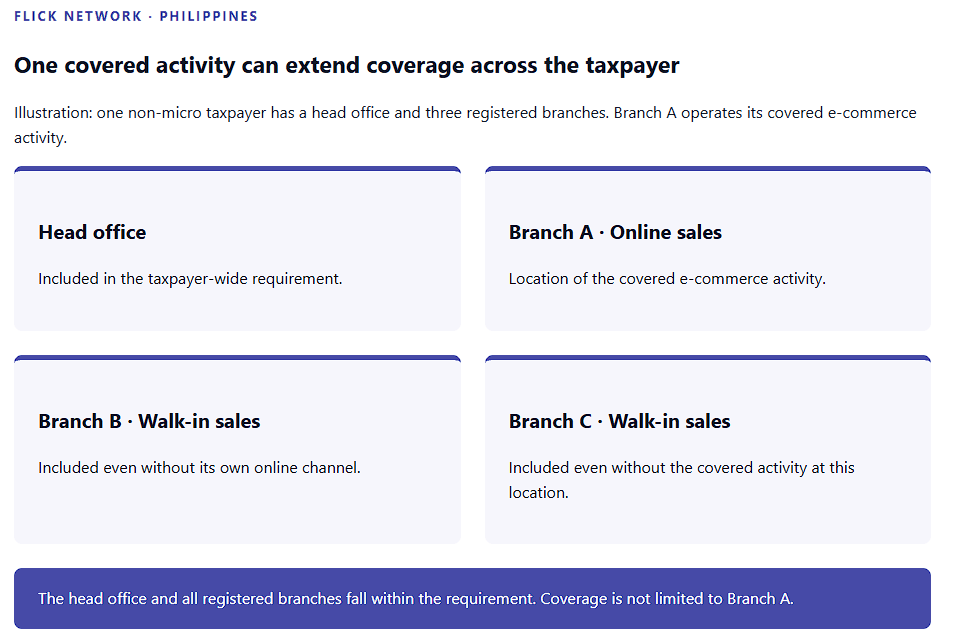
Consider a Philippine retailer with a head office in Manila and three registered branches. Assume all four locations belong to the same taxpayer, which is correctly classified as Small and has no applicable exemption.
Branch A operates the retailer’s online-sales business. Branches B and C make walk-in sales and do not operate their own online stores.
| Location | Activity in this example | Effect of the branch rule |
| Head office | Administration and business oversight | Included in the taxpayer-wide electronic invoicing requirement |
| Branch A | Covered e-commerce activity | Included as the location conducting the covered activity |
| Branch B | Walk-in retail sales | Included even though it does not conduct e-commerce |
| Branch C | Walk-in retail sales | Included even though it does not conduct e-commerce |
The retailer’s assessment cannot stop at Branch A. Its invoicing arrangements must account for the head office and all registered branches.
This does not mean the head office must issue a duplicate invoice for every branch sale. The published rule establishes coverage across locations. The actual transaction still needs to be documented through the appropriate invoicing arrangement.

Do Branches Without the Covered Activity Still Need Electronic Invoices?
Yes, where they are branches of a taxpayer subject to the requirement.
The circular expressly includes branches regardless of whether the covered activity is undertaken there. That prevents the business from limiting implementation to the location that first brought it within scope.
For the retailer in the example, Branches B and C remain included even though their customers purchase in person.
BIR Head Office Invoicing and Branch Invoicing Must Be Considered Together
Head-office readiness alone does not demonstrate that every branch’s invoice process meets the requirements.
A business may use one accounting system across its locations or several distinct invoicing systems. Either arrangement needs to be assessed against the published requirements. The number of systems affects PTI treatment, while the taxpayer-wide rule determines which locations are covered.
Separate Companies Need Their Own Assessment
The rule concerns a taxpayer’s head office and registered branches. It should not be extended automatically to every business sharing a brand, owner or corporate group.
A separately registered subsidiary or franchise operator needs its own coverage assessment. Common branding does not, by itself, establish that a location is a branch of the same taxpayer.
How Does the PTI Electronic Invoice Apply to Branches?
The Permit to Issue Electronic Invoice authorizes electronic invoice issuance through the approved invoicing software or system. RMC 98-2026 sets out specific provisions for head offices and branches.
These provisions distinguish the locations covered from the systems they use.
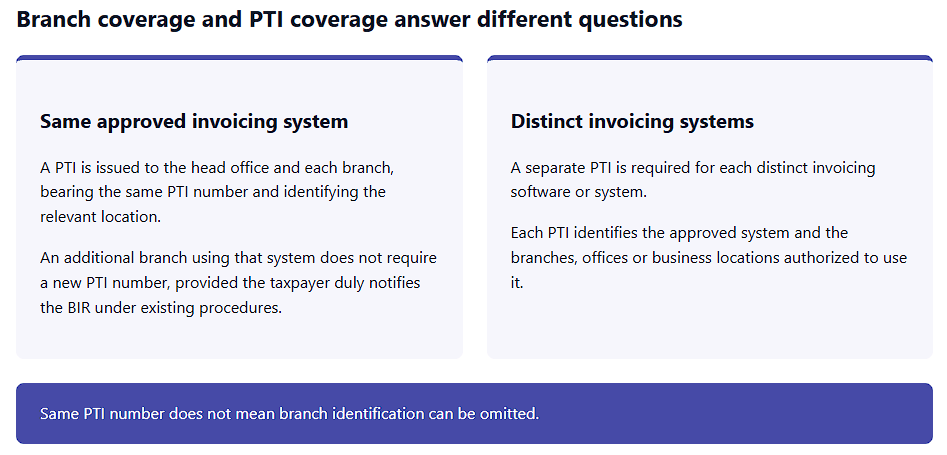
Head Office and Branches Using the Same System
Section IV(13) provides for a PTI Electronic Invoice to be issued to the head office and each separate branch, bearing the same PTI number and identifying the branch to which it pertains.
The shared number does not mean branch identification can be omitted. The authorization must still identify the relevant location.
It is therefore more precise to describe PTIs bearing the same number than to say that one unidentified head-office permit automatically covers everything.
Branches Using Distinct Invoicing Systems
Where different branches, offices or business segments use distinct invoicing software or systems, a separate PTI Electronic Invoice must be secured for each distinct system.
Each PTI must identify the approved system and the branches, offices or business locations authorized to use it.
For example, if the retailer’s online branch uses one invoicing system and its physical stores use another distinct system, the business must account for that distinction. The fact that all locations belong to one taxpayer does not remove the separate-system requirement.
A System Change Can Affect the PTI
Section IV(12) also addresses changes to the approved system’s identity, name, platform or core details, including migration to or adoption of another invoicing system.
Such changes require a new or amended PTI, as applicable. Businesses should therefore consider the authorization implications before treating a software replacement as only an internal IT change.
Flick’s electronic invoice requirements guide explains the wider PTI and system requirements.
What Changes When a New Branch Opens?
RMC 98-2026 states that adding branches using the same approved electronic invoicing system does not require a new PTI number, provided the taxpayer duly notifies the BIR in accordance with existing rules and procedures.
That is a limited rule. It does not remove the notification requirement or mean the new location can be omitted from the business’s records.
If the new branch uses a distinct invoicing system, the separate-system PTI provision must also be considered.
Does Branch Coverage Also Trigger Electronic Sales Reporting?
Invoice issuance and electronic sales reporting remain separate obligations.
RR 11-2025 includes a head-office and branch provision in its electronic sales reporting framework. However, reporting scope must be read together with the implementation conditions in RR 26-2025 and RMC 98-2026.
Under the amended transition provisions, the general reporting rollout depends on the relevant BIR system and separate regulations. RMC 98-2026 likewise makes reporting compliance subject to the implementing policies, guidelines and procedures.
The Issuance Deadline Is Not a Universal Reporting Start Date
Covered taxpayers must comply with electronic invoice issuance requirements on or before 31 December 2026, subject to applicable exemptions.
The branch rule determines the locations included in that obligation. It does not automatically make 31 December 2026 the date on which every location must begin transmitting sales data to the BIR.
Businesses already subject to specific reporting requirements must continue to assess those requirements and current BIR advisories.
PTI, Certification and PTT Have Different Purposes
The taxpayer must secure the PTI before electronic invoice issuance. EIS Certification must be obtained within six months of PTI issuance to validate the required system capabilities.
The Permit to Transmit requirement applies upon the Commissioner’s notification or directive for electronic sales reporting compliance.
These requirements should be tracked separately. A branch being included in invoice issuance coverage does not establish that every reporting-related permission has already been obtained.
What Should a Business Review Across Its Locations?
The following checks help apply the published rules. They are preparation steps, rather than a new branch-registration procedure.
Identify the Taxpayer and Its Registered Locations
List the head office and registered branches belonging to the taxpayer. Keep separately registered entities distinct so the assessment does not accidentally include or exclude the wrong business.
Record the activity or category establishing mandatory coverage and any exemption being relied upon.
Record the Invoicing Systems in Use
Identify which locations use the same system and which use distinct systems. Compare that information with the approved system and location coverage shown in the relevant PTIs.
A list of software names alone may be insufficient if the business has different approved configurations or platforms. The review should reflect the actual systems covered by its authorizations.
Check Electronic Invoice Capability at Each Relevant Location
The invoice must meet the required system-generation, electronic-issuance and structured-data conditions.
Check how customers receive or access invoices and whether the underlying data can be extracted and processed. A branch’s ability to print a document does not, by itself, establish electronic invoice compliance.
Include Corrections and Downtime
A branch outage does not remove the invoice obligation. RMC 98-2026 requires BIR-authorized manual invoices where a qualifying disruption prevents electronic issuance.
After restoration, the corresponding electronic invoices must reference the manual invoice numbers. Staff should be able to connect those documents without recording the same sale twice.
Corrections also need controlled handling. Issued electronic invoices must not simply be deleted or overwritten; the applicable adjustment documents must refer to the original invoice.
Keep Permits and Provider Claims Separate
Taxpayer coverage, PTI authorization, EIS Certification and a provider’s regulatory status answer different questions.
Choosing software does not, by itself, establish that every branch is covered by the appropriate authorization. Review the relevant evidence for the actual system and locations rather than relying on a general compliance claim.
Plan for the Whole Taxpayer
Philippines e-invoicing branch requirements can extend beyond the location conducting the covered activity. The practical task is to identify the taxpayer’s full branch structure, understand the invoicing systems used and apply the published authorization requirements to those systems.
Keep actual BIR sales reporting tied to its separate implementation requirements. This avoids both missing covered locations and assuming that every reporting obligation begins with the invoice issuance deadline.
To discuss your head-office and branch workflows, speak with Flick Network. A list of locations, invoicing systems and representative transactions provides a useful starting point for reviewing the implementation scope.

FAQs
Q1. If only one branch sells online, do the other branches need electronic invoices?
Where that activity brings the taxpayer within mandatory coverage, the requirement extends to the head office and all registered branches. The other branches do not need to conduct the same covered activity themselves.
Q2. Does every branch need a different PTI number?
Not necessarily. RMC 98-2026 provides for PTIs issued to the head office and each branch bearing the same PTI number and identifying the relevant branch. Where distinct invoicing systems are used, a separate PTI is required for each distinct system.
Q3. Can the head office’s PTI be treated as proof that every branch is covered?
Check the actual authorization and system coverage. The circular requires branch identification and contains separate provisions for distinct systems. The existence of a head-office PTI alone should not replace that review.
Q4. Does a new branch using the same approved system need a new PTI number?
The circular says a new PTI number is not required for an additional branch using the same approved system, provided the taxpayer duly notifies the BIR under existing rules and procedures.
Q5. Is a low-sales branch automatically exempt as a micro taxpayer?
No. First establish the taxpayer to which the branch belongs and the applicable taxpayer classification. A branch’s own sales should not automatically be treated as a separate taxpayer classification.
Q6. Does branch coverage extend automatically to subsidiaries and franchisees?
No automatic extension should be assumed. The published rule concerns the same taxpayer’s head office and registered branches. Separate legal entities require their own coverage assessment.
Q7. Must every covered branch begin electronic sales reporting on 31 December 2026?
The issuance deadline does not automatically start general electronic sales reporting. Reporting depends on the applicable BIR implementing rules and directives. Existing taxpayer-specific reporting obligations must also be considered.
Quick Navigation
Book a Demo
Learn more by booking a demo with our team. We'll guide you step by step.