Philippines E-Sales Reporting Tax Deduction Under RR 11-2025
Last updated at
November 17, 2026
Book a Demo
Learn more about this by booking a demo call with us. Our team will guide you through the process and answer any questions you may have.
Book NowPhilippines Electronic Sales Reporting Tax Deduction Under RR 11-2025
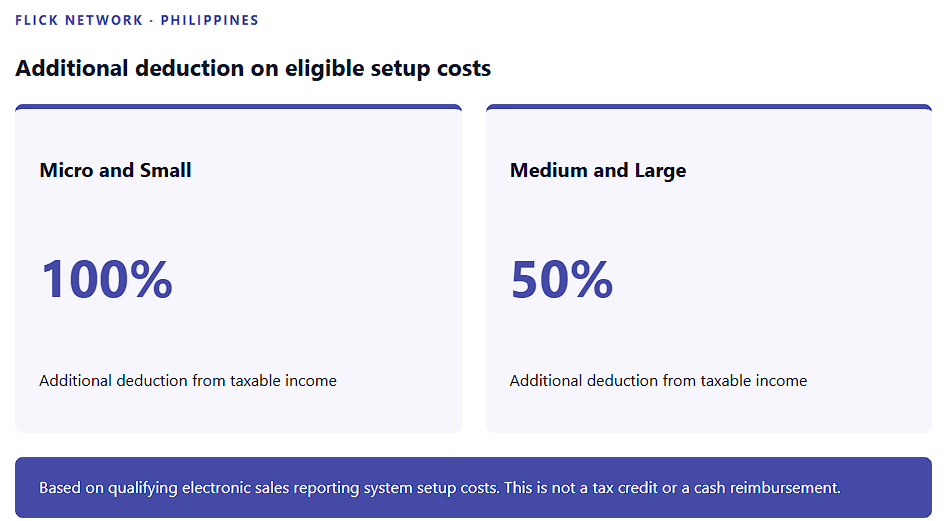
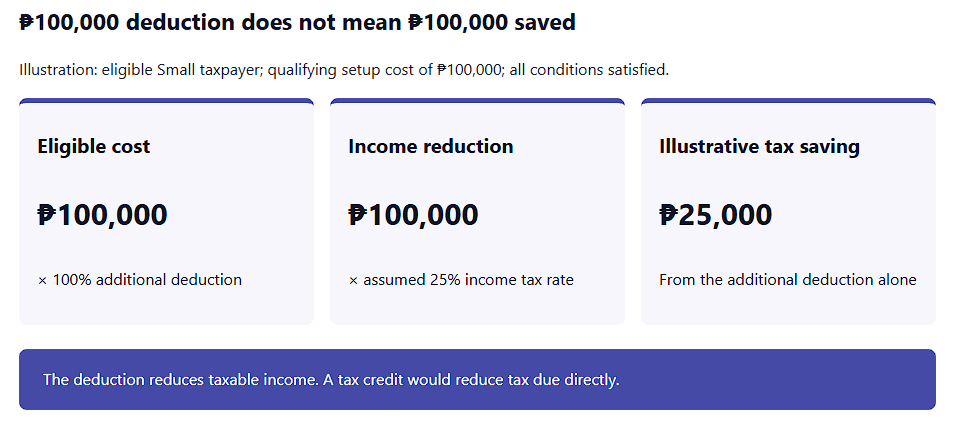
RR 11-2025 gives Philippine taxpayers an additional deduction for the cost of setting up an electronic sales reporting system: 100% of qualifying setup costs for micro and small taxpayers, and 50% for medium and large taxpayers. The deduction reduces taxable income, not tax due, so a ₱100,000 system purchase does not automatically mean a ₱100,000 tax saving.
The incentive also comes with conditions. Eligibility depends on the taxpayer’s classification and on compliance with both electronic invoicing and electronic sales reporting. Buying software, receiving a supplier invoice or starting to issue electronic invoices does not, by itself, establish entitlement.
For a finance team reviewing a proposal, three questions come first: does the business qualify, which costs belong in the calculation, and when can the deduction be claimed? The actual tax saving comes after those questions have been answered. It also depends on the business’s income tax position, rather than the deduction percentage alone.
What Is the RR 11-2025 Additional Deduction?
Section 4 of RR 11-2025 provides an additional deduction from taxable income based on the cost of setting up an electronic sales reporting system:
- Micro and Small taxpayers: 100% of qualifying setup costs.
- Medium and Large taxpayers: 50% of qualifying setup costs.
The incentive is additional to the allowable deduction under Section 34(A)(1) of the Tax Code. Its statutory basis is Section 237-A, as amended by the CREATE MORE Act.
“Additional” does not mean every project expense can automatically be deducted twice in the same year. The ordinary treatment of the expenditure must also be established under the applicable tax rules.
Which Taxpayer Classification Applies?
The deduction uses the Micro, Small, Medium, and Large classifications under the Ease of Paying Taxes framework.
| Taxpayer classification | Annual gross sales threshold | Additional deduction on qualifying setup costs |
| Micro | Below ₱3 million | 100% |
| Small | ₱3 million to below ₱20 million | 100% |
| Medium | ₱20 million to below ₱1 billion | 50% |
| Large | ₱1 billion and above | 50% |
For classification purposes, RR 8-2024 uses business gross sales, net of VAT where applicable, without other deductions. Gross sales are different from profit or the amount left after operating expenses.
Check the business’s BIR classification and any applicable reclassification notice. A change in this year’s sales should not be treated as permission to select a different category independently.
Who Can Qualify?
RR 11-2025 covers taxpayers required to comply with its electronic invoicing and electronic sales reporting provisions. It also includes taxpayers that voluntarily comply with both.
That matters for a Micro business considering voluntary adoption. Its exemption from mandatory electronic invoicing does not, by itself, rule out the incentive. However, voluntarily issuing electronic invoices alone is not the same as voluntarily meeting both requirements.
Before including the deduction in a project budget, establish the business’s position under each obligation. Our Philippines e-invoicing guide provides the broader invoicing context.
What Has Subsequent BIR Guidance Changed?
Later guidance makes the distinction between issuing invoices and reporting sales especially important.
RR 26-2025 extended the electronic invoice issuance deadline for the specified covered groups to 31 December 2026. That date is not a universal electronic sales-reporting deadline.
RMC 98-2026 expressly separates the two obligations. For the taxpayers it covers, electronic sales reporting depends on the BIR issuing the implementing policies, guidelines, and procedures for that purpose. It also states that the Permit to Transmit requirement applies upon the Commissioner’s notification or directive.
Neither issuance changes the 100% and 50% deduction rates in Section 4 of RR 11-2025. The practical consequence is narrower: meeting the invoice issuance deadline does not automatically establish a sales-reporting deduction claim.
For a business preparing its first claim, the applicable reporting requirements and its compliance status need to be checked alongside the expenditure.
Which Electronic Sales Reporting System Costs Count?
The regulation describes the base as the total cost of setting up an electronic sales reporting system. Section 4 does not provide an item-by-item schedule covering every possible software, hardware, integration, training, or subscription charge.
Avoid treating an entire digital transformation budget as eligible without reviewing its components.
For example, a supplier proposal might combine reporting functionality with inventory tools, payroll features and ongoing support. The presence of a reporting component does not settle the tax treatment of every other line.
A useful working approach is to ask for an itemised proposal and map each proposed cost to the reporting project. Separate one-time setup expenditure from recurring charges for review. This is a practical way to prepare the calculation, rather than a BIR-prescribed list of eligible expenses.
When Can the Additional Deduction Be Claimed?
RR 11-2025 states that the additional deduction may be availed of only once, within the taxable year in which the electronic sales reporting system has been completed or final payment has been made.
It should therefore not be presented as a fresh annual allowance on the same setup cost.
If completion and final payment fall in different taxable years, establish the correct treatment before filing. The wording should not be used to justify claiming the same expenditure in both years.
Keep the completion and payment evidence together so the proposed claim year can be explained.
A Simple Calculation: Deduction Versus Tax Credit
Assume a business:
- Is correctly classified as a Small taxpayer.
- Has ₱100,000 of qualifying electronic sales reporting system setup costs.
- Meets the applicable eligibility and compliance conditions.
- Has ₱1,000,000 of taxable income before the additional deduction, with ordinary cost treatment already reflected.
- Is subject to an assumed 25% income tax rate, with no minimum-tax or other limitation changing the result.
The 25% rate is an illustration. Small taxpayer classification does not, on its own, determine the business’s income tax rate.
| Calculation | Amount |
| Qualifying setup cost | ₱100,000 |
| Additional deduction percentage | 100% |
| Additional deduction | ₱100,000 |
| Taxable income before the additional deduction | ₱1,000,000 |
| Taxable income after the additional deduction | ₱900,000 |
| Tax before the additional deduction, at assumed 25% | ₱250,000 |
| Tax after the additional deduction, at assumed 25% | ₱225,000 |
| Illustrative tax saving from the additional deduction | ₱25,000 |
The business deducts ₱100,000 from taxable income. The resulting tax saving in this example is ₱25,000.
A ₱100,000 tax credit would operate differently: it would reduce tax due directly by ₱100,000, subject to the rules governing that credit. The RR 11-2025 incentive discussed here is an income deduction.
For an eligible Medium or Large taxpayer with the same qualifying cost, the additional deduction would be ₱50,000. At the same assumed 25% rate, that would produce an illustrative ₱12,500 saving.
These calculations isolate the additional incentive. They do not promise a refund, reimbursement, or fixed saving for every business.

What Should the Finance Team Prepare?
Prepare a working file that connects the proposed claim to the actual project. Useful records include:
- The taxpayer’s classification and relevant BIR notices.
- An itemised contract or statement of work.
- Supplier invoices and payment records.
- Evidence of system completion.
- Records supporting the applicable invoicing and sales-reporting compliance.
- A calculation showing the cost base, percentage, and proposed claim year.
This is a practical review file, not an official application checklist. It should help the person preparing the return explain what was purchased, why the costs were included and how the deduction was calculated.
A supplier’s estimate of tax savings should be treated as a budgeting assumption until those points are settled.
Budget for the Project Before Counting the Savings
The additional deduction can reduce the after-tax cost of a qualifying reporting project. It is still sensible to assess the project on its full cost first.
Confirm the system scope, separate the relevant expenditure, and establish the business’s reporting position. Then calculate the potential deduction using the correct classification and income tax treatment.
That sequence gives the finance team a defensible estimate instead of a headline percentage.

For the full BIR e-invoicing requirements and permits, see our main guide.
RR 11-2025 Tax Deduction FAQs
Q1. Does a 100% additional deduction mean the BIR pays back the full system cost?
No. It reduces taxable income by the eligible amount. The resulting tax saving depends on the applicable tax rate and the business’s tax position.
Q2. Can Micro taxpayers qualify?
RR 11-2025 includes Micro taxpayers in the 100% category and allows voluntary compliance. The relevant conditions involve both electronic invoicing and electronic sales reporting.
Q3. Does purchasing e-invoicing software automatically qualify?
No. A software purchase alone does not establish eligibility. The nature of the setup costs, applicable compliance conditions, and claim timing must be assessed.
Q4. Can the same setup cost support an additional deduction every year?
No. The regulation provides a one-time additional deduction. It should not be treated as a recurring annual allowance on the same expenditure.
Q5. Is 31 December 2026 the deadline for claiming the deduction?
It is the electronic invoice issuance deadline for the specified covered taxpayers. The deduction’s timing is governed separately by the completion or final-payment provision and the applicable conditions.
Quick Navigation
Book a Demo
Learn more by booking a demo with our team. We'll guide you step by step.