Leitweg-ID in Germany: E-Invoice Rules
Last updated at
October 19, 2026
Book a Demo
Learn more about this by booking a demo call with us. Our team will guide you through the process and answer any questions you may have.
Book NowLeitweg-ID in Germany: When Does an E-Invoice Need One?
A missing or incorrect Leitweg-ID can prevent a public-sector e-invoice from being routed correctly or cause it to fail applicable submission checks. However, Germany doesn't require a Leitweg-ID for every e-invoice. The requirement depends on the recipient and the invoicing framework that applies.
For invoices covered by the federal E-Rechnungsverordnung (ERechV), §5 requires a Leitweg-Identifikationsnummer. The contracting authority normally provides this identifier in the contract or order documentation. In an XRechnung, it is entered in BT-10, the Buyer reference field.
For private-sector B2B invoices, a Leitweg-ID is generally not required. This article explains when it is needed, where it belongs, how it relates to OZG-RE and Peppol, and what to check before submission.
When Does an E-Invoice Need a Leitweg-ID in Germany?
A Leitweg-ID is required for applicable public-sector invoices where the recipient must be identified using that buyer reference. It is not a general requirement for German e-invoices.
The Federal Ministry of Finance (BMF) states that companies generally do not need a Leitweg-ID for B2B e-invoices. It becomes relevant when a company issues an e-invoice to a public authority in the B2G context. Businesses should assess Germany’s B2G e-invoicing requirements separately to determine which framework applies to the particular transaction.
Leitweg-ID for Public-Sector Invoices
For the federal administration, the Leitweg-ID is part of the information required under §5 ERechV. Federal e-invoicing guidance identifies it as the buyer reference used to identify the intended public-sector recipient.
The contracting authority provides the relevant Leitweg-ID, normally through the contract or order documentation. Suppliers should use the reference provided for the specific contract or order. If it has not been provided, they should request it from the authority rather than construct or substitute an identifier.
The Leitweg-ID is not a universal requirement for every public-sector invoice in Germany. Its use depends on the applicable public-sector invoicing framework and the recipient’s submission requirements. The federal ERechV applies to the federal administration, while the Länder have their own public-sector e-invoicing requirements.
Private-Sector B2B Invoices Do Not Use the Leitweg-ID
An ordinary private-sector B2B e-invoice does not generally require a Leitweg-ID because the identifier is used for applicable public-sector invoice processing. However, if a B2B invoice is issued as an XRechnung, the BT-10 Buyer reference is still a mandatory field. The buyer can provide a reference for this field, such as a supplier number or another internal identifier. If no reference is supplied, the BMF permits a placeholder such as “-” for VAT purposes.
Where Is the Leitweg-ID Entered in an XRechnung?
In an XRechnung, the Leitweg-ID is entered in BT-10, the Buyer reference field. BT-10 is part of the structured invoice data. It is not simply a piece of text that can be added anywhere in a PDF representation or invoice note.
BT-10 Is the Buyer Reference Field
BT-10 is the Buyer reference business term in the EN 16931 invoice model. In the federal public-sector context, the Leitweg-ID is entered in this field. The value should come from the contracting authority and be mapped from the ERP or billing system into BT-10 when the XRechnung is generated. Do not confuse BT-10 with other invoice references:
| Reference | Purpose |
| Leitweg-ID in BT-10 | Buyer reference used for the applicable public-sector invoice |
| Peppol participant ID | Network identifier used to address a participant through Peppol |
| VAT ID | Identifier used for VAT purposes |
| Purchase order reference / BT-13 | Connects the invoice with the buyer's purchase order |
| Invoice number | Identifies the individual invoice |
Note: These references can appear in the same invoice workflow, but they perform different functions. Putting a purchase order number or VAT ID into BT-10 does not make it equivalent to the Leitweg-ID supplied by the contracting authority.
How Does the Leitweg-ID Work With OZG-RE?
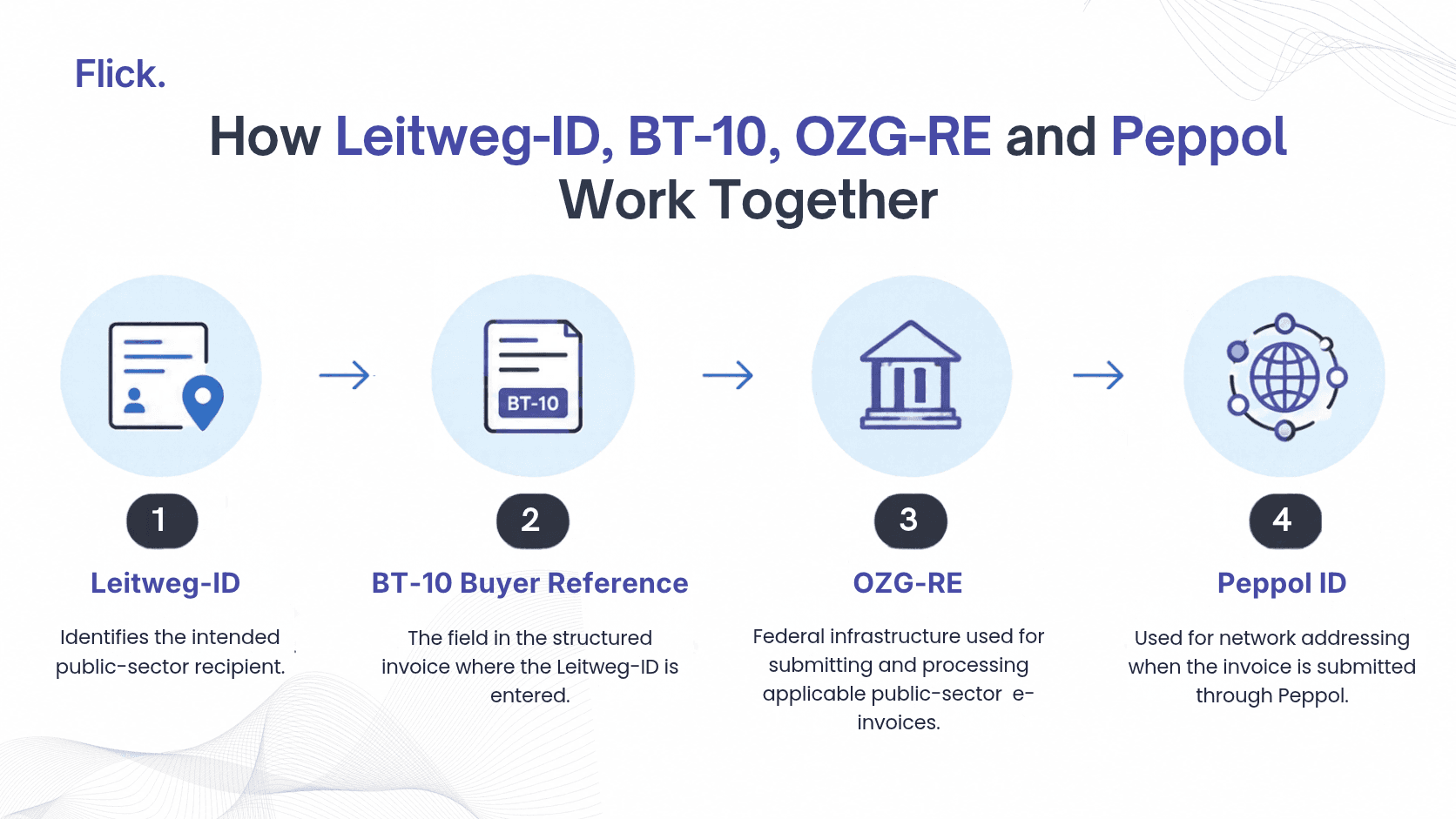
The Leitweg-ID identifies the public-sector recipient. OZG-RE is the federal invoice submission platform used to submit e-invoices to connected recipients. If Peppol is used, the Peppol receiver ID addresses the recipient through the network. These elements work together, but they serve different purposes in the submission process.
Leitweg-ID as the Buyer Reference
The Leitweg-ID does not determine how the invoice is transmitted. For federal invoices, the supplier must use the submission method specified by the recipient. OZG-RE supports several transmission routes, including upload, email and Peppol, depending on the applicable submission arrangements.
OZG-RE and Peppol Addressing
When Peppol is used for an OZG-RE-connected recipient, the invoice contains the Leitweg-ID in BT-10, while the Peppol receiver ID is used for network addressing.
For relevant federal recipients, the Peppol receiver ID generally follows the structure 0204:Leitweg-ID.
For example:
Leitweg-ID: 991-33333TEST-33
Peppol receiver ID: 0204:991-33333TEST-33
The 0204 structure should not be treated as a universal format for every German public authority. Peppol participant IDs and buyer references can differ across public-sector environments, including the Länder. Do not derive or construct the recipient's Peppol ID from the Leitweg-ID unless the recipient's instructions explicitly specify that format.
What Happens If the Leitweg-ID Is Missing or Incorrect?
A missing or incorrect Leitweg-ID can create a processing problem, but it is important to distinguish a technical or business-rules error from a VAT-law invoice-content error. The BMF specifically distinguishes between errors in the business requirement of an e-invoice and violations of VAT invoice-content requirements. A missing BT-10 Buyer reference is given as an example of a business-rule error. The BMF states that such a business-rule error is not, by itself, a VAT-law invoice-content defect.
A Missing Leitweg-ID Can Trigger a Business-rule Error
Where the applicable invoice process requires the buyer reference, leaving BT-10 empty can cause the invoice to fail a validation or business-rule check.
The practical consequence can still be significant. A federal submission platform can reject an invoice that cannot meet the required formal or processing conditions. The supplier may then need to correct the invoice and resubmit it. This is why technical validation should be treated as an operational control rather than as a substitute for checking the invoice's legal and commercial information.
An Incorrect Leitweg-ID Can Affect Invoice Processing
An incorrect Leitweg-ID can prevent the invoice from reaching the intended recipient. Compare the Leitweg-ID in the generated invoice with the value provided by the contracting authority. If the reference is missing or unclear in the contract, purchase order, or invoice instructions, confirm it with the contracting authority before submission. Federal guidance specifically advises suppliers to contact the invoice recipient if they have questions about the applicable buyer reference.
What Should Finance and IT Teams Check Before Sending the Invoice?
The main control is to ensure that the buyer reference supplied by the contracting authority reaches the correct structured invoice field unchanged. This requires coordination between finance, procurement, ERP, and e-invoicing systems.
Confirm the Recipient Information
Before generating the invoice:
- Match the invoice recipient with the contract or purchase order.
- Confirm the exact Leitweg-ID supplied by the contracting authority.
- Check whether the authority has provided additional recipient or processing instructions.
- Ensure that the stored Leitweg-ID has not been manually changed.
- Contact the contracting authority if the reference is missing, unclear, or inconsistent across documents.
Check the XRechnung Mapping
The ERP or billing system should map the relevant information to the correct XRechnung fields. Check that:
- The Leitweg-ID is mapped to BT-10, the Buyer reference field.
- Purchase order information is mapped to the appropriate purchase-order field, where applicable.
- Supplier identification and VAT information remain in their respective fields.
- The generated XML contains the same buyer reference that was approved or provided by the contracting authority.
- Where Peppol is used, the recipient's Peppol receiver ID is configured separately from the BT-10 value.
Validate the Complete Invoice
Validate the complete structured invoice against the applicable technical and business requirements before transmission. Check that required fields are present, data is logically consistent, and the invoice contains the correct recipient and transaction information.
The BMF states that validation supports the checking process but does not replace the recipient's obligation to verify the invoice for completeness and accuracy. For federal submissions, the OZG-RE also performs technical checks on submitted invoice data. The federal FAQ explains that the platform checks formal requirements and provides information when an invoice is rejected.
Conclusion
The Leitweg-ID is primarily a recipient reference for applicable public-sector e-invoices in Germany. Suppliers should use the identifier provided by the contracting authority and ensure it is correctly mapped before submission. Where Peppol is used, the network addressing details must also match the recipient’s stated requirements. Clear recipient data and correct invoice mapping help avoid unnecessary submission and processing issues.
For businesses managing B2B and B2G invoice flows across different systems, an e-invoicing solution can help centralise data mapping, validation and transmission controls.
Frequently Asked Questions
Is a Leitweg-ID required for every e-invoice in Germany?
No. A Leitweg-ID is generally relevant to applicable public-sector invoicing, while ordinary private-sector B2B e-invoices do not generally require one.
Where is the Leitweg-ID entered in an XRechnung?
The Leitweg-ID is entered in BT-10 Buyer reference when it is the applicable buyer reference for the public-sector recipient.
Do I need a Leitweg-ID for invoices to all German public authorities?
Not necessarily. The Leitweg-ID requirement depends on the public-sector invoicing framework and submission requirements applicable to the recipient. Suppliers should follow the recipient’s stated invoice and addressing instructions.
Is a Leitweg-ID the same as a Peppol ID?
No. The Leitweg-ID is the buyer reference contained in the invoice, while the Peppol participant or receiver ID is used for network addressing. For relevant OZG-RE-connected recipients, the receiver ID can use the 0204 prefix together with the Leitweg-ID.
Does a missing Leitweg-ID make an invoice invalid for VAT purposes?
Not automatically. The BMF distinguishes a missing BT-10 Buyer reference as a business-requirements issue from errors in VAT-relevant invoice content.
Quick Navigation
Book a Demo
Learn more by booking a demo with our team. We'll guide you step by step.