E-Invoicing in Germany 2026: Requirement, Timeline, Format & Examples
Last updated at
September 18, 2026
Book a Demo
Learn more about this by booking a demo call with us. Our team will guide you through the process and answer any questions you may have.
Book NowE-Invoicing in Germany: Complete Guide 2026
Germany’s e-invoicing mandate was introduced under the Growth Opportunities Act by the BMF Circular on 1 January 2025. From January 2025, businesses must be able to receive structured e-invoices. From January 2027, businesses whose previous-year turnover exceeded €800,000 must issue e-invoices for domestic B2B transactions. From January 2028, mandatory e-invoice issuance applies to all businesses for in-scope domestic B2B transactions.
What Is E-Invoicing in Germany?
Under German VAT law (UStG), e-invoicing is an invoice exchanged in a structured electronic format that can be automatically processed by systems and complies with the European EN 16931 standard. Common formats include XRechnung and ZUGFeRD.
A normal PDF or scanned invoice is not an e-invoice because it does not contain structured data. E-invoices can be exchanged through channels such as Peppol, EDI, service-provider platforms, or email, allowing invoice data to be processed automatically by systems.
Who Is in Scope for Germany’s E-Invoicing Mandate?
Germany’s mandatory B2B e-invoicing framework applies to domestic B2B Business transactions where German VAT rules require an invoice. The mandate does not apply to B2C transactions.B2G invoicing follows a separate public-sector framework. Federal public-sector suppliers are subject to the ERechV, alongside any applicable VAT invoicing requirements under the UStG.
An e-invoice requirement depends on the type of transaction, parties involved, VAT treatment, and applicable exemptions or transition requirements.
Which Transactions Are Exempt?
Exceptions include VAT-exempt transactions, small-value invoices up to €250 gross, qualifying passenger tickets, invoices issued under Germany’s small-business VAT regime, and transactions involving non-business legal entities.
Businesses should therefore determine the scope at the transaction level rather than applying a single rule to every invoice.
When Does Germany’s E-Invoicing Mandate Apply?
E-invoicing in Germany is phased in on 1 January 2025. Receiving is mandatory from 2025; issuing becomes mandatory in stages from 2025 to 2027, with the general requirement from 2028.
| Year | Requirement |
| 2025 | Businesses must be able to receive e-invoices for in-scope domestic B2B transactions. |
| 2026 | Businesses can still issue paper invoices or PDF invoices for B2B transactions under the transition framework. |
| 2027 | Businesses with more than €800,000 turnover in the previous year must mandatorily issue e-invoices for in-scope domestic B2B transactions. |
| 2028 | All businesses issuing e-invoices for in-scope domestic B2B transactions are mandatory. |
Note: B2G e-invoicing follows a separate public-sector framework. For the federal administration, electronic invoicing has been mandatory for suppliers since 27 November 2020 under the ERechV, subject to statutory exceptions.
What Information Must an E-Invoice Contain in Germany?
The structured invoice must contain the information required under German VAT law. For enterprise implementations, these requirements should be mapped directly to ERP master data, transaction data and the selected invoice syntax.
- Supplier and customer name and address
- Supplier tax number or VAT identification number
- Invoice date and unique invoice number
- Description and quantity of goods or scope of services
- Supply date
- Consideration and applicable reductions
- VAT rate and VAT amount, or the relevant exemption information
- Additional transaction-specific references where required
Which E-Invoice Formats Are Accepted in Germany?
E-Invoicing In Germany does not prescribe one universal B2B invoice format. The format must provide structured data and meet the applicable German and European requirements.
XRechnung is a structured XML format based on EN 16931 and is widely used for public-sector invoicing.
ZUGFeRD: combines structured XML with a human-readable PDF. The specific version and profile matter because not every ZUGFeRD profile qualifies.
Other EN 16931-compliant formats: It can also be used where it satisfies the required semantic and technical conditions.
EDI: It can continue where the existing exchange process meets the statutory requirements. Non-qualifying EDI arrangements receive transition treatment through the end of 2027.
Peppol BIS Billing: It is an EN 16931-aligned structured invoice specification exchanged through the Peppol network. Peppol is a transmission network, not Germany's mandatory invoice format.
Note: A conventional PDF is not an e-invoice. However, PDF invoices remain permitted during Germany’s transition period, subject to the applicable requirements.
E-Invoicing Transmission Methods in Germany
The transmission architecture can vary according to transaction volume, customer requirements, and the existing ERP landscape. E-invoicing in Germany does not require businesses to adopt one universal B2B exchange channel.
- Direct transmission: A company's own invoicing application can generate and transmit structured invoices directly to the customer. This approach can work where the internal application already supports the required formats and transmission requirements.
- ERP-integrated transmission: The ERP can generate the invoice and connect to an e-invoicing platform or transmission service. This approach is more suitable for larger finance environments where invoice creation, tax data, customer master data, and accounting records already reside in the ERP.
- EDI: Companies with established EDI infrastructure can continue using it where the legal and technical requirements are satisfied. The implementation should confirm that the existing message format contains sufficient information and that any applicable transition provision is correctly applied.
- Peppol: Peppol can provide an interoperable exchange mechanism between connected trading partners. It is particularly useful where businesses need a standardised network approach across multiple customers or suppliers, but participation is not itself a general B2B legal requirement in Germany.
- Service providers: A specialist provider can manage functions such as format generation, transformation, validation, transmission, receipt and status monitoring. This model can reduce the amount of country-specific e-invoicing functionality that needs to be built directly into the ERP.
- Government portals: B2G transactions follow separate public-sector e-invoicing requirements. The applicable submission portal depends on the federal, state, or local authority and its procurement requirements, so businesses supplying public authorities may need B2G submission capabilities alongside their commercial B2B process.
How Does E-Invoicing Work in Germany?
E-invoicing in Germany’s B2B framework integrates invoice creation, structured data exchange, validation, and accounting across the supplier’s and buyer’s systems. The 4-corner model below illustrates
Corner 1: Supplier’s ERP generates invoice data and sends it to the e-invoicing service provider.
Corner 2: E-invoicing service provider validates the data, converts it into the required e-invoice format, and prepares it for transmission.
Corner 3: Buyer’s service provider receives and validates the e-invoice before delivering it to the buyer.
Corner 4: Buyer’s ERP or accounting system receives the invoice for processing.
Return flow: Acknowledgement or processing status can be sent back to the supplier.
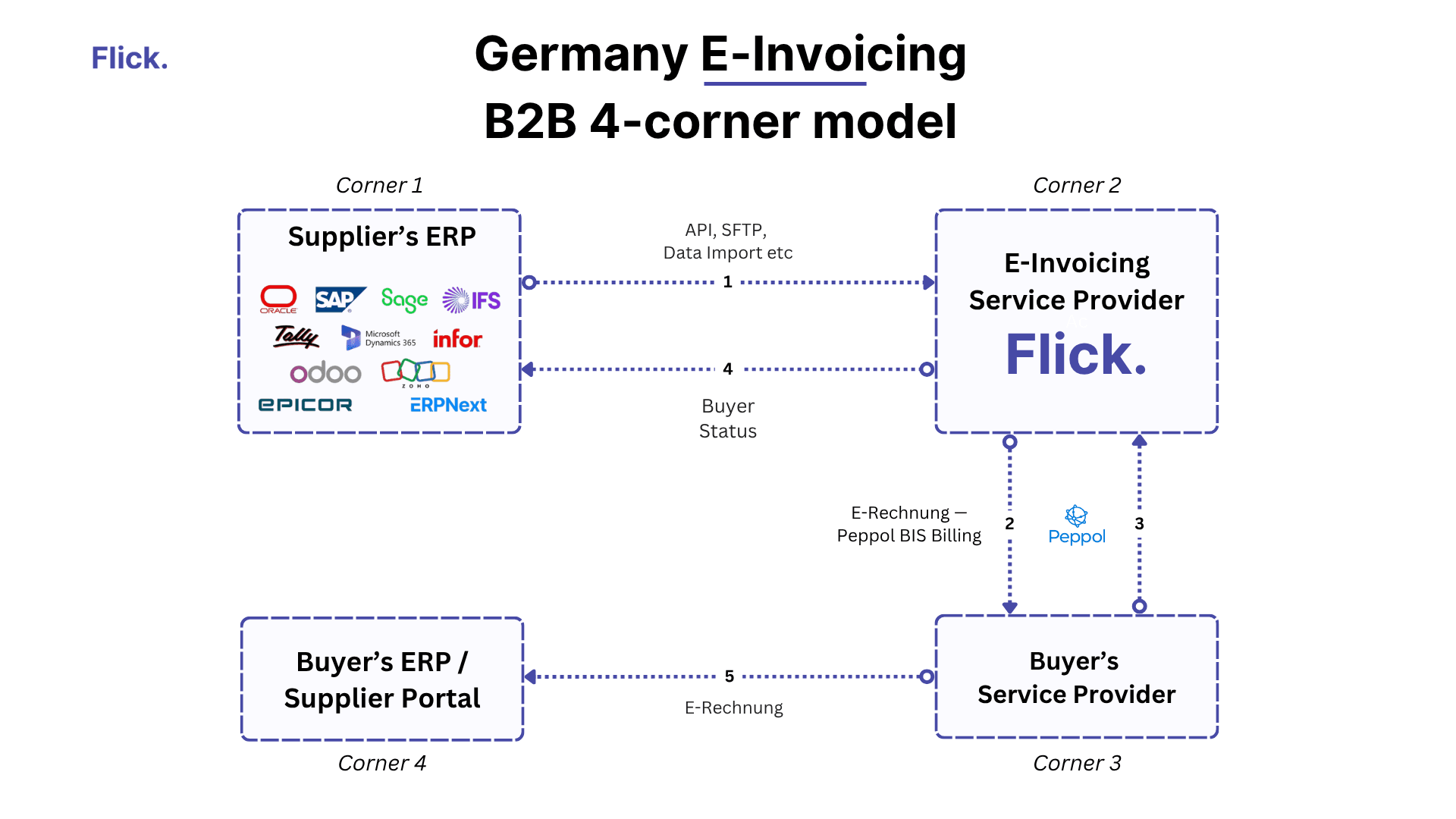
Note: Peppol is one available transmission option in Germany; businesses can also use other agreed electronic channels
What Does E-Invoicing in Germany Require for Implementation?
A successful implementation requires more than generating an XML file. Finance and IT teams should address five areas:
- Scope and transition frameworks: Determine which entities and transactions are affected and which exemptions or transition provisions apply.
2. Invoice data: Ensure customer, supplier, tax, line-item, and payment data can be mapped correctly into the selected structured format.
3. ERP and integration: Confirm that the ERP or e-invoicing platform can generate, receive, validate, and exchange the required formats.
4. Exception handling: Establish processes for validation failures, incorrect tax data, rejected invoices, routing problems, and invoice corrections.
5. Retention: Preserve the required electronic invoice records and their integrity throughout the statutory retention period.
E-Invoice Archiving and Retention under GoBD
Under GoBD, businesses must preserve e-invoices in their original electronic form and ensure the records remain complete, authentic, unaltered, readable, and accessible for tax audits.
- Original format: Retain the original XML. For ZUGFeRD, retain the complete PDF/A-3 file with its embedded XML.
- Data integrity: Changes must be prevented or traceable through an audit trail.
- Structured data: The embedded XML remains relevant where the invoice is legally required as a structured e-invoice. A PDF copy alone is not sufficient.
- Audit access: Invoices must remain retrievable and readable throughout the retention period.
- Retention: §14b UStG requires invoices to be retained for 8 years from the end of the year of issue. Longer retention can apply where other tax provisions require the records to remain available.
Penalties for E-Invoicing Non-Compliance in Germany
Germany does not have a separate penalty framework specifically for B2B e-invoicing. Non-compliance can instead result in consequences under existing VAT invoice and record-keeping rules in the UStG. B2G transactions follow separate public-sector requirements under the ERechV, and non-compliance with applicable submission requirements may also prevent proper invoice processing by the public authority.
- Administrative fines: Under Section 26a UStG, invoice and retention violations can result in fines of up to €5,000, €1,000, or €30,000, depending on the offence.
- VAT deduction risk: An incorrect or non-compliant invoice can affect the recipient’s ability to claim input VAT until the invoice is corrected.
- Invoice correction: If an invoice contains incorrect or missing mandatory information, the issuer may need to correct it before it can support the relevant VAT treatment.
- Record-keeping breaches: Businesses must retain invoices for the required period and preserve the structured part of an e-invoice in its original, unaltered form. Failure to meet these requirements can result in separate VAT law consequences.
How Does Flick Support E-Invoicing in Germany?
Flick acts as an e-invoicing layer between a company’s existing ERP systems and invoice exchange workflows. It supports the processing, validation, format handling, and exchange of structured e-invoices across Germany and other markets.
- ERP Integration: Connects existing ERP and accounting systems with e-invoicing workflows, reducing manual data transfer and re-entry.
- Automated Validation: Validates invoice data before exchange to identify structural and data errors earlier.
- Structured E-Invoicing: Processes structured e-invoices in the formats required by the applicable market and transaction.
- Electronic Exchange: Supports invoice exchange through connectivity channels such as Peppol, where applicable.
- Centralised Infrastructure: Provides a central e-invoicing layer for managing Germany alongside other country-specific e-invoicing requirements.
Conclusion
Germany’s e-invoicing mandate is being phased in from 2025, with broader issuing obligations in 2027 and the general B2B requirement from 2028. Businesses should already be prepared to receive structured e-invoices and plan for compliant issuance across both B2B and applicable B2G transactions.
Key priorities include identifying in-scope transactions, applying transition rules and exemptions, using compliant formats such as XRechnung or ZUGFeRD, and ensuring ERP, transmission, validation, and retention processes are ready. B2G invoicing requires separate consideration of public-sector submission requirements, including applicable XRechnung specifications and routing data.
Early preparation reduces manual processing, supports accurate invoice handling, and provides a controlled transition across B2B and B2G invoicing workflows.
FAQs
When was e-invoicing phased in Germany?
The framework took effect on 1 January 2025. Receiving is mandatory from 2025, while issuing is phased in through 2027.
Is a PDF an e-invoice in Germany?
No. A standard PDF is not a structured e-invoice. It may remain permitted during applicable transition periods or for out-of-scope transactions.
Is XRechnung mandatory?
No. XRechnung is not mandatory for all B2B invoices. Other qualifying EN 16931-compliant formats can also be used.
Is Peppol mandatory in Germany?
No. Peppol is an available transmission network, not a mandatory channel for German B2B e-invoicing.
Can businesses still use ZUGFeRD?
Yes. ZUGFeRD can be used where the specific version and profile meet the applicable requirements.
How long must e-invoices be retained?
Invoices must be retained for eight years under German VAT regulations.
Do businesses need government approval to issue e-invoices?
No. Ordinary B2B e-invoicing does not require general government approval or registration. B2G transactions may have separate submission requirements.
What happens if an e-invoice is rejected?
The business should identify the technical or data error, correct the invoice, and retransmit it while maintaining an appropriate audit trail.
Quick Navigation
Book a Demo
Learn more by booking a demo with our team. We'll guide you step by step.